SEC EDGAR API Alternatives to sec-api.io: 5 Options (2026)
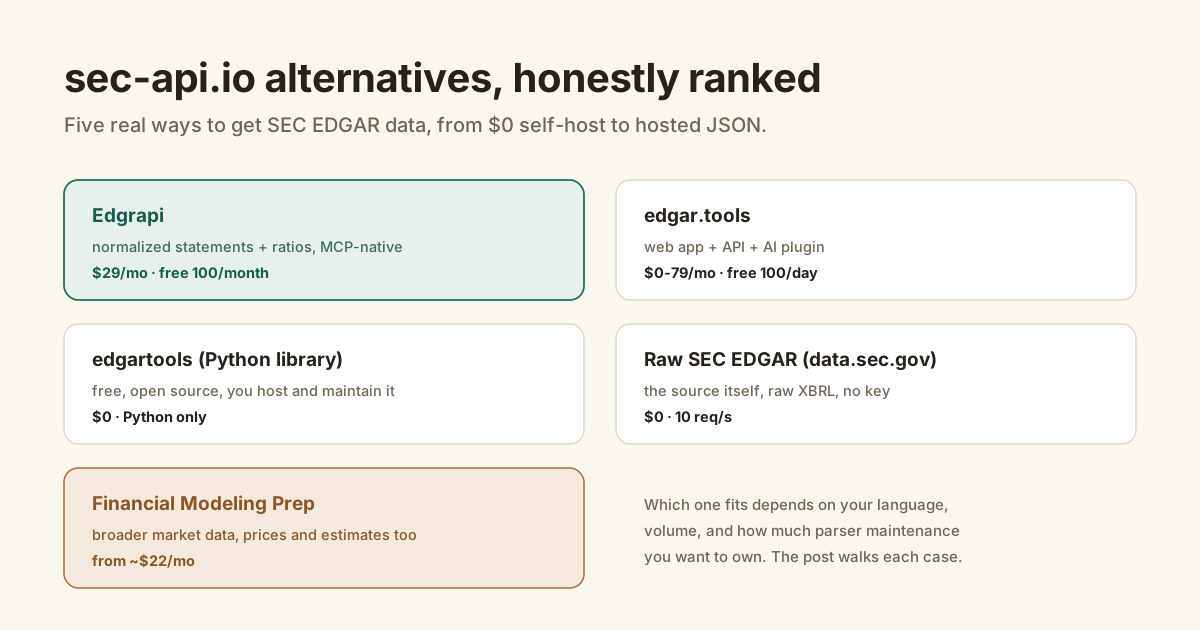
sec-api.io is the incumbent for SEC EDGAR data. It is also $49 a month, and its free tier is 100 calls, ever.
Full disclosure before anything else: we build Edgrapi, one of the alternatives below. I'll keep the comparison honest anyway, because you can verify every row in an afternoon.
The best sec-api.io alternative depends on what you actually pull. For normalized financial statements as JSON, Edgrapi is $29/month with a free 100 credits every month. For a web app plus light API, edgar.tools is $0 to $79/month. Python self-hosters get the free edgartools library, and the SEC's own API at data.sec.gov costs nothing if you'll parse raw XBRL yourself.
Why look past sec-api.io at all?
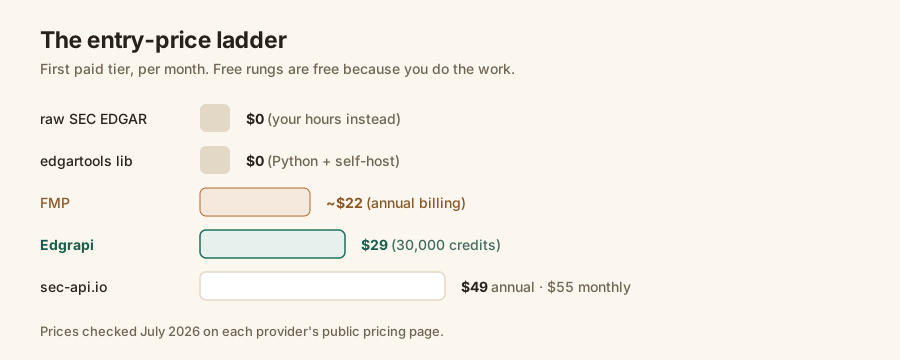
Three reasons come up again and again: price, free-tier terms, and scope. sec-api.io starts at $49/month billed annually, $55 month-to-month, per its pricing page, checked July 2026. Its free tier is 100 calls for life, which demos the API but can't run even a tiny project. And its core strength, full-text search across every form type, is more than a fundamentals pipeline needs.
None of that makes it a bad product. It makes it a specific one.
If your project lives on searching filings, stop reading and pay for it. If your project is "get me revenue and cash flow as JSON," keep going.
The five alternatives at a glance
Here are the five real options as of July 2026, with entry prices and what each free tier actually renews. Two are free because you do the work. Three are hosted, so someone else maintains the parser. Every price below comes from the provider's public pricing page, checked this month.
| Option | Entry price | Free tier | Best at |
|---|---|---|---|
| 1. Edgrapi | $29/mo (30,000 credits) | 100 credits / month, no card | Normalized statements + ratios as JSON, MCP for agents |
| 2. edgar.tools | $0 to $79/mo | 100 calls / day | Browsing filings in a web app, light API use |
| 3. edgartools (Python lib) | Free, open source | Everything, self-hosted | Python teams who want full control |
| 4. Raw SEC EDGAR | Free | Unlimited at 10 req/s | Anyone willing to normalize XBRL themselves |
| 5. Financial Modeling Prep | ~$22/mo (annual) | 250 calls / day, limited endpoints | Broader market data: prices, estimates, and EDGAR |
1. Edgrapi: normalized fundamentals as JSON, MCP built in
Edgrapi is the cheapest hosted way to get income statements, balance sheets, cash flow, and 14 computed ratios as flat JSON. Pro is $29/month for 30,000 credits, the free tier refills to 100 credits every month with no card, and every endpoint plus the hosted MCP server is open on free. It reads the same XBRL as everyone else; you pay for the tag mapping being someone else's job.
Yes, this is us. Judge the claims by the docs, not this paragraph.
The pitch in one call: GET /v1/fundamentals/AAPL returns all three financial statements with fields named revenue and net_income, quarterly or annual, TTM rows already filtered. For AI builders there's a hosted MCP server at api.edgrapi.com/mcp, so a Claude or ChatGPT agent pulls statements without you writing tool plumbing. The agents guide shows that setup.
The honest weakness: no full-text search. If your project is "find every filing that mentions X," we are the wrong tool and sec-api.io is the right one. Edgrapi is deliberately narrow: company fundamentals, ratios, filings lists, and 10-K sections, done conveniently.
Best for: teams outside Python, agent builders, and anyone who wants named fields without owning a parser.
2. edgar.tools: a web app first, an API second
edgar.tools runs $0 to $79/month and pairs a filing-browsing web app with an API and an AI plugin advertising 23 tools for Claude and ChatGPT. Its free tier renews 100 API calls every day, the most generous renewal on this list. If your workflow is mostly reading filings in a browser with occasional programmatic pulls, this shape fits.
The web app is the differentiator. None of the other options here give a non-developer anything to click.
The catch: the daily cap structure means bursty backfills stall, and the API is one feature among several rather than the whole product. For a pipeline that hammers fundamentals endpoints all day, a credit wallet or the raw SEC route fits better.
Best for: analysts who browse first and script second, and teams that want one subscription covering both.
3. edgartools: the free Python library
edgartools is an open-source Python library that downloads and parses EDGAR filings locally, for free, with no account anywhere. It normalizes XBRL concepts much like the paid wrappers do. We diffed our own API against it across 10 tickers in July 2026 and got identical values on net income and operating cash flow, 10 of 10 where concepts aligned, which tells you exactly what the paid products are and aren't selling.
If you write Python and enjoy owning your stack, this is the strongest free option, full stop. The longer head-to-head walks the tradeoffs.
What you give up: it's a library, not a service. You host it, you version it, you own the breakage when a company's tagging shifts, and nothing outside Python can call it. There's no HTTP endpoint for an agent, a Zapier step, or a Node app without you building one.
Best for: Python-native quants, researchers, and anyone whose time budget includes maintenance.
4. Raw SEC EDGAR: the source itself
The SEC's own API at data.sec.gov is free, keyless, and complete: every filing, all XBRL facts, and full-text search across every electronic filing since 2001, per the SEC's search FAQ. The limit is 10 requests per second per IP with a User-Agent header. Nothing on this list, sec-api.io included, has data the SEC doesn't.
Every provider here is a layer on top of this. That's worth sitting with before paying anyone.
The tradeoff: the output is raw XBRL, where one line item hides among the US GAAP taxonomy's 15,000+ elements, per XBRL US, and quarterly data mixes in trailing-twelve-month windows. The free SEC EDGAR API guide walks exactly what $0 buys and the four normalization jobs it leaves you.
Best for: learners, one-off pulls, and teams with the appetite to build their own normalization layer once and keep it.
5. Financial Modeling Prep: when you need more than EDGAR
FMP starts near $22/month on annual billing and covers market data well beyond filings: prices, estimates, and screeners alongside EDGAR-derived statements. The free tier allows 250 calls a day on a limited endpoint set. If your app needs a stock price next to the balance sheet, FMP consolidates two subscriptions into one.
Where it wobbles: EDGAR is a slice of its catalog, not the specialty. Field-level normalization decisions differ from filing-first tools, so audit a few companies you know before trusting the mapping. Our FMP comparison goes deeper.
Best for: consumer-facing finance apps where filings data is one ingredient among many.
Do the alternatives match sec-api.io's data quality?
For XBRL financials, yes, because everyone reads the same filings from the same SEC servers, so the numbers converge on identical values. Our 10-ticker diff against edgartools returned 10 of 10 matches on net income and operating cash flow. The differences you'll actually feel are plumbing: field naming, language support, hosting, and how each handles the quarterly TTM trap.
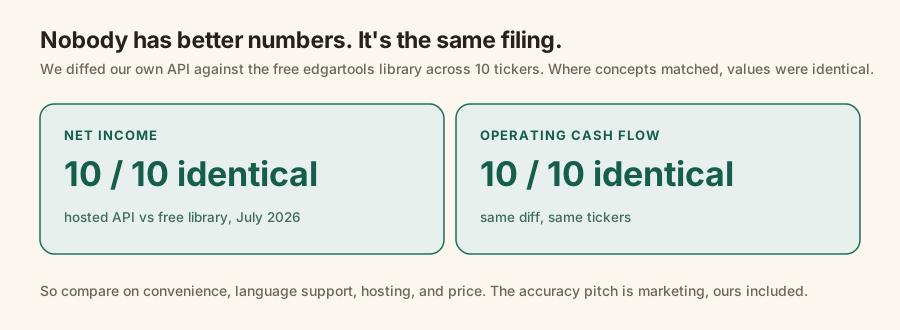
That cuts both ways, including against us. When a provider, us included, says "cleaner data," read it as "less work to use," because the underlying values are the company's own filing. The real quality questions are: does it survive a ticker change, does it merge tag switches across years, and does it keep TTM rows out of your quarterly series.
The one real capability gap is search, not accuracy. sec-api.io's full-text search across every form type is genuinely hard to replace; if that's your workload, its $49 is fair.
Which alternative should you pick?
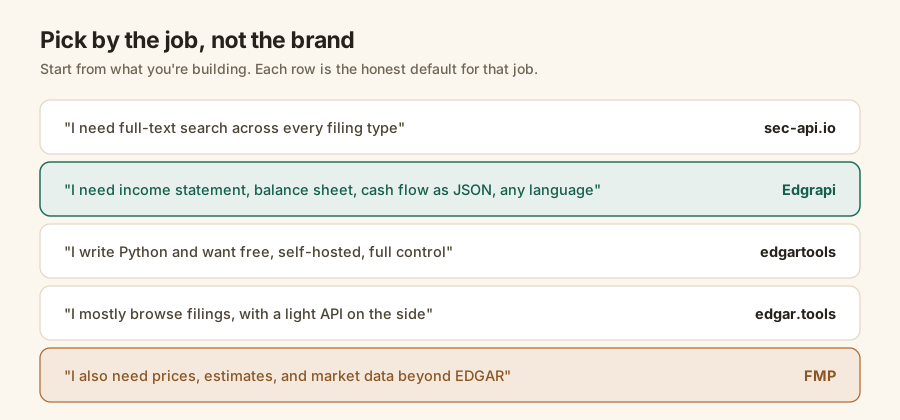
Pick by the job. Full-text search across all form types: stay with sec-api.io. Statements and ratios as JSON from any language: Edgrapi. Python plus a taste for self-hosting: edgartools. Mostly browsing with occasional API calls: edgar.tools. Prices and estimates alongside filings: FMP.
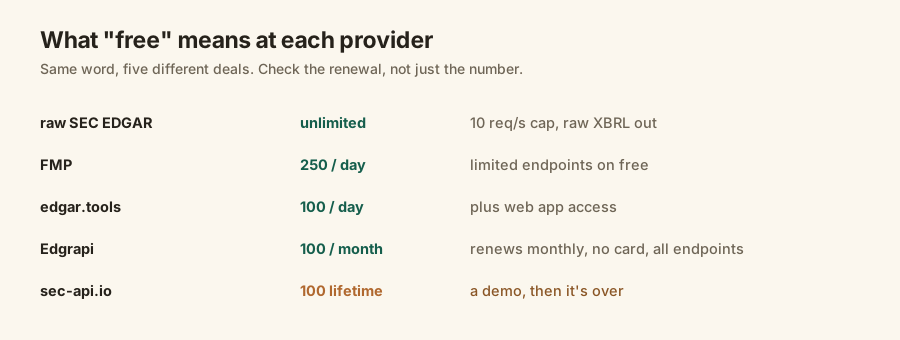
Then check the free-tier fine print, because "free" means five different deals here. sec-api.io's 100 calls are lifetime, a demo. edgar.tools renews daily, Edgrapi monthly, FMP daily on fewer endpoints, and the SEC never meters you at all below 10 requests a second. A practical test: can the free tier run a small side project indefinitely? Renewing tiers can. A lifetime cap can't, whatever the number says.
Down to a final pair? The head-to-heads go deeper: Edgrapi vs sec-api.io and Edgrapi vs edgartools.
How do you switch without breaking things?
Key on the CIK, not the provider's IDs, and the move is small. Every serious option exposes the CIK because it is the SEC's own permanent identifier, the one that survived Facebook becoming Meta. Store it, map your field names once, and re-run a month of numbers on both providers before you cut over. If values differ, you've found a period-handling bug, not a data-quality difference.
Budget an afternoon. The statements post shows the exact response shape you'd map to on our side, and the CIK post covers the identifier itself.
Try the cheap ones first
The rational order is free to paid: raw SEC or edgartools if you're in Python, then the wrapper free tiers, then a paid plan when your volume outgrows them. Most projects discover their real request volume within two weeks, and that number picks the tier for you.
Ours renews 100 credits every month with no card at https://edgrapi.com/app. If a competitor on this list fits your job better, use them. The table is the argument.
Frequently asked questions
What is the best alternative to sec-api.io?
It depends on the job. For normalized financial statements as JSON in any language, Edgrapi at $29/month is the cheapest hosted option. For a web app with a light API, edgar.tools runs $0 to $79/month. For Python teams happy to self-host, the free edgartools library covers most of it. sec-api.io keeps the edge on full-text search across every filing type.
Is there a free alternative to sec-api.io?
Yes, two real ones. The SEC's own API at data.sec.gov is completely free with no key, capped at 10 requests per second, but returns raw XBRL you normalize yourself. The edgartools Python library is free and open source if you self-host. Hosted wrappers add free tiers on top: Edgrapi gives 100 credits every month, edgar.tools 100 per day.
How much does sec-api.io cost?
As of July 2026, sec-api.io's Personal plan is $49/month billed annually or $55 month-to-month, and Business is $199/month billed annually or $239 month-to-month, per its public pricing page. The free tier is 100 API calls total, a lifetime cap rather than a renewing allowance, so it works as a demo rather than a small project tier.
What is the cheapest SEC EDGAR API?
The SEC's own API is free, so nothing beats it on price if you can parse XBRL. Among hosted wrappers with normalized output, Edgrapi's Pro plan is $29/month for 30,000 credits, under sec-api.io's $49 entry, and Financial Modeling Prep starts near $22/month on annual billing but meters by daily calls and covers broader market data.
Is sec-api.io worth it?
For full-text search across every SEC form type and real-time filing streams, yes, that breadth is its genuine edge and the alternatives don't fully match it. If you only need company financials, statements, and ratios as clean JSON, you are paying for search infrastructure you won't use, and a $29 wrapper or the free library covers the job.
Do sec-api.io alternatives have the same data quality?
For XBRL financials, yes, because everyone reads the same filings. We diffed Edgrapi against the free edgartools library across 10 tickers in July 2026: net income and operating cash flow matched 10 out of 10 where concepts aligned. Accuracy claims are marketing. Compare on convenience, language support, hosting, and price instead.