Best Insider Trading APIs for Developers (2026)
When a CEO buys a million dollars of their own stock, the SEC knows within two business days. So can you.
An insider trading API turns SEC Form 4 filings into clean JSON: who traded, how many shares, at what price, and whether they bought on the open market or sold on a schedule. This guide compares the real options for 2026, edgrapi, Form4API, Finnhub, Financial Modeling Prep, Quiver Quantitative, and raw SEC EDGAR, so you pick the right one on your first try.
/v1/insider flags the buy-versus-sell signal (code P vs 10b5-1) and covers 13F and US government data on one key. Pick by your one question, and treat insider buys as leads, not trades.They all read the same public filings. What separates them is packaging, price, and whether they hand you the signal or just the raw rows.
What is an insider trading API?
An insider trading api is a service that returns SEC Form 4 filings as structured JSON instead of raw XML. Corporate officers, directors, and holders of more than 10% of a company must report every trade in their own stock, and the API parses each filing into fields you can query: the person, their role, the transaction code, share count, price, and dollar value. It saves you from writing an XML parser against EDGAR.
Form 4 exists because of Section 16 of the Securities Exchange Act. Anyone the law calls an insider has to file within two business days of a trade, per the SEC's Form 4 rules.
That two-day window is the whole appeal. You are seeing what the people who run a company do with their own money, almost in real time.
The catch is volume. Thousands of Form 4s land every day, most of them boring option grants and tax-related sales. An API earns its keep by parsing the noise into fields you can filter, so you can ask "which insiders bought on the open market this week" without reading a single PDF.
The parsing you are paying for is mostly the transaction code. Every line on a Form 4 carries a one-letter code, and they are not equal. P is an open-market purchase and S is an open-market sale. A is a grant or award, M is an option exercise, F is shares withheld for taxes, and G is a gift. A raw filing feed treats all of these as "insider activity," which is why an unparsed count looks busy and means nothing.
A good insider trading api maps those codes to plain labels and, ideally, to a signal. That is the difference between a data dump and something you can act on.
Which insider trading API is best for developers?
For most developers, edgrapi and Form4API lead the pack, and the right pick depends on one question: do you only need Form 4, or do you need the signal plus other filings on one key? Form4API is the sharpest Form-4 specialist, with webhooks on every new filing. edgrapi surfaces the buy-versus-sell signal by default and covers 13F, activist stakes, and government data on the same key. The others fit narrower cases.
Here is the honest field. Every provider reads the same SEC data, so the columns that matter are packaging, not access.
| Provider | Data scope | Buy/sell signal | Free tier | Real-time push | Best for |
|---|---|---|---|---|---|
| edgrapi | Form 4 plus 13F, activist, congress, federal data | Yes, code P vs 10b5-1 flagged | Yes, metered | Webhooks and alerts | Signal plus breadth on one key, AI agents |
| Form4API | Form 4, Form 144, 13F-HR | Yes, is10b5Plan flag | Yes, no card | Yes, webhooks | Pure Form 4 push, amendment-aware |
| Finnhub | Broad market data, insider is one endpoint | Basic | Generous for testing | No | Teams already on Finnhub for prices |
| Financial Modeling Prep | Fundamentals plus insider | Basic | Limited | No | Teams already paying FMP |
| Quiver Quantitative | Insider plus 30+ alt datasets | Basic | Limited | No | Retail-quant, alt-data blends |
| Raw SEC EDGAR | Everything, unparsed | No, you build it | Free, keyless | No | Zero budget, you parse XML |
Here is the short read on each, without the marketing.
Form4API is the Form 4 specialist. It pushes a webhook on every new filing, parses amendments correctly, and adds Form 144 and 13F-HR, with a free tier that skips the credit card. If a live stream of new insider filings is the product you need, it is hard to beat.
Finnhub folds an insider-transactions endpoint into a broad market-data API. Its free tier is the most generous for testing, so it is the fastest place to prototype. Insider data is a side feature, not the focus.
Financial Modeling Prep bundles insider transactions with fundamentals, but the insider data sits behind its mid tier rather than the entry plan. It is a fine choice only if you already pay FMP for statements and prices.
Quiver Quantitative treats insider trades as one of more than 30 alternative datasets, alongside Congress trades, lobbying, and patents. Reach for it when you are blending signals, not when insider data is the whole job.
Raw SEC EDGAR is the source everyone else reads. It is free, keyless, and authoritative, and it makes you do every bit of the parsing yourself.
None of these is a scam and none is strictly best. Form4API is genuinely excellent if a real-time Form 4 stream is all you want. Finnhub is the friendliest place to prototype for free. FMP and Quiver make sense when insider data rides along with something you already pay for.
edgrapi's lane is narrower and more opinionated: it flags the signal for you, it gives you three ways to pull insider data from one endpoint, and it puts SEC filings and US government data behind a single key. It is not the cheapest option and it is not the only one with push. Pick it for signal and breadth, not for a rock-bottom price.
How do you tell a real insider buy from an automatic sale?
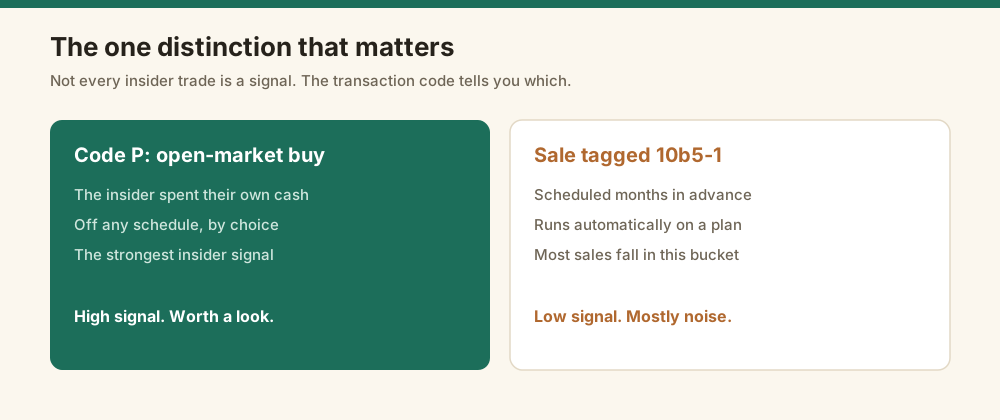
You read the transaction code. Code P means an open-market purchase, the insider chose to spend their own cash, and that is the only insider action with a strong track record as a signal. A sale tagged as a Rule 10b5-1 trade was scheduled months earlier and tells you almost nothing about conviction today. Most sales fall in this bucket, which is why raw insider "activity" counts mislead people.
Academic work backs this up. In "Decoding Inside Information," a 2012 study in the Journal of Finance, Cohen, Malloy, and Pomorski found that opportunistic insider trades predicted returns while routine, scheduled trades did not.
So the number that matters is not "how many insiders traded." It is "how many bought on the open market, with their own money, off any schedule."
A good API makes that distinction a field, not a research project. edgrapi returns a signal value and a plan_10b5_1 boolean on every transaction, and Form4API exposes an is10b5Plan flag. Raw EDGAR gives you the footnotes and leaves the interpretation to you.
If your tool treats a scheduled sale and an open-market buy as the same "insider transaction," it will bury the one signal you were looking for.
There is a second filter worth applying: size relative to the person. A director buying five thousand dollars of stock is noise; a director buying a year of their salary is a statement. The dollar value field lets you rank by conviction, not just by count, so the biggest open-market buys float to the top on their own.
How do you get SEC Form 4 data as JSON?
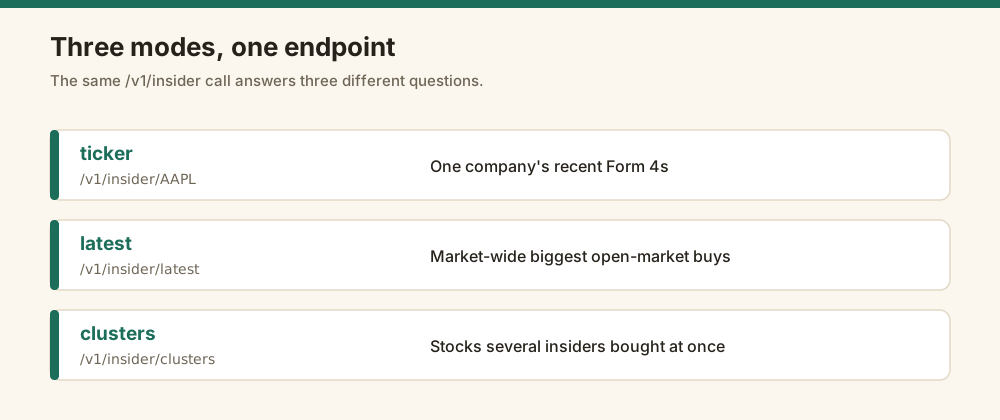
Point an insider trading api at a ticker and read the parsed filings. With edgrapi, one endpoint has three modes: pass a ticker for that company's recent Form 4s, pass latest for the market-wide feed of the biggest open-market buys, or pass clusters for stocks where several insiders bought at once. Each transaction comes back with the code, the dollar value, and the 10b5-1 flag already resolved.
Here is a by-ticker call.
GET https://api.edgrapi.com/v1/insider/AAPL
Authorization: Bearer YOUR_KEY

{
  "ticker": "AAPL", "cik": "320193", "company": "Apple Inc.",
  "count": 6,
  "filings": [
    {
      "filer": "Cook Timothy D", "relationship": ["officer"],
      "transactions": [{
        "security": "Common Stock", "date": "2026-09-14",
        "code": "P", "code_label": "Open-market purchase",
        "signal": "bullish", "shares": 5000,
        "price_per_share": 228.10, "value": 1140500.0,
        "plan_10b5_1": false
      }]
    }
  ],
  "source": "SEC EDGAR ownership filings"
}
The latest and clusters modes flip the question from "what did this company's insiders do" to "where is insider buying happening right now." That market-wide view is what you want for discovery instead of monitoring one name.
Empty results are free on edgrapi, so probing a quiet ticker costs you nothing. That matters when you scan hundreds of symbols and most have no recent open-market buys.
You can also skip the code entirely. edgrapi runs a Model Context Protocol server, so an AI assistant like Claude can call get_insider as a tool and pull the same data in a chat.
Is there a free insider trading api?
Yes. Raw SEC EDGAR is completely free and keyless, and several commercial APIs offer a free tier for testing. The trade-off is always the same: free-and-raw means you parse XML and classify codes yourself, while free-tier means low limits and, often, no signal classification. For real projects, a small paid or metered plan usually costs less than the engineering time you spend rebuilding the parser.
Your free options, ranked by how much work they leave you:
- Raw SEC EDGAR. Free forever, authoritative, no signup. You handle the ownership XML, the transaction codes, and the EDGAR full-text search queries. Respect the fair-access limit of 10 requests per second. - Finnhub free tier. A real insider-transactions endpoint you can prototype against, per the Finnhub docs, with the generous limits it is known for. - Form4API free tier. No credit card, and it is Form-4 native, so you get the specialist parsing even on the free plan. - edgrapi free credits. Metered, so you start free and pay per call after; empty results do not count.
The honest read: if you can write an XML parser and stay under EDGAR's rate limit, raw EDGAR costs nothing. If your time is worth anything, a parsed API pays for itself the first week.
What can you build with an insider trading api?
The three most common builds are a single-stock monitor, a market-wide buy scanner, and an alert bot. A monitor watches one ticker and posts new Form 4s to a dashboard. A scanner runs the latest and clusters views on a schedule to surface where open-market buying is concentrated. An alert bot pushes a message the moment an officer buys their own stock, filtered to code P so scheduled sales never wake you.
The scanner is where the market-wide feed earns its keep. Instead of watching a fixed list, you let the SEC's own filing flow decide what is interesting today, then rank by dollar value and by how many distinct insiders bought.
Cluster buying is the version most worth automating. When several insiders at one company buy in the same short window, that has historically been a stronger tell than one executive acting alone, and it is rare enough that a filter catches only a handful a week.
The fourth build is the newest: an AI agent that answers questions in plain language. Wire an insider endpoint to a Model Context Protocol server and you can ask an assistant "which financial-sector insiders bought the most last week" and get a real answer from live filings, not a guess.
How should you choose an insider trading api?
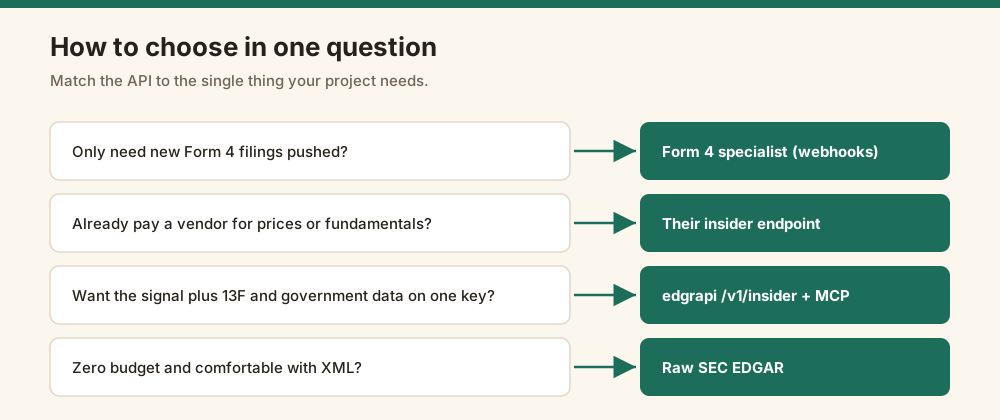
Choose by the single question your project actually asks. If you only need a real-time push of new Form 4s, a specialist like Form4API wins. If you already pay a data vendor for prices or fundamentals, use their insider endpoint and save an integration. If you want the buy-versus-sell signal plus 13F and government data on one key, edgrapi fits. If your budget is zero and you can parse XML, go straight to raw EDGAR.
Run it as a quick decision tree:
- Need only new Form 4 filings pushed the moment they land? Pick the Form-4 specialist. - Already integrated with Finnhub or FMP for other data? Add their insider endpoint. - Building an AI agent, or want SEC plus congress plus contracts on one key? Pick edgrapi and point it at /v1/insider and the MCP server. - Zero budget and comfortable with XML? Use raw SEC EDGAR.
Do not over-buy. Most builders reach for a full alt-data platform when a single Form 4 endpoint would do, and most quants under-buy, scraping raw EDGAR when a parsed feed would have saved a sprint.
Whatever you pick, treat insider data as one input. An open-market cluster buy is a strong lead worth researching, not a trade to place blind. None of this is investment advice.
Start with the question, not the vendor
The best insider trading api is the one that answers your one question with the least glue code. Write that question down first: monitor one company, scan the whole market, or feed an agent. Then match it to the table above. If you want the signal surfaced and SEC plus government data on a single key, read the edgrapi docs and pull your first Form 4 today.
Frequently asked questions
What is an insider trading api?
An insider trading api is a service that returns SEC Form 4 filings as structured JSON. It parses each filing into fields, the insider's name, their role, the transaction code, share count, price, and value, so you can query who bought or sold company stock without writing your own XML parser against SEC EDGAR.
Which is the best insider trading api for developers?
For pure Form 4 with real-time webhooks, Form4API leads. For the buy-versus-sell signal plus 13F, activist, and government data on one key, edgrapi fits. Finnhub is best for free prototyping, and FMP or Quiver make sense if you already pay them for other data. All read the same SEC filings.
Is there a free insider trading api?
Yes. Raw SEC EDGAR is free and keyless if you parse the XML yourself, and Finnhub, Form4API, and edgrapi all offer free tiers or free credits for testing. Free-and-raw means more engineering work; a small metered plan usually costs less than rebuilding the parser.
How do I get SEC Form 4 filings as JSON?
Call an insider trading api with a ticker and read the parsed filings. With edgrapi, one endpoint has three modes: a ticker returns that company's Form 4s, latest returns the market-wide biggest open-market buys, and clusters returns stocks where several insiders bought at once, each transaction with its code and dollar value resolved.
How do I tell an open-market buy from a scheduled 10b5-1 sale?
Read the transaction code and the 10b5-1 flag. Code P is an open-market purchase where the insider spent their own money, the strongest signal. A sale tagged 10b5-1 was scheduled in advance and carries little signal. Good APIs expose this as a field so you can filter conviction buys from routine sales.
Can an AI agent pull insider trades on its own?
Yes. edgrapi runs a Model Context Protocol server, so an assistant like Claude or a Claude Code agent can call get_insider as a tool and fetch parsed Form 4 data inside a conversation. You connect it with one config block; discovery is open and tool calls use your API key.