Financial Modeling Prep API Pricing (2026): Every Plan and Limit
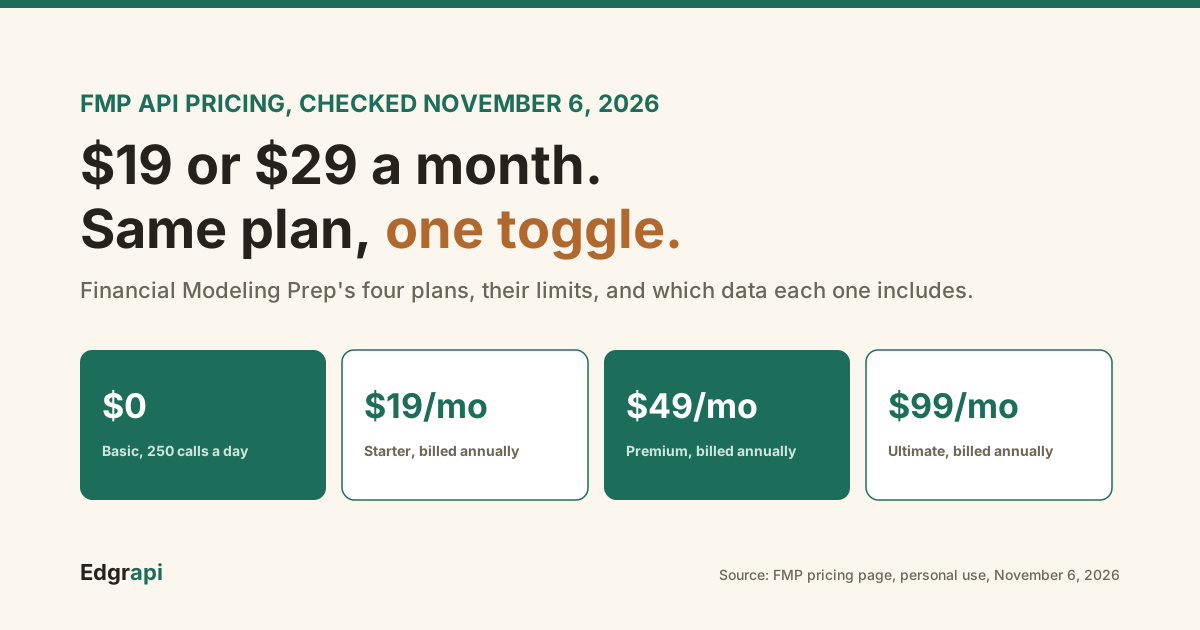
FMP's cheapest paid plan costs $19 a month. Or $29. It depends on one toggle at the top of the pricing page.
Financial Modeling Prep API pricing has four public tiers, which I checked on FMP's pricing page on November 6, 2026. Basic is free with 250 calls a day. Starter costs $29 a month, or $19 a month billed annually. Premium is $69, or $49 annually, and Ultimate is $139, or $99 annually. The catch is the dataset grid: 13F holdings, earnings call transcripts and bulk downloads are Ultimate-only.
How much does the Financial Modeling Prep API cost?
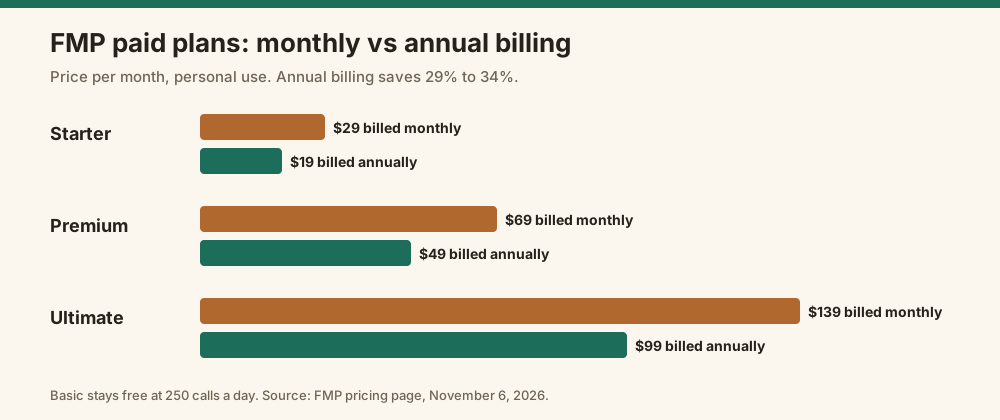
The Financial Modeling Prep API costs $0 to $139 a month for personal use. Starter is $29 a month billed monthly or $19 a month billed annually, Premium is $69 or $49, and Ultimate is $139 or $99, according to FMP's pricing page on November 6, 2026. Paying yearly saves 29% to 34%. Commercial use, including showing FMP data to your own users, needs a custom Enterprise quote.
Here's every personal plan, side by side:
| Plan | Billed monthly | Billed annually | Per year (annual) | API calls | History |
|---|---|---|---|---|---|
| Basic | $0 | $0 | $0 | 250 a day | 5 years |
| Starter | $29/mo | $19/mo | $228 | 300 a minute | 5 years |
| Premium | $69/mo | $49/mo | $588 | 750 a minute | 30+ years |
| Ultimate | $139/mo | $99/mo | $1,188 | 3,000 a minute | 30+ years |
Starter covers the US. Premium adds the UK and Canada, and Ultimate is the only personal plan with global coverage.
Watch out for old price lists. One comparison site that says it last verified its facts on August 20, 2026 lists Starter at $22, Premium at $59 and Ultimate at $149 billed annually. FMP's own pricing page showed $19, $49 and $99 when I checked.
So check the date on any FMP price you read, including mine.
What do you get on FMP's free plan?
FMP's free Basic plan gives you 250 API calls a day, end-of-day prices, company profiles, and up to 5 years of annual financial statements for US companies. It has no real-time data and a 500MB bandwidth cap over any 30 days. You need an account to get a key: in my tests, a request with no key or the old "demo" key returned HTTP 401.
FMP's FAQ describes the free plan as "up to 250 market data API requests per day."
Most datasets on the free plan say "Limited Coverage" in FMP's grid. Insider trades, SEC filings and Senate trades are all limited there.
Some datasets are missing entirely. The free plan has no 13F holdings, no earnings call transcripts, no ETF holdings and no bulk downloads.
There's no free trial of the paid plans either. FMP's FAQ says plainly: "We currently do not offer free trials." You can cancel anytime instead.
To put 250 calls in perspective: a company's income statement, balance sheet and cash flow are three separate calls. So the free plan covers about 83 companies' statements a day, before you ask for anything else.
One more change trips up old tutorials. FMP's FAQ says its Legacy APIs are "now only available to existing paid customers," so free and new plans use the newer Stable endpoints.
Which FMP plan includes insider trades, 13F and SEC filings?
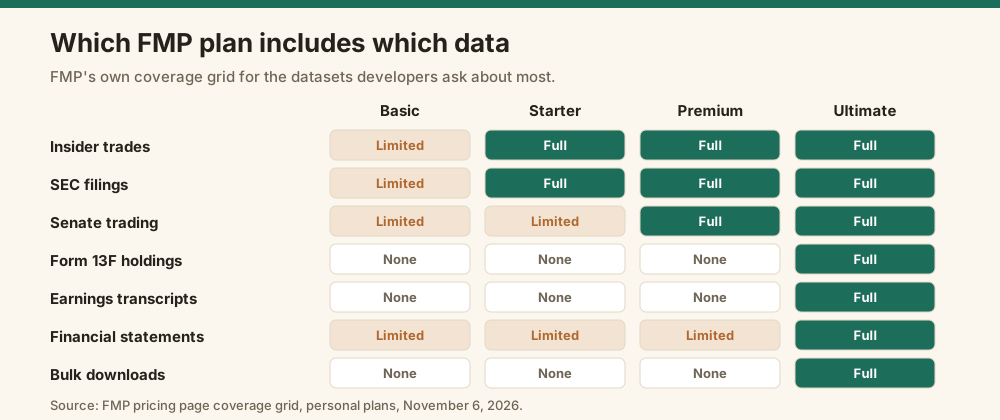
For SEC-based data, Starter at $19 a month billed annually gets you full insider trades and full SEC filings. Senate trading data needs Premium at $49. Form 13F institutional holdings need Ultimate at $99, the top personal plan, as do earnings call transcripts, ESG data and bulk downloads. Every paid tier below Ultimate still says "Limited Coverage" for financial statements and company information.
FMP's own grid, for the datasets developers ask about most:
| Dataset | Basic | Starter | Premium | Ultimate |
|---|---|---|---|---|
| Insider trades | Limited | Full | Full | Full |
| SEC filings | Limited | Full | Full | Full |
| Senate trading | Limited | Limited | Full | Full |
| Form 13F holdings | None | None | None | Full |
| Earnings call transcripts | None | None | None | Full |
| Financial statements | Limited | Limited | Limited | Full |
| Bulk downloads | None | None | None | Full |
| Real-time data | No | Yes | Yes | Yes |
That 13F line is the one that surprises people. If you want fund holdings, the cheapest FMP path is $1,188 a year.
The financial statements line is odd too. Premium's plan card promises "Full Fundamentals and Ratios," but the grid still marks statements as limited until Ultimate.
What's the difference between FMP Starter, Premium and Ultimate?
The difference between FMP's paid plans is speed, history, region and tickers. Starter gives 300 calls a minute, 5 years of history and US coverage. Premium raises that to 750 calls a minute, 30+ years, and the UK and Canada. Ultimate gives 3,000 calls a minute, global coverage, and every ticker, since FMP says Premium "still comes with limits on the number of tickers" on some endpoints.
That ticker limit is easy to miss. It isn't on the plan cards.
FMP's FAQ spells it out: "To access all tickers without restrictions, you would need to upgrade to the Ultimate plan."
So if you're screening the whole market, the real choice is Ultimate or nothing. If you only follow 20 stocks, Starter may be all you need.
Here's how I'd pick:
- Starter: US prices, annual statements, insider trades, a watchlist-sized project
- Premium: longer history, intraday charts, technical indicators, Senate trades
- Ultimate: 13F holdings, transcripts, all tickers, bulk downloads, global data
Should you pay FMP monthly or annually?
Paying FMP annually saves $120 a year on Starter, $240 on Premium and $480 on Ultimate, based on FMP's November 2026 prices. Monthly billing costs $348, $828 and $1,668 a year for those plans, against $228, $588 and $1,188 billed annually. That's the 29% to 34% discount FMP advertises. The trade-off is commitment: monthly lets you leave after one month.
The math, plan by plan:
| Plan | 12 months, billed monthly | 1 year, billed annually | You save |
|---|---|---|---|
| Starter | $348 | $228 | $120 (34%) |
| Premium | $828 | $588 | $240 (29%) |
| Ultimate | $1,668 | $1,188 | $480 (29%) |
My rule: pay monthly for the first month or two. You'll find out fast whether the dataset you need is really "Full Coverage" for your tickers.
Then switch to annual once you know the plan fits. Since there's no free trial, that first month is your trial.
How much does FMP cost for common projects?
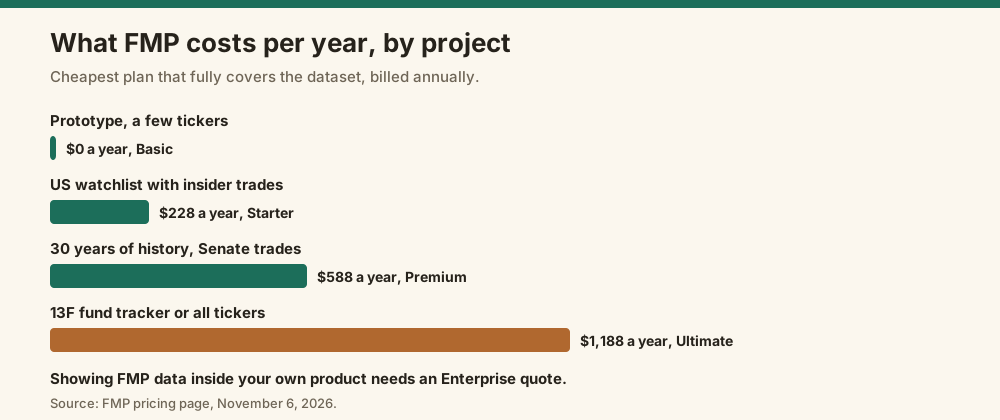
What FMP costs for a real project depends on the one dataset you can't do without. Insider trades or SEC filings start at $228 a year on Starter, billed annually. Full Senate trading data starts at $588 on Premium. 13F holdings, earnings call transcripts and bulk downloads start at $1,188 on Ultimate. Showing the data inside your own product means an Enterprise quote.
Here's the cheapest FMP plan for each kind of project, at annual prices:
| Project | Cheapest FMP plan | Cost per year |
|---|---|---|
| Learning, prototypes, a few tickers | Basic | $0 |
| US watchlist with insider trades | Starter | $228 |
| 30 years of history, intraday, Senate trades | Premium | $588 |
| Fund tracker using 13F holdings | Ultimate | $1,188 |
| Whole-market screener, all tickers | Ultimate | $1,188 |
| A product that shows FMP data to users | Enterprise | Quote only |
The jump from $588 to $1,188 is where most people stall. It's the price of 13F data and every ticker.
What are FMP's API rate limits?
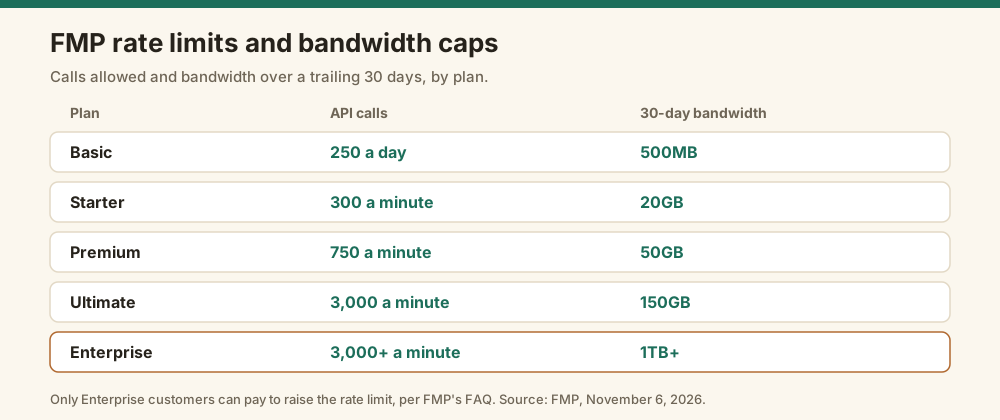
FMP's API rate limits depend on the plan: 250 calls a day on the free plan, then 300 a minute on Starter, 750 on Premium and 3,000 on Ultimate. Each plan also has a bandwidth cap over a trailing 30 days: 500MB free, 20GB Starter, 50GB Premium and 150GB Ultimate. Enterprise starts at 1TB, and FMP says only Enterprise customers can pay to raise the rate limit.
The bandwidth cap matters more than it looks.
Heavy daily pulls can hit the bandwidth cap before the call limit. Estimate your payload sizes before you pick a plan.
FMP's pricing page also marks Ultimate's 3,000 calls a minute with an asterisk. I didn't find the footnote that explains it, so treat 3,000 as a ceiling, not a promise.
Can you use FMP data in a commercial app?
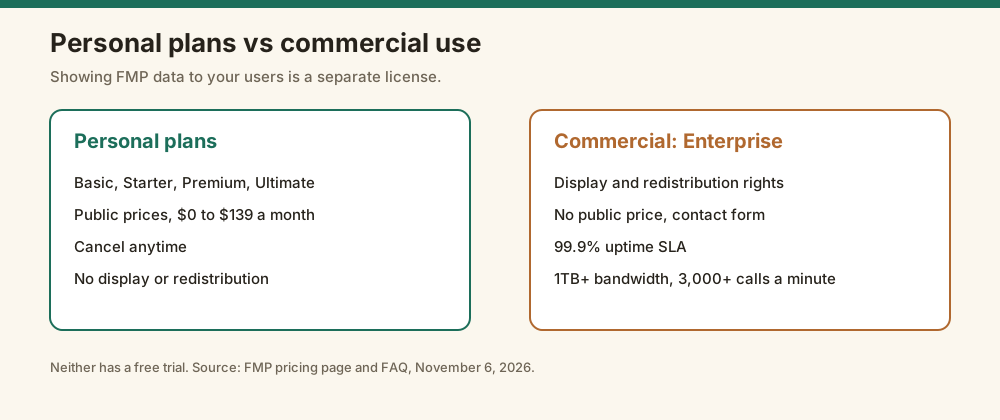
Not on a personal plan. FMP's pricing page says "displaying or redistributing data sourced from FMP requires a specific Data Display and Licensing Agreement." The Commercial Use tab on that page shows one option, Enterprise, with no public price, just a contact form. It lists display and redistribution rights, custom call limits, a 99.9% uptime SLA and 1TB+ of bandwidth.
This is the part to read twice if you're building a product.
If your app shows FMP numbers to your users, the $19 Starter plan doesn't cover it. You need the licensing agreement, and the price is whatever sales quotes you.
There's no free trial to test that path either. FMP's FAQ says its sales team will "provide sample data sets as needed" instead.
How do you get an FMP API key?
You get an FMP API key by creating a free account on FMP's site, which issues a key on the Basic plan. You then send it with every request, either as an apikey header or as an apikey query parameter, according to FMP's docs. Requests without a valid key fail: when I tested on November 6, 2026, both no key and the old "demo" key returned HTTP 401.
FMP's documentation says "All API requests must be authorized using an API key."
Here's the test I ran, with no key:
curl -s "https://financialmodelingprep.com/stable/profile?symbol=AAPL&apikey=demo"It returned HTTP 401 and this body:
{"Error Message": "Invalid API KEY. Feel free to create a Free API Key or visit https://site.financialmodelingprep.com/faqs?search=why-is-my-api-key-invalid for more information."}Use the header form in real code. A key in the query string ends up in server logs and browser history.
Old tutorials may point at endpoints FMP now treats as Legacy, which free and new plans can't use. Start from the /stable/ paths in FMP's current docs, like the one above.
Is FMP worth it, or is a cheaper API enough?
FMP is worth it if you need stock prices, intraday charts, forex, crypto or global fundamentals in one place. Its Starter plan is cheap for that. It's less of a deal if you only need SEC data like 13F holdings, because FMP puts 13F on its $99-a-month Ultimate plan. A filings-focused API can cost less there, though it won't replace FMP's market data.
I run Edgrapi, an SEC and government data API, so weigh my take with that in mind.
Here's the honest comparison for SEC-sourced data:
| Need | Cheapest FMP plan | Edgrapi |
|---|---|---|
| Insider trades (Form 4) | Starter, $19/mo billed annually | 5 credits a call; $10/mo plan has 10,000 credits |
| 13F fund holdings | Ultimate, $99/mo billed annually | 5 credits a call, same plans |
| Congress trades | Premium for full Senate data, $49/mo | House trades, 2 credits a call |
| Financial statements | Ultimate for full coverage | 3 credits a call, every plan |
| Stock prices, intraday, forex, crypto | Starter and up | Not offered |
| Transcripts, ETF holdings, global stocks | Ultimate | Not offered |
Edgrapi's free plan has 50 one-time credits, then $10 a month for 10,000 credits, or one-time packs from $7 for 5,000 credits that never expire. That's from Edgrapi's pricing page.
Here's what an insider-trades call looks like on Edgrapi, 5 credits:
import requests

r = requests.get("https://api.edgrapi.com/v1/insider/AAPL", headers={"X-API-Key": "YOUR_KEY"},
                 params={"limit": 3}, timeout=60).json()
for f in r["filings"]:
    for t in f["transactions"]:
        print(f["filed"], f["owner"], t["code_label"], t["shares"], t["price_per_share"])
When I ran it on November 6, 2026, it returned Apple's three latest Form 4 filings, all from general counsel Jennifer Newstead. The newest, filed November 5, was an open-market sale of 2,399 shares at $325.75, made under a 10b5-1 plan.
If you need prices and fundamentals for 5,000 global tickers, buy FMP. If you need SEC filings, insider trades and fund holdings, compare first. I wrote a fuller feature comparison in Edgrapi vs Financial Modeling Prep.
Pick the FMP plan by dataset, not by call count
Before you pay, list the datasets you need, then find the cheapest FMP tier that marks each one "Full Coverage" in its grid. For most projects, the dataset decides the plan, not the 300 or 3,000 calls a minute. If 13F holdings or SEC filings are the main need, get a free Edgrapi key and price that out too.
Frequently asked questions
How much does the FMP API cost?
The FMP API costs $0 for the Basic plan, $29 a month for Starter, $69 for Premium and $139 for Ultimate when billed monthly, according to FMP's pricing page on November 6, 2026. Billed annually, the paid plans drop to $19, $49 and $99 a month. Commercial use requires a custom Enterprise quote with no public price.
Is the Financial Modeling Prep API free?
Yes, FMP has a free Basic plan with 250 API calls a day, end-of-day data, company profiles and up to 5 years of annual statements for US companies. It has a 500MB bandwidth cap over 30 days and "Limited Coverage" for most datasets. You need a free account to get an API key, since requests without one return HTTP 401.
Does Financial Modeling Prep have a free trial?
No. FMP's FAQ says "We currently do not offer free trials." You can use the free Basic plan to test endpoints, then subscribe to a paid plan and cancel anytime. For commercial plans, FMP's sales team can send sample data sets instead of a trial.
Which FMP plan includes 13F data?
Only the Ultimate plan includes Form 13F institutional holdings among FMP's personal plans. Ultimate costs $139 a month, or $99 a month billed annually, which is $1,188 a year, according to FMP's pricing page in November 2026. Basic, Starter and Premium all show "No Coverage" for 13F. Enterprise plans also include it.
What is the FMP API rate limit?
FMP's free plan allows 250 API calls a day. Paid plans allow 300 calls a minute on Starter, 750 on Premium and 3,000 on Ultimate. Each plan also has a trailing 30-day bandwidth cap of 500MB, 20GB, 50GB and 150GB respectively. Only Enterprise customers can pay to raise the rate limit, according to FMP's FAQ.
Can I use FMP data commercially?
Not on FMP's personal plans. FMP's pricing page says displaying or redistributing its data "requires a specific Data Display and Licensing Agreement." Commercial use goes through the Enterprise plan, which has no public price; you fill in a contact form and get a quote. It includes display and redistribution rights and a 99.9% uptime SLA.