Free Government Data APIs: The Developer's Map (2026)
The US government gives away more data than almost anyone, for free. The hard part is finding the right API and knowing which ones make you sign up.
The best free government data APIs cover federal spending, contracts, company filings, the economy, and the law, and most are genuinely free because a public mandate funds them, not a subscription. Some are keyless and you can call them right now; others want a free key. This guide maps the major ones by what they cover, flags the auth on each, and shows how to avoid stitching five of them together yourself.
What are the best free US government data APIs?
The best free US government data APIs are the ones with production-grade data and a real JSON interface: SEC EDGAR for company filings, USAspending for federal awards, SAM.gov for contract opportunities, Grants.gov for grants, Treasury FiscalData for federal finances, plus Census, FRED, and BLS for the economy. All are free. What varies is whether they need a key and how clean the output is.
Here's the map in one table.
| API | Covers | Key? | Format |
|---|---|---|---|
| SEC EDGAR | Company filings, financials, insider trades | No | JSON |
| USAspending | Federal awards + spending | No | JSON (POST) |
| Grants.gov (Search2) | Federal grant opportunities | No | JSON (POST) |
| SAM.gov | Federal contract opportunities | Free key | JSON |
| Treasury FiscalData | Debt, revenue, federal finances | No | JSON |
| Federal Register | Rules, notices, executive orders | No | JSON |
| Census Bureau | Demographics, business, economy | Free key | JSON |
| FRED (Federal Reserve) | Economic indicators | Free key | JSON |
| BLS | Jobs, inflation, CPI | Free key | JSON |
| Congress.gov | Bills, laws, members | Free key | JSON/XML |
| House Clerk (STOCK Act) | Congressional stock trades | No (PDFs) |
Most of these route through api.data.gov, GSA's free API gateway. It was built to meet the Open Government Data Act of 2018, and it now fronts more than 450 APIs across 25 agencies with a single free key.
That gateway is why one Census or FRED key can unlock several services. It's also why "free" is the norm here, not the exception.
One habit saves a lot of pain: check the auth column before you write code. A keyless API is a prototype you can start now, and a keyed one is usually a two-minute signup, except SAM.gov, which is the one real wait on this map.
Which government data APIs need a key, and which are keyless?
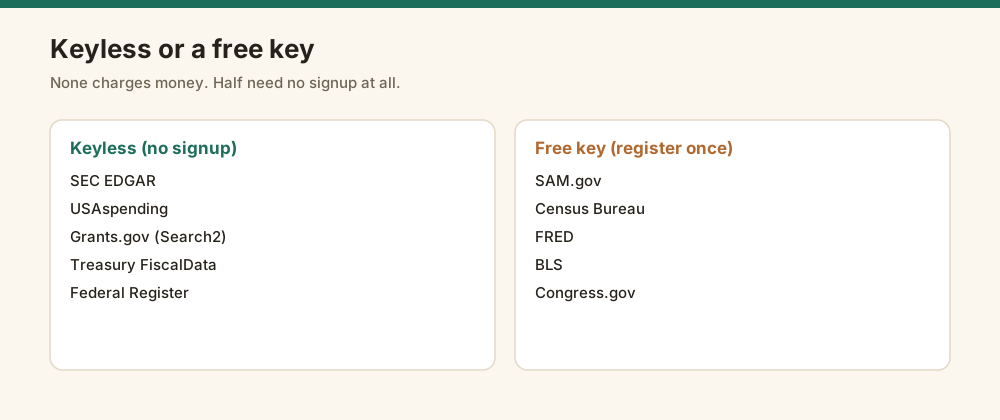
Roughly half need a free key and half are keyless. The keyless ones, where you can send a request in the next minute, include SEC EDGAR, USAspending, Grants.gov's Search2, Treasury FiscalData, and the Federal Register. The key-required ones, where you register once for a free token, include SAM.gov, Census, FRED, BLS, and Congress.gov. No major federal data API charges money for basic access.
The split matters more than it looks.
A keyless API is a five-minute integration. You write the request and you're done, which is perfect for a prototype or a script.
A keyed API adds a signup step. Usually it's instant, but SAM.gov is the exception: a system-level key there can take up to 10 business days to issue, so plan around it if you need contract opportunities.
The other quiet difference is rate limits. Keyless APIs often have generous but unstated limits, while keyed APIs tie your quota to your registered key. Neither is a paywall, but both can throttle a busy job.
What free APIs cover federal money and contracts?
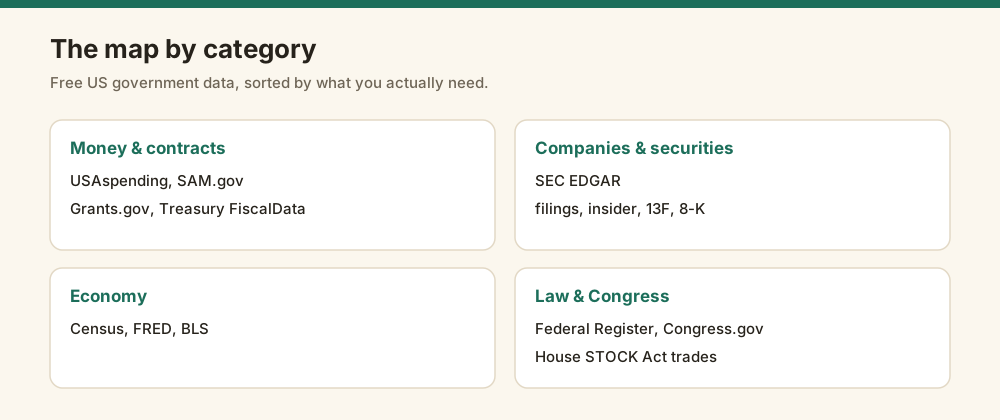
Four APIs cover the flow of federal money, and none of the core ones charges a cent. USAspending reports awards the government already made, keyless. SAM.gov lists open contract opportunities you can bid on, with a free key. Grants.gov publishes grant opportunities through its keyless Search2 endpoint. Treasury FiscalData covers the big picture: debt, revenue, and federal finances, also keyless.
Think of them as stages of the same pipeline.
SAM.gov is the front: solicitations that are open for bids right now. Grants.gov is the same idea for grant funding rather than contracts.
USAspending is the back: awards already made and the dollars spent. It pulls from the same systems behind SAM.gov, so it's the record of who won.
Treasury FiscalData sits above all of it, with the aggregate numbers, like the public debt to the penny. If your question is "how much and to whom," these four answer it.
A quick way to choose between them: use SAM.gov when you're looking for work to win, and USAspending when you're researching who already won it. They're two ends of the same contract, which is why serious GovCon tools read both. Grants.gov covers the funding side, and FiscalData zooms out to the national totals.
What free APIs cover company filings and securities?
For public companies, SEC EDGAR is the source, and it's completely keyless. Every US public company files with the SEC, and the EDGAR APIs at data.sec.gov serve company facts, filings, and financial statements as JSON with no signup. It's the backbone of any tool that touches fundamentals, insider trades, 13F holdings, or 8-K events.
The catch with EDGAR is not access, it's shape.
The raw data is free and complete, but it arrives as XBRL and nested JSON that varies by filer. Getting clean, comparable numbers out of it is the work, which is a whole topic on its own.
That's why a layer of normalized SEC APIs exists on top of EDGAR. The data underneath is the same free public record; what you pay for, if anything, is not re-parsing it yourself.
The same free EDGAR data powers insider-trade feeds, 13F institutional holdings, and 8-K event trackers. None of that needs a new source, just a cleaner read of the one that's already public and free.
What free APIs cover the economy and demographics?
Three agencies cover the macro picture, each with a free key. The Census Bureau serves demographics, business patterns, and geography. FRED, run by the Federal Reserve, is the go-to for economic indicators like GDP, rates, and unemployment. BLS covers jobs, wages, and inflation, including the CPI. All three are free; all three want a free registration key.
These are the numbers behind most economic dashboards.
FRED is the friendliest for time series. One key, hundreds of thousands of series, clean JSON, which is why it shows up in so many finance projects.
Census is deeper but more complex, with a query model built around geography and tables. BLS is the authority for labor and price data, and its inflation series feed everything from research to news.
One practical note ties them together. Several of these services sit behind api.data.gov, so a single free key can cover more than one of them. Register once and you avoid juggling a separate credential for every economic series you pull.
None of these overlaps with the spending or filings APIs. If your project needs both a company's filings and national inflation, that's two different worlds and two different integrations.
What free APIs cover laws, regulations, and Congress?
Three sources cover the legislative and regulatory side. The Federal Register API is keyless and serves rules, proposed rules, notices, and executive orders as JSON. Congress.gov's API, with a free key, covers bills, laws, votes, and members. Congressional stock trades under the STOCK Act are public too, but the House publishes them as PDFs rather than a clean API.
Each has a different shape.
The Federal Register is the daily journal of the executive branch, and its API is clean and open, good for tracking new rules or executive orders.
Congress.gov is the legislative record: what bills exist, who sponsored them, how votes went. It's a free key through the same api.data.gov gateway.
The STOCK Act trades are the odd one out. The data is public, but it lives as House Clerk PDFs and a Senate portal, so getting it as JSON means parsing the filings yourself or using a wrapper. It's the one "government data" people expect to be an API and find isn't.
What other free government APIs are worth knowing?
Plenty, beyond money and filings. The National Weather Service API at weather.gov is keyless and serves forecasts and alerts. NASA's api.nasa.gov covers imagery and space data with a free key. The CDC, NIH, EPA, and FCC all publish open data APIs, and Data.gov's API catalog lists hundreds more across agencies. If a federal agency has data, it usually has an API.
A few are worth singling out.
The National Weather Service API is a favorite because it's genuinely free, keyless, and reliable, covering forecasts, alerts, and observations.
NASA's API is the fun one, with imagery, near-earth objects, and Mars rover photos, all behind a free key that even ships a shared DEMO_KEY for testing.
For health and environment, the CDC, NIH, and EPA each run open data services. None of these overlaps with finance, but they show the pattern: the map is far bigger than the well-known names, and Data.gov is where you find the rest.
What are the common gotchas with government APIs?
The data is free, but the interfaces are uneven. Some "APIs" are really PDFs, like House STOCK Act trades. Others use POST bodies with filter languages instead of simple GETs, like USAspending and Grants.gov. Rate limits are often unstated, dates arrive in odd formats, and one signup, SAM.gov's, can take up to 10 business days. Free doesn't always mean easy.
A few traps catch almost everyone.
Not everything is JSON. The most-wanted congressional-trade data is House Clerk PDFs, and plenty of older datasets are CSVs or fixed-width files.
POST-body query languages surprise people. USAspending and Grants.gov want a nested JSON filter body, not a tidy query string, so a naive GET returns nothing or an error, and you can lose an afternoon before you notice the method is wrong.
Rate limits hide until you hit them. Keyless APIs rarely publish a number, and a busy job can trip an invisible ceiling, so watch response headers and back off on a 429.
And formats vary. Dates show up as MM/DD/YYYY, ISO, or worse, and amounts sometimes come as ranges rather than exact figures. Budget time for the cleanup, because that's where the real work lives.
How do I use several government APIs without five integrations?
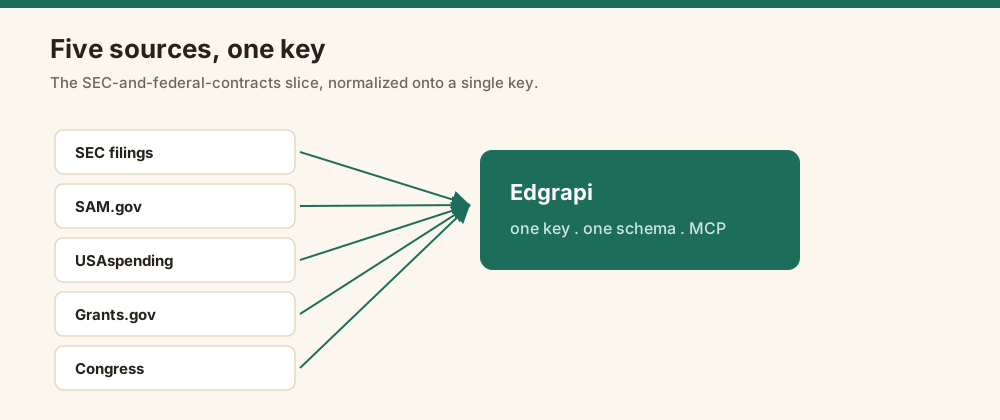
You use a normalized wrapper for the slice you need, and go direct for the rest. If your project lives in the SEC-plus-federal-contracts world, Edgrapi puts five of these sources behind one key: SEC filings, SAM.gov opportunities, USAspending awards, Grants.gov grants, and House STOCK Act trades, all as flat JSON with an MCP server for agents. For economy or demographics data, you still go to FRED, Census, or BLS directly.
Be honest about the tradeoff.
Each of those five sources is free on its own, so a wrapper isn't cheaper. What it saves is integration work: one key, one schema, and no separate clients for SAM's keyed GET, USAspending's POST body, and the House Clerk's PDFs.
It also doesn't cover everything. Edgrapi is the smart-money-and-contracts slice, not Census or FRED, so if you need macroeconomic series, use the Fed's API and skip the middle layer.
The rule of thumb is simple. For one or two keyless sources, call them directly. For the SEC-and-federal-contracts cluster, or for an AI agent that needs all of it as tools, one key beats five integrations.
Start with the API you can call today
The best free government data API is the one that answers your question with the least setup. If you want federal awards or SEC filings, start keyless today with USAspending or EDGAR. If you want the economy, get a free FRED or Census key.
And if your project needs the whole SEC-and-federal-contracts picture, or an agent that can reach all of it, don't build five integrations. Put that slice on one key and spend your time on the product instead of the plumbing. Either way, the data is public, the APIs are free, and the only real cost is deciding which door to walk through first.
Frequently asked questions
What are the best free government data APIs?
The strongest free US government data APIs are SEC EDGAR (company filings), USAspending (federal awards), SAM.gov (contract opportunities), Grants.gov (grants), Treasury FiscalData (federal finances), and FRED, Census, and BLS for the economy. All are free. SEC EDGAR, USAspending, Grants.gov Search2, Treasury FiscalData, and the Federal Register are keyless; SAM.gov, Census, FRED, BLS, and Congress.gov need a free key.
Are US government APIs really free?
Yes. US federal data APIs are free because they're funded by public mandates like the Open Government Data Act and the DATA Act, not by subscriptions. None of the major ones charges for basic access. The only differences are whether an API needs a free registration key and what its rate limits are. Government data is among the most reliably free data on the internet.
Which government data APIs need an API key?
SAM.gov, Census, FRED, BLS, and Congress.gov require a free API key, which you register for once. SEC EDGAR, USAspending, Grants.gov's Search2 endpoint, Treasury FiscalData, and the Federal Register are keyless and need no signup. Many keyed APIs route through api.data.gov, so a single free key can work across several agencies at once.
What is api.data.gov?
api.data.gov is GSA's free API management gateway for the federal government. Built to meet the Open Government Data Act of 2018, it fronts more than 450 APIs across 25 agencies and issues a single free key that works across many of them. Agencies like FRED and Census use it, so one key can unlock several services rather than a separate signup per API.
What is the best API for US federal spending and contracts?
USAspending is the best free API for federal spending and completed awards, and it's keyless. For open contract opportunities you can still bid on, use SAM.gov, which needs a free key. For grants, use Grants.gov's keyless Search2 endpoint. USAspending pulls from the same systems behind SAM.gov, so together they cover both open solicitations and the awards already made.
Can I get SEC and government data from one API?
For the SEC-and-federal-contracts slice, yes. Edgrapi normalizes SEC EDGAR filings, SAM.gov opportunities, USAspending awards, Grants.gov grants, and House STOCK Act congressional trades into flat JSON on one key, with an MCP server for AI agents. It doesn't cover Census, FRED, or BLS, so for economic data you still use those agency APIs directly. The underlying data is the same free public record.