How to Track Hedge Fund Holdings With 13F Filings (2026)
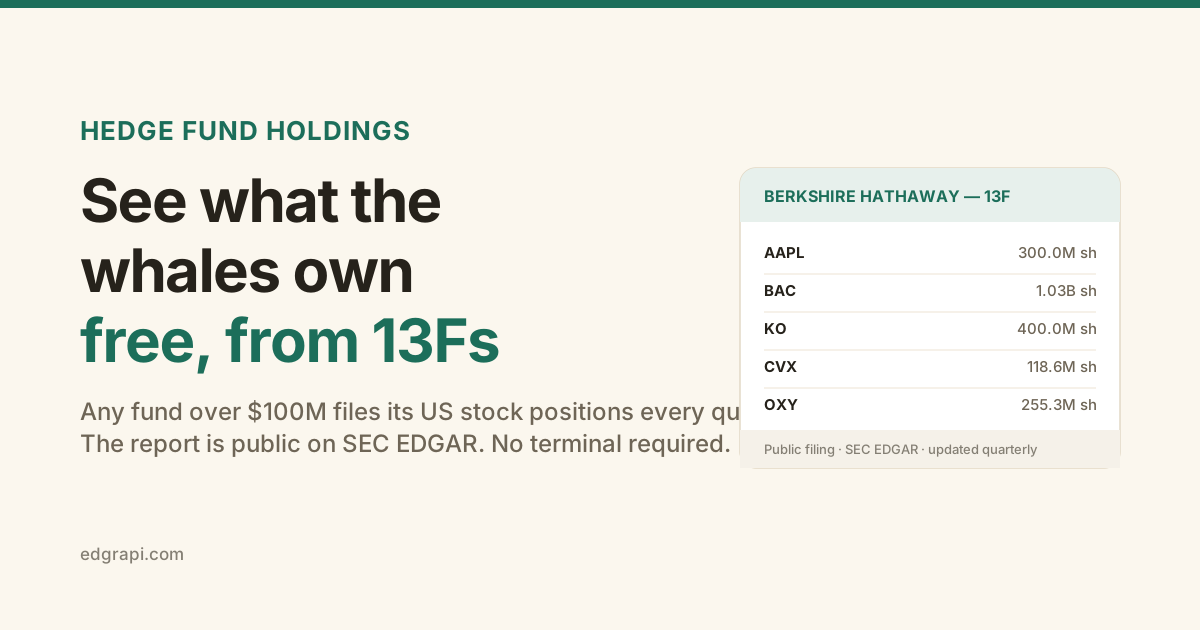
You can see almost every US stock Warren Buffett owns. For free. Legally. Today.
Most people think that kind of information sits behind a Bloomberg terminal or a hedge fund's locked door. It doesn't.
Any manager running $100 million or more has to hand the SEC a full list of their US stock positions every quarter. That list is called a 13F, and anyone can read it.
What is a 13F filing, and how does it reveal hedge fund holdings?
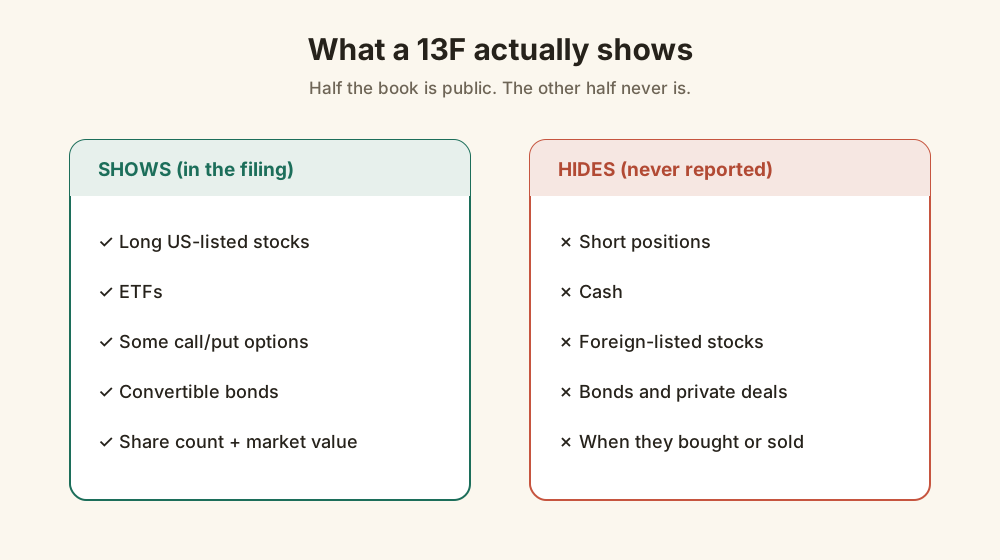
A 13F filing is the quarterly report every institutional manager with at least $100 million in US securities must file with the SEC, listing their long US-listed stock and option positions. It's required under Section 13(f) of the Securities Exchange Act. Filers include hedge funds, pensions, and asset managers, and the report shows each holding, the share count, and its market value on the last trading day of the quarter.
Think of it as a forced confession. Buffett would probably rather not tell you he loaded up on a stock. The law makes him anyway.
The rule comes from Form 13F and SEC Rule 13f-1. The $100 million bar is measured against "Section 13(f) securities," mostly exchange-traded stocks, ETFs, certain options, and convertible bonds. Not the fund's total assets. Just the qualifying US equities.
So when a fund crosses that line, it's on the hook to report every quarter for the rest of that year, even if it drops back below $100 million later.
That's the mechanism that turns a secretive industry into something you can read on a Saturday morning.
Are 13F filings really public and free?
Yes. 13F filings are completely public and free on SEC EDGAR, the government's filing database at sec.gov. There is no paywall, no account, and no API key needed to read a raw filing. The SEC also publishes structured Form 13F data sets pulled straight from EDGAR. Paid trackers exist, but they charge for convenience and history, not for access to the data itself.
The scale is bigger than most people realize. HedgeFollow tracks more than 10,000 institutional managers that file a 13F, and every one of those filings lands on EDGAR the day it's submitted, readable by anyone with a browser.
This is the part most people never hear. They assume "hedge fund holdings" is premium information.
It's the opposite. The data is a public good. Congress decided in 1975 that big-money positions should be visible so markets stay honest.
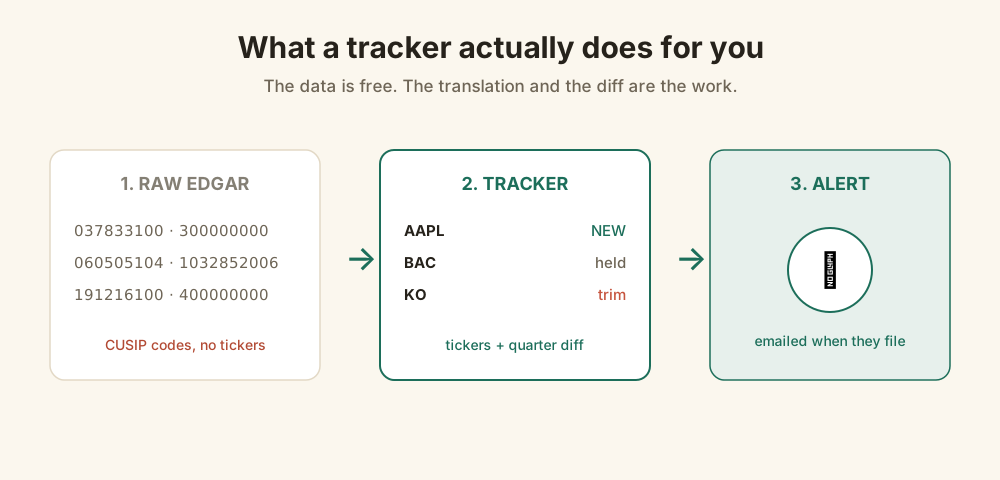
What you pay for, when you pay, is not having to dig through EDGAR by hand. A raw 13F is a table of CUSIP numbers, not tickers. It lists "Ally Financial" five times because Berkshire files across sub-managers. Reading it straight is a chore.
That's the whole reason trackers and APIs exist. The data is free. Your time isn't.
How do I see what stocks a specific investor is buying?
To see what a specific investor is buying, pull their two most recent 13F filings and compare them position by position. New tickers are fresh buys, bigger share counts are adds, smaller counts are trims, and dropped tickers are exits. You can do this by hand on EDGAR by searching the manager's name, or in one click on a tracker that shows the quarter-over-quarter diff already computed.
Here's the manual version, step by step.
- Find the manager on EDGAR. Go to the SEC's EDGAR full-text search and type the fund's name. Berkshire Hathaway, Scion Asset Management, Pershing Square. Open their filing list.
- Open the latest 13F-HR. "HR" means the full holdings report. The information table lists every position.
- Open the prior quarter's 13F too. One filing is a snapshot. Two filings tell you what changed.
- Compare the two. What's new, what grew, what shrank, what's gone. The changes are the story, not the static list.
A quick example of what a change looks like. Say Scion showed no position in a stock last quarter and 500,000 shares this quarter. That's a brand-new buy, and it's the kind of thing that makes headlines when it's Burry. If the share count dropped from 500,000 to 100,000, he trimmed 80% and is heading for the exit. The diff is the signal.
Size matters as much as direction. A stock that's 10% of a fund's portfolio is a real conviction bet. A 0.3% starter position is barely a whisper, and treating the two the same is how people misread a 13F.
The catch is the CUSIP problem. Raw 13Fs identify holdings by CUSIP, a nine-character security code, not by ticker. So "037833100" means Apple, but you'd never know without a lookup. The SEC ships no free CUSIP-to-ticker file, so every raw filing is a wall of codes you have to translate yourself.
That's why most people skip the manual route after trying it once. A tracker maps CUSIPs to tickers and diffs the quarters for you.
You can browse the big names' portfolios already mapped and diffed at Edgrapi: Buffett, Michael Burry, Bill Ackman, and the rest of the fund directory. New buys, adds, trims, and exits are labeled for you.
What's the best free tool to track hedge fund holdings?
The best free tool depends on what you want. Dataroma is the simplest for browsing famous value investors with no account. HedgeFollow tracks 10,000+ managers with strong visualizations and a cheap paid tier. WhaleWisdom has the deepest research features and backtesting. 13F.info and SEC EDGAR are fully free and raw. Most serious trackers gate history and alerts behind a paid plan, so match the tool to whether you want a quick look or a research system.
Here's how the main options stack up.
| Tool | Free tier | Paid from | Best for |
|---|---|---|---|
| SEC EDGAR | Everything, raw | Free | The source of truth. CUSIPs, no tickers, no diff |
| Dataroma | Yes, no account | Free | Quick browsing of famous value investors |
| HedgeFollow | Yes | ~$10/mo | Visualizations, 10,000+ managers, money-flow view |
| WhaleWisdom | Limited | ~$25/mo | Deep research, backtesting, WhaleScore ranking |
| Edgrapi | Follow + alerts | Free to start | Follow investors, get emailed when they file a new 13F |
Pricing checked August 2026 from each tool's own pages, via a comparison roundup at Dilutracker. Tiers change, so confirm before you pay.
My honest take: start free. Dataroma or EDGAR to look, a follow-and-alert tool so you don't have to remember to check back. Pay for WhaleWisdom only when you're doing real backtesting.
Is a 13F the only way to see what a fund is buying?
No. A 13F is the fullest quarterly list, but three other public sources fill its gaps. A 13D or 13G is filed within days of an investor crossing 5% of a company, so it's far fresher than a 13F and signals activist intent. Forms 3, 4, and 5 show individual insiders trading their own stock. And some managers publish letters or speak at conferences, which is where the reasoning lives.
The one worth watching next to 13Fs is the 13D.
Because it's filed in days, not 45, a fresh 13D filing means an investor just took a big, concentrated stake, often with a plan to push for change. That's a live signal, not a quarterly rear-view mirror. Edgrapi's activist radar tracks new 13D and 13G stakes across the whole market.
Fund letters and conference talks are the other half. They rarely list positions, but they tell you why. The 13F shows what changed. The letter shows the thinking behind it.
Does copying a hedge fund's 13F actually work?
Sometimes, but not the way people hope. Academic research on "13F cloning" has found that mechanically copying top-performing managers can beat the market on a risk-adjusted basis. A 2024 study by Dr. J. Schroeder, analyzing over 150,000 cloned portfolios from 2013 to 2023, found top-quartile clones exceeded the S&P 500 by 24.3% annualized on a risk-adjusted basis. But that's the top quartile, rebalanced on the filing date, not a promise for any single fund you pick.
Other research points the same way. One academic analysis found that "copycat" investors piggybacking on disclosed hedge fund trades captured about 5.5% of extra annual return on the trades they mirrored. Real, but a slice of the original edge, not the whole thing.
The word doing the heavy lifting in all of this is "top-quartile."
Clone a bad manager and you inherit their losses. Schroeder's work mirrored both winners and losers faithfully. The edge came from picking good managers first, which is its own hard problem.
There's a second reason to be careful. Copying only works if the manager has real skill to copy, and that skill has gotten scarcer. Research on hedge fund returns has found their edge shrinking since the 2008 crisis.
So treat 13Fs as an idea generator, not a buy list. The people who track this for a living say the same thing: use the filings for idea creation, then do your own homework.
Find names worth researching. Then go research them.
Why 13F data is 45 days late, and 3 other traps
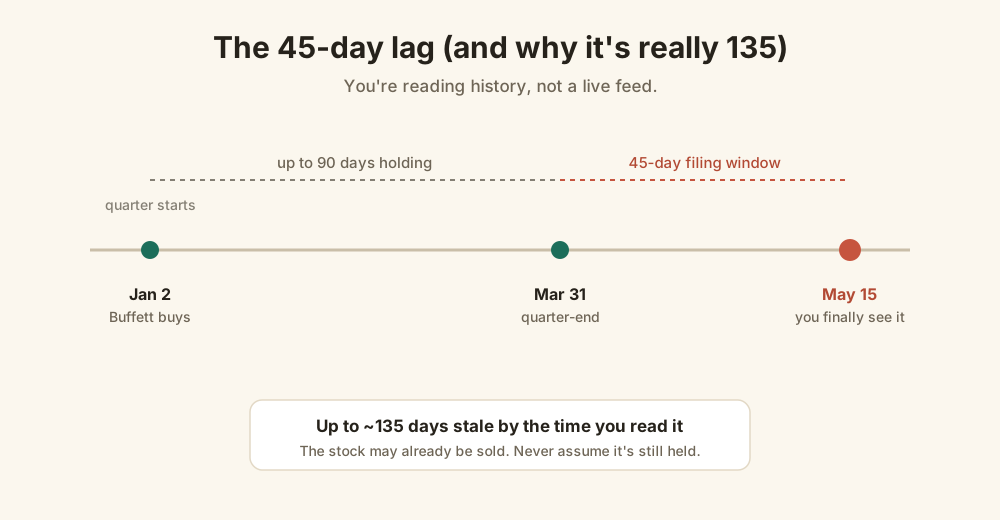
The biggest trap is timing: a 13F is filed up to 45 days after the quarter ends, so the position it shows could be up to 135 days old by the time you read it. A manager can buy in January, sell in March, and you'd still see the stock in the mid-February filing as if they held it. The other traps are that 13Fs show long positions only, hide the fund's real strategy, and invite window dressing.
Let me break down all four, because this is where amateurs get burned.
Trap 1: The 45-day lag. The SEC gives managers 45 days after quarter-end to file. Add the time since they opened a position, and the data can be four months stale. You're reading history, not a live feed. The "Form 13F Trap" write-up on Yahoo Finance calls this the single most common mistake.
Trap 2: Long positions only. A 13F reports what the fund is long. It never shows shorts, written options, or bonds. So a fund that's actually net short a stock can appear in the filing as a plain long holder. You're seeing one leg of a trade and guessing at the rest.
Trap 3: A partial picture of strategy. Cash, foreign-listed stocks, and private positions never appear. For a global macro or long-short fund, the 13F might cover a small slice of what they actually do. Judging their strategy from it is like reviewing a movie from three still frames.
Trap 4: Window dressing. Some managers buy hot stocks right before quarter-end so their public filing looks smart, then sell after. The filing shows the polished version, not the messy quarter.
None of this makes 13Fs useless. It makes them a lagging, partial, long-only snapshot. Read them that way and they're genuinely useful.
How to build a superinvestor tracker that pings you
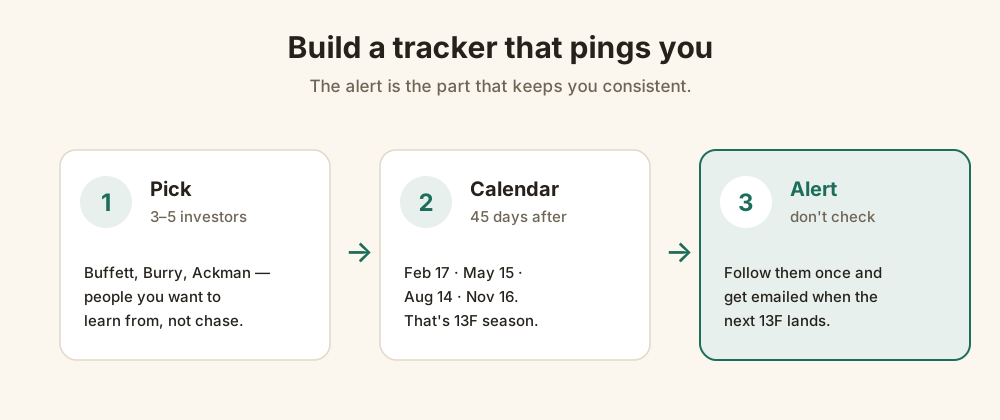
The practical system is three steps: pick a short list of investors worth following, check their new 13F each quarter, and set an alert so you hear about a filing instead of remembering to look. The filing calendar is predictable, 45 days after each quarter-end, so alerts matter more than dashboards. Following five managers you respect beats scrolling all 10,000 every week.
Here's the workflow I'd actually use.
Pick your investors. Three to five is plenty. Maybe Buffett for quality, Burry for contrarian bets, Ackman for concentration. Follow people whose thinking you want to learn from, not just whoever posted the best return last year.
Know the calendar. 13Fs land on a schedule. The 2026 deadlines, per a Finrep breakdown, are February 17 (Q4 2025), May 15 (Q1), August 14 (Q2), and November 16 (Q3). Circle them. Managers tend to file right up against the deadline, and anything submitted after 5:30 p.m. ET counts as the next day, so the biggest funds often land in a rush on deadline evening.
Get alerted, don't check. This is the whole trick. Nobody remembers to check EDGAR every 45 days. So let something watch for you and email you when your investor files a new 13F.
That last step is what Edgrapi's Superinvestors tool does. You follow an investor, and when their next 13F hits EDGAR, you get an email with what changed: the new buys, the adds, the exits, already diffed. Following is free to start.
It turns quarterly homework into something that shows up in your inbox on its own.
Start tracking one investor today
Don't overthink the first step. Pick one investor you're curious about and look at what they own.
Open the fund directory, click Buffett or Burry, and read their latest 13F with the buys and exits already labeled. Then follow them so the next filing comes to you.
Short on time? The superinvestor consensus page aggregates all of them into one view: the stocks the most legends own, and the ones the most of them bought last quarter.
Browse superinvestor portfolios free →
Edgrapi surfaces public SEC filings for research. It is not investment advice, and a 13F is a lagging, long-only snapshot, not a signal to buy.
Frequently asked questions
How do I find out what stocks Warren Buffett owns?
Read Berkshire Hathaway's latest 13F filing. Every quarter Berkshire must list its US stock holdings with the SEC, and the report is public and free on EDGAR. It shows each position and share count as of the quarter's last day. For a version with tickers instead of CUSIPs and buys already labeled, see the Buffett page in Edgrapi's fund directory.
How often do hedge funds have to report their holdings?
Every quarter. Any manager with $100 million or more in US securities files a 13F within 45 days of each quarter-end, so four times a year. The 2026 dates are February 17, May 15, August 14, and November 16. There's no monthly or real-time requirement, which is why 13F data always lags the market by up to 45 days.
Do 13F filings show short positions?
No. A 13F reports only long US-listed positions. Short positions, written options, bonds, cash, and foreign stocks never appear. That's a real blind spot: a fund that is net short a stock can still show up as a long holder, because only the long leg gets reported. Treat the filing as one side of the book, not the whole strategy.
Is it legal to copy hedge fund trades from 13F filings?
Yes. 13F filings are public disclosures the SEC requires managers to make, and acting on public information is ordinary research, not insider trading. What's illegal is trading on material non-public information, which is the opposite of a filing everyone can read. Copying is legal, but the data is up to 45 days old, so you're never trading on fresh information.
How stale is 13F data by the time I see it?
Up to about 135 days. A manager has 45 days after quarter-end to file, and the position may have been opened up to 90 days before that. So a stock in a mid-February filing could have been bought in early January and sold before you ever read it. Never assume a 13F holding is still held.
What's the difference between a 13F and a 13D filing?
A 13F is a quarterly list of a big manager's entire long US portfolio, filed 45 days after quarter-end. A 13D is filed within days of an investor crossing 5% ownership of a single company, and it signals activist intent. Use 13Fs to track a fund's whole book; use 13Ds to catch a fast, concentrated stake in one stock.