What Is a Form 8-K? Material Events Explained (2026)
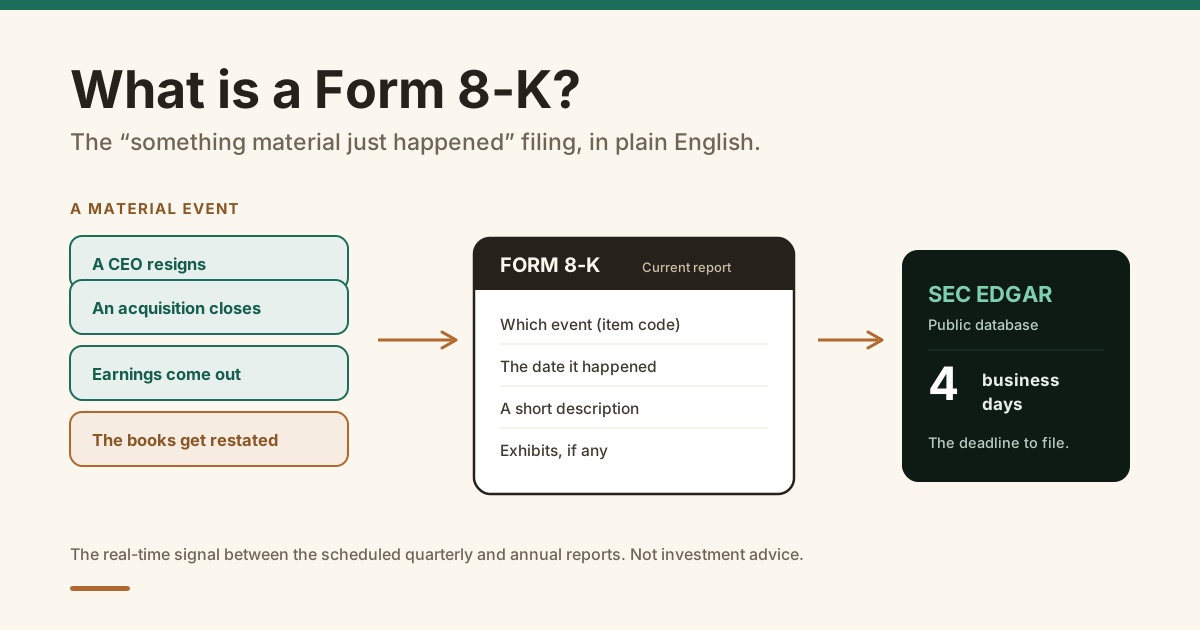
A Form 8-K is the report a public company files with the SEC to announce a major event as it happens, instead of waiting for its next quarterly or annual report. The SEC calls it a "current report," and that word current is the whole idea. It exists to get important news out fast.
Think of an executive quitting, an acquisition closing, a bankruptcy, or a fresh earnings release. Each one triggers an 8-K, and the company has to file it within four business days. It lands on SEC EDGAR tagged with an item code that tells you what kind of event it is.
So if a 10-K is the company's yearbook, the 8-K is its group text. Short, quick, and sent the moment something worth knowing actually happens.
What is a Form 8-K, really?
Let me back up and explain why this filing even exists. Public companies report on a fixed schedule, four times a year. But the business itself does not run on a schedule.
A CEO can resign in March. A factory can burn down in July. A rival can get bought in October. None of those things politely wait for the next quarterly report, and investors deserve to hear about them close to when they happen.
Closing that gap is the job an 8-K does. It puts the news out so that everyone, big fund or small saver, learns it around the same time. The SEC's own glossary entry describes it in almost those exact terms.
And here is the part people miss. An 8-K is narrow on purpose. It covers one event, or a small handful, and it is not audited. You are reading a bulletin, not a book.
One word does a lot of work here: material. A company does not have to file an 8-K for every little thing, only for events a reasonable investor would consider important. That standard is deliberately fuzzy, so companies lean on their lawyers to decide where the line sits, which is why some 8-Ks feel borderline and others are obviously huge.
Why does that matter to you? Because it changes how you read it. You do not comb an 8-K for the full financial picture. You open it to answer one question: what just happened, and does it change anything?
What kinds of events trigger an 8-K?
A lot of them, honestly. The SEC lists dozens of triggering events in the form's official instructions, and each one gets its own item number.
You do not need to memorize that list. But it helps to know the rough shape of it, because the events fall into a few buckets.
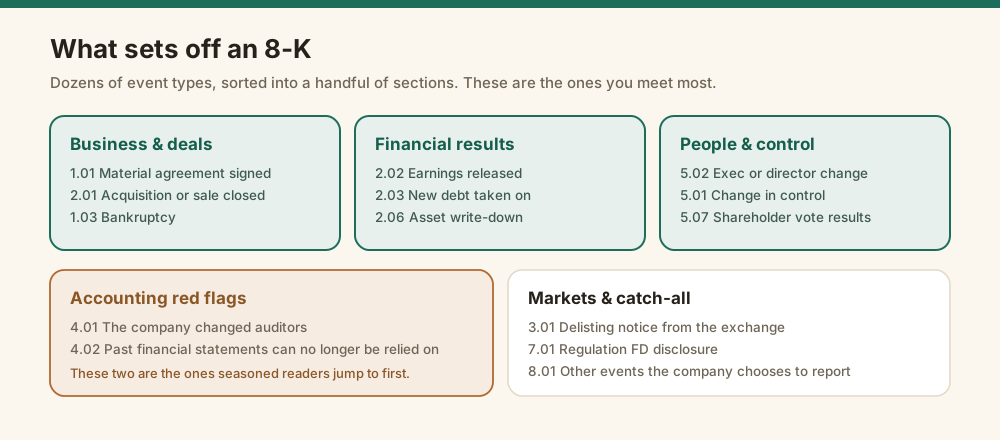
The buckets go something like this. There are deals and business changes, financial results, people and control of the company, accounting matters, and then a catch-all for anything else the company decides is worth disclosing.
So why bother with the codes at all? Because they let you read an 8-K without opening it. A filing tagged 5.02 is about someone in leadership leaving or joining. One tagged 2.01 is a deal that closed. The code is basically the headline.
Two accounting codes are the ones experienced readers watch closely. A 4.01 says the company swapped auditors, and a 4.02 says its past financial statements can no longer be trusted. Both are the kind of thing that makes you slow down and read every word.
There is also a newer code worth knowing. Since the SEC's 2023 cybersecurity rules, Item 1.05 covers a material cybersecurity incident, like a serious data breach. That clock is a little different: it starts four business days after the company decides the incident is material, not the moment it was discovered.
What is actually inside an 8-K?
Open one and it can look sparse, so let me show you the three parts that matter. Once you see them, every 8-K reads the same way.
First is the item number itself, up at the top. That single code, like Item 5.02, tells you the category of news before you read a word of it. A filing can carry more than one item if several things happened at once.
Second is the body text under that item. This is usually short, a paragraph or two of plain language describing what happened. A 5.02, for example, will name the executive, say whether they resigned or were terminated, and give the effective date.
Third, and this is the part people skip, are the exhibits attached at the bottom. An 8-K often carries the actual document behind the news. Exhibit 99.1 is very often the company's press release, and a contract or agreement might be attached as Exhibit 10.1.
So when you read an 8-K, do not stop at the short item text. The real detail, the numbers, the full statement, the signed terms, usually lives in those exhibits. The item tells you the category; the exhibit tells you the story.
Which 8-K items actually matter?
Here is the honest truth. Most 8-Ks are routine and you can ignore them.
The signal lives in a short list of codes. Learn those, and you can skim past the housekeeping and stop only for the filings that could actually move a stock.
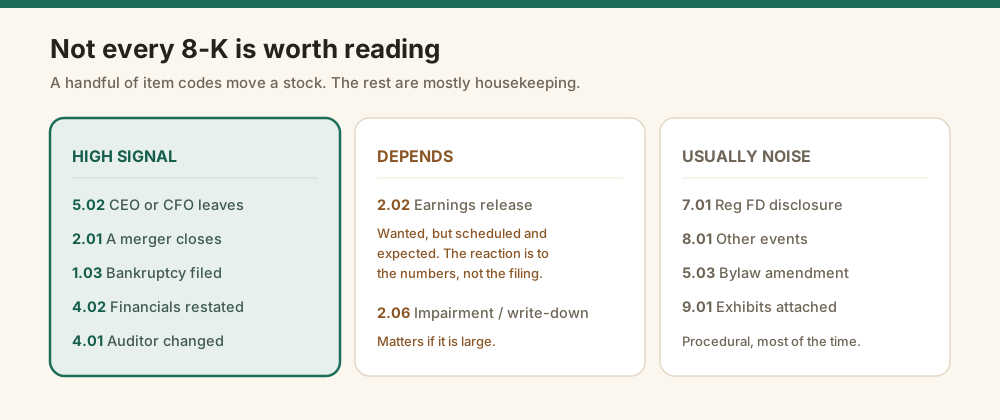
So which ones deserve your attention? Here are the codes I would actually react to, and why.
| Item | What it means | Why it matters |
|---|---|---|
5.02 | A director or officer departs or joins | A sudden CEO or CFO exit is one of the strongest signals an 8-K can carry |
2.01 | An acquisition or sale completed | The deal is done, not just a rumor |
1.01 | A material definitive agreement was signed | A big contract, loan, or partnership the business is now committed to |
1.03 | Bankruptcy or receivership | About as material as news gets |
4.02 | Past financials can no longer be relied on | A restatement, and a serious red flag |
4.01 | The company changed auditors | Worth asking why, especially if it was sudden |
1.05 | A material cybersecurity incident | A breach the company judged serious enough to disclose |
2.02 | Results of operations (earnings) | Wanted, but scheduled. The market reacts to the numbers, not the filing itself |
Notice how different these are in weight. A 5.02 that says the CFO resigned "effective immediately" is a very different morning than a 2.02 earnings release everybody already had on their calendar.
What about the rest? A Regulation FD disclosure (7.01), an "other events" note (8.01), a bylaw tweak (5.03), those are usually procedural. Not worthless, but not the reason you follow a company.
Once you internalize that split, the noise drops away. You quit reading every 8-K and start reading the four or five a year that genuinely mean something.
How fast does an 8-K have to be filed?
Within four business days of the triggering event. That is the general rule, and it is a tight one.
Notice the phrase business days. Weekends and holidays do not count against the clock, and the countdown starts when the event happens, not whenever the company gets around to it.
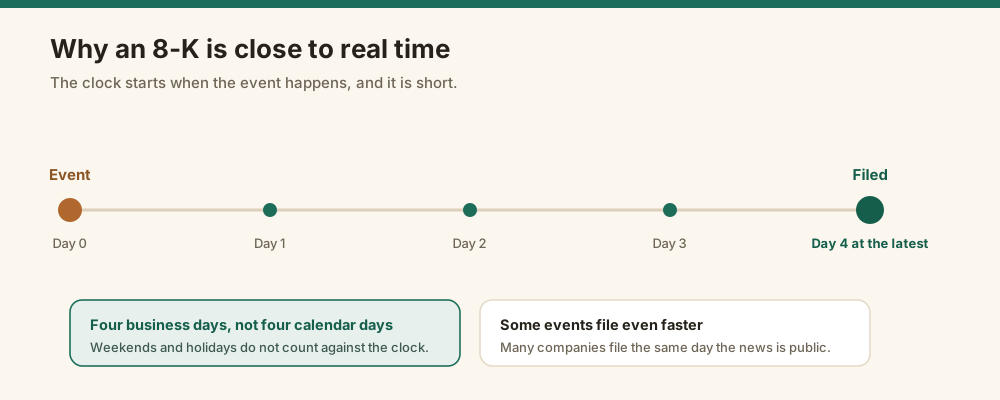
This short window is the entire reason an 8-K is useful. A 10-K shows up months after the year it covers. An 8-K shows up within days of the news.
That speed is why an alert on a company's 8-Ks tells you something is happening right now, not something that happened last quarter. It is the one filing type built for timeliness.
In practice, plenty of companies file the same day the news breaks. They are already putting out a press release, so they attach the 8-K and send both at once. If the exact clocks for every filing type are your thing, I broke them all down in the SEC filing deadlines guide.
How is an 8-K different from a 10-K or a 10-Q?
The cleanest way to think about it is scheduled versus event-driven. A 10-K and a 10-Q both arrive on a fixed calendar. An 8-K arrives whenever something material happens.
They also differ in depth and in whether an auditor touched them. Here is the side-by-side.
| Form 8-K | Form 10-Q | Form 10-K | |
|---|---|---|---|
| Trigger | A material event | The calendar (quarterly) | The calendar (yearly) |
| Timing | Within 4 business days | 40 to 45 days after quarter-end | 60 to 90 days after year-end |
| Audited? | No | No (reviewed) | Yes |
| Scope | One event | A full quarter | A full year |
| Read it for | What just happened | Recent performance | The whole business |
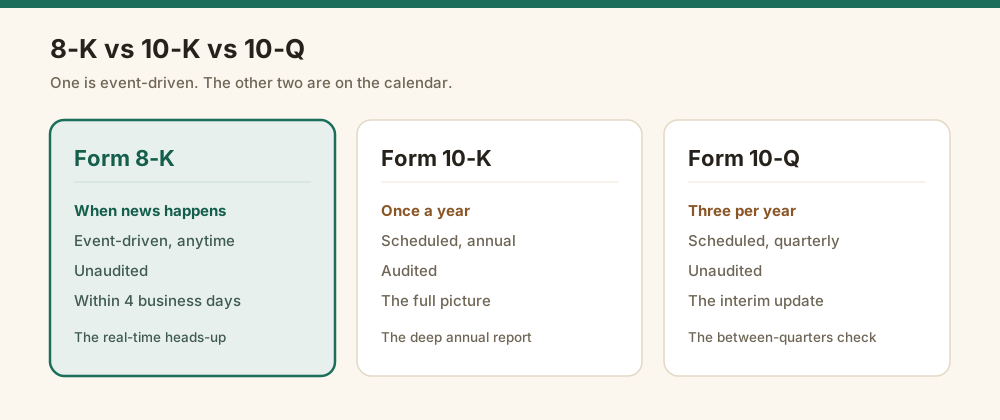
Here is a detail that ties them together. An 8-K often announces something that later shows up in fuller detail in the next quarterly or annual report.
The 8-K tells you a plant closed. The next 10-Q tells you what closing it actually cost. So they are not competitors, they are a relay.
Want the periodic side of that relay? The 10-K explainer walks through the audited annual report the same way this piece walks through the 8-K.
A quick example: reading one in ten seconds
Let me make this concrete. Say you follow a mid-size software company, and an 8-K from them hits EDGAR on a Tuesday morning.
First thing you check is the item number. It says Item 5.02. Right away, before reading anything else, you know this is about a leadership change, not a routine disclosure.
You read the two short paragraphs under it. The CFO has resigned, effective immediately, and no successor is named yet. That word immediately, and the missing successor, is what makes you sit up.
Then you scroll to the exhibits and open the 99.1 press release for the company's framing. Ten seconds in, you already know more than the headline writers will by lunch. That is the whole skill: item number, body, exhibit, done.
How do you use 8-Ks in practice?
Reading every 8-K a company files is a waste of your time. Most of them are routine, and you already know how to spot the ones that are not.
So the smarter move is to flip it around. Instead of reading everything, you watch a company and get pinged when a notable 8-K lands. A 5.02 or a 2.01 on a business you actually care about is exactly the kind of thing worth knowing the day it files.
Where do you find them? Every 8-K is free on SEC EDGAR the moment it posts, so you can always pull one up and read it yourself.
To skip the manual watching, a tool that reads the feed for you and flags the events by item code does the boring part. That is the idea behind Edgrapi. The Superinvestors tracker lets you follow companies and the big investors who hold them, and it can email you when a company you follow files something notable, alongside insider buys and new stakes.
If insider activity is your angle too, the sister explainer on what a Form 4 is reads the exact same way, and the 13F filing guide covers what the big funds are holding. For the full map of every filing type, start with the guide to SEC filings.
So here is where it leaves you. Learn maybe eight item codes, watch the handful of companies you care about, and the SEC's firehose turns into a short, useful feed of things that actually happened.
Track any company's 8-K events free →
Edgrapi surfaces public SEC filings for research. It is not investment advice.
Frequently asked questions
What is a Form 8-K?
A Form 8-K is a 'current report' a public company files with the SEC to announce a material event between its scheduled quarterly and annual reports. A CEO leaving, an acquisition, an earnings release, a bankruptcy: each triggers an 8-K, filed within four business days. It is how the market learns important company news close to when it actually happens.
What events require a Form 8-K?
Dozens of event types do, each with an item code. The common ones are a material agreement (1.01), a completed acquisition (2.01), earnings (2.02), a bankruptcy (1.03), a change of executive or director (5.02), a change of auditor (4.01), and a restatement of past financials (4.02). The filing names which item applies, so the code tells you the kind of event.
How quickly must a Form 8-K be filed?
Within four business days of the triggering event, and the clock counts business days, so weekends and holidays do not count against it. Many companies file the same day the news is public. That short window is what makes an 8-K close to a real-time feed of company news, unlike the quarterly and annual reports.
What are 8-K item numbers?
Every 8-K is tagged with one or more item codes that say what kind of event it reports, grouped into sections. Item 2.02 is an earnings release, 5.02 is an executive or director change, 2.01 is a completed acquisition, 1.03 is bankruptcy, and 4.02 is a restatement. Reading the codes tells you what an 8-K is about before you open it.
What is the difference between an 8-K and a 10-K?
A 10-K is the audited annual report, filed once a year on a schedule, giving the full picture of the business. An 8-K is event-driven: it is filed whenever something material happens, is not audited, and covers just that one event. The 10-K is the deep periodic report; the 8-K is the real-time heads-up between them.
Where can I find a company's 8-K filings?
Every 8-K is public on SEC EDGAR the moment it is filed. You can browse a company's filings there, or use a tool that reads the feed and flags the notable events. Edgrapi's events endpoint returns a company's 8-Ks as clean JSON with the item codes already labeled.