Form 424B2 Prospectus: What It Is and How to Read One
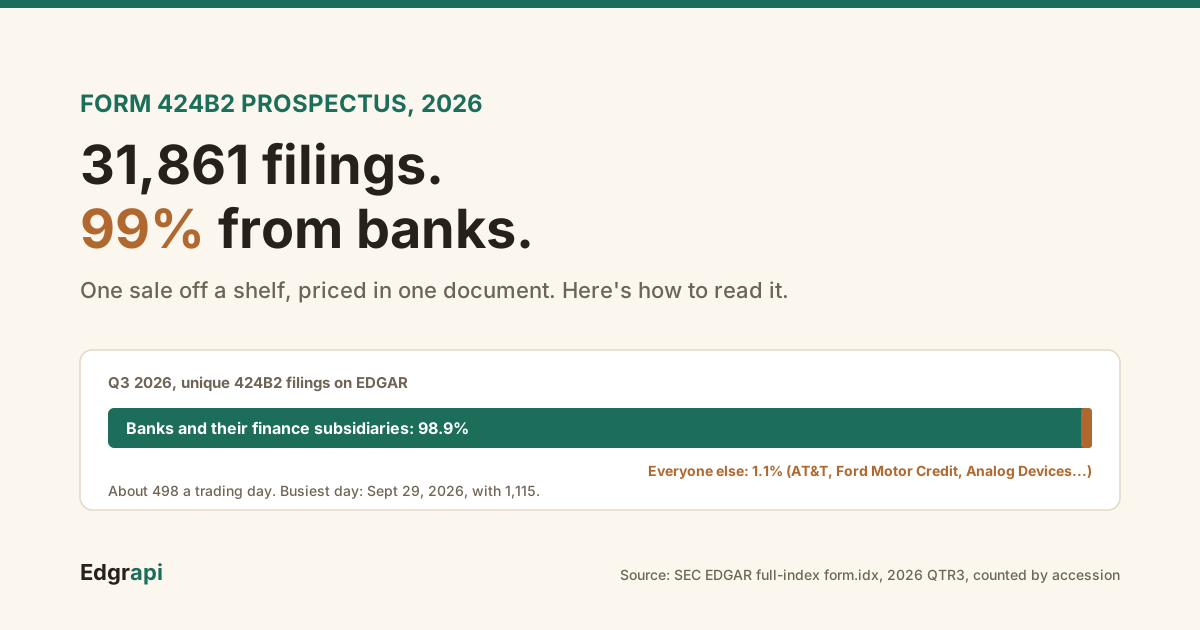
The SEC received 31,861 Form 424B2 filings in the third quarter of 2026. About 99% came from banks.
Start there, because it explains almost everything about a Form 424B2 prospectus. It's the document an issuer files to set the final terms of one sale from a shelf registration, and it's due within two business days of pricing. Most are bank structured notes. When a regular company files one, it's usually selling bonds, and the cover page tells you which.
What is a Form 424B2 prospectus?
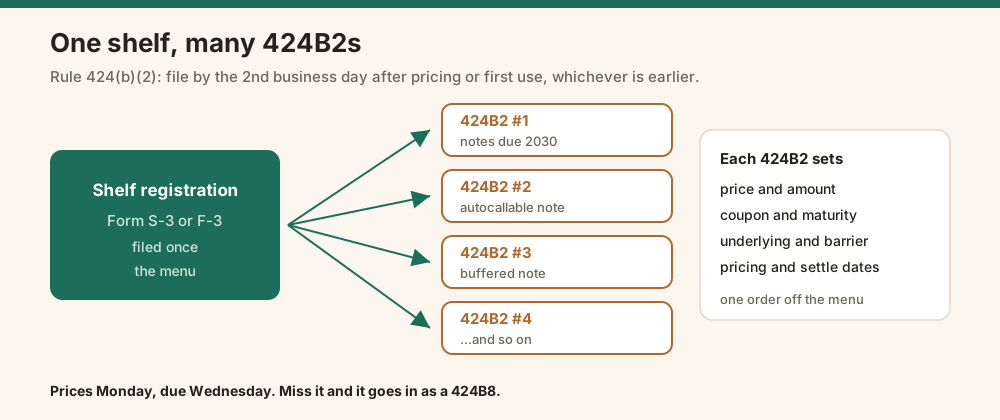
A Form 424B2 prospectus is a prospectus supplement filed under SEC Rule 424(b)(2) for a primary offering made off a shelf registration. The shelf, usually a Form S-3 or F-3, is filed once. Each later sale gets its own 424B2 with the price, amount, and terms. The rule requires it by the second business day after the earlier of pricing or first use.
If the shelf is the menu, the 424B2 is one order off it.
What the issuer may sell over the next few years sits in the shelf registration. What it's selling today sits in the 424B2.
The deadline is in the rule text itself. 17 CFR 230.424 sets "the second business day following the earlier of the date of the determination of the offering price or the date it is first used."
The "B2" just means paragraph (b)(2) of that rule. Other paragraphs produce the 424B3, 424B5, and so on, which I'll get to.
Why do banks file so many 424B2s?
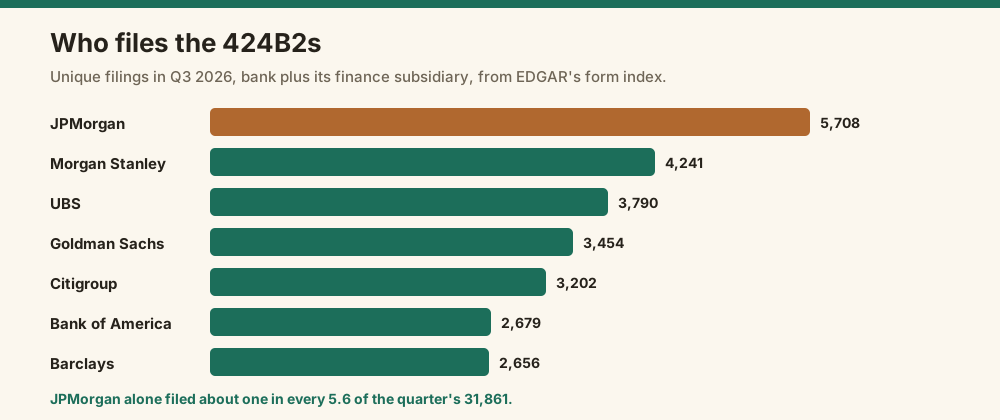
Banks file most 424B2s because each structured note they sell is its own shelf takedown with its own pricing document. In Q3 2026, EDGAR's form index shows 31,861 unique 424B2 filings, about 498 per trading day, and 98.9% came from banks or their finance subsidiaries. JPMorgan alone filed 5,708, roughly one in every 5.6.
I pulled those numbers from the SEC's quarterly full-index file and counted each accession once, since a bank and its finance arm often file together.
The busiest issuers in Q3 2026:
| Bank (incl. finance subsidiary) | 424B2 filings, Q3 2026 |
|---|---|
| JPMorgan | 5,708 |
| Morgan Stanley | 4,241 |
| UBS | 3,790 |
| Goldman Sachs | 3,454 |
| Citigroup | 3,202 |
| Bank of America | 2,679 |
| Barclays | 2,656 |
The busiest single day was September 29, 2026, with 1,115 filings. Even the quietest day had 300.
That volume is the whole structured-notes business showing up in public. Every autocallable, buffered, or index-linked note a wealth advisor sells gets its own filing.
Why one filing per note? Each note has its own underlying, barrier, coupon, call schedule, and pricing date. Change any one of those and it's a new security with a new CUSIP, so it needs its own pricing supplement.
When I checked on October 20, 2026, JPMorgan's three most recent 424B2s had all been filed that same day. For a big issuer, that's routine.
What does a 424B2 mean when a regular company files one?
When a regular company files a 424B2, it's almost always selling bonds off its shelf, not issuing stock. The filing lists the notes, coupons, and maturities. In Q3 2026, only about 1.1% of 424B2s came from non-bank issuers like AT&T, Ford Motor Credit, and Analog Devices. Check the cover page: it names the security in the first lines.
AT&T is a clean example. Its July 27, 2026 424B2 covered 4.1 billion euros and 550 million pounds of notes in five tranches, with coupons between 3.600% (due 2030) and 7.050% (due 2052).
Debt, not dilution. Your shares don't change.
Stock sales off a shelf usually show up under other forms. At-the-market programs and many follow-on share sales use the 424B5 or 424B4 instead.
A corporate 424B2 also reads differently from a bank's. Analog Devices' September 15, 2026 filing follows the standard layout: summary, risk factors, use of proceeds, capitalization, description of the notes, tax, and underwriting.
For a bond buyer, two sections carry the weight. "Description of the notes" has the coupon, maturity, call terms, and covenants. "Use of proceeds" tells you whether the money refinances old debt or funds something new.
Seeing "424B2" on a company's filing list is no reason to panic. Open it and read the first line, which will say "notes," "debentures," or "shares."
How do you read a 424B2 prospectus?
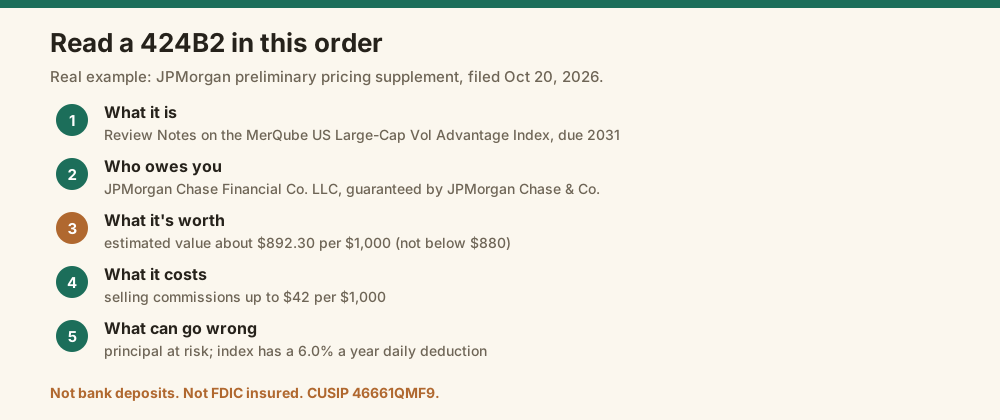
Read a 424B2 prospectus in a fixed order: the security and issuer, the estimated value, the fees, the risk to principal, and the key dates. Those five answers fit on the first two pages of a structured-note pricing supplement. The other 10,000 words back them up and point to three companion documents: the base prospectus, the prospectus supplement, and a product supplement.
Here's that order on a real one, a JPMorgan preliminary pricing supplement filed October 20, 2026 (on EDGAR):
1. What it is. Review Notes linked to the MerQube US Large-Cap Vol Advantage Index, due October 28, 2031. CUSIP 46661QMF9. 2. Who owes you. JPMorgan Chase Financial Company LLC issues the notes, and JPMorgan Chase & Co. guarantees them. You carry the credit risk of both. 3. What it's worth. The estimated value is about $892.30 per $1,000 note, and the filing promises it won't be set below $880. 4. What it costs. Selling commissions can reach $42 per $1,000. 5. What can go wrong. You can lose some or all of your principal, and the index carries a 6.0% per year daily deduction that drags on returns.
The dates sit right under that. This one prices on or about October 23, 2026, settles October 28, and has its first possible call date on October 27, 2027.
Find the phrase "not bank deposits" too. These notes aren't FDIC insured, even though a bank sells them, and plenty of buyers assume otherwise.
What documents does a 424B2 prospectus point to?
A structured-note 424B2 prospectus is the top layer of a four-document stack: the base prospectus from the shelf, a prospectus supplement for the note program, a product supplement for the note type, and sometimes an underlying supplement for the index. The pricing supplement controls when they disagree. Jefferies' pricing supplements say so outright: the pricing supplement "will supersede those documents."
The JPMorgan example points to product supplement no. 3-I and underlying supplement no. 5-I, both dated April 17, 2026.
So the pricing supplement feels thin on mechanics, and that's by design. The payoff math for "Review Notes" as a type lives in the product supplement.
My rule: read the pricing supplement for the numbers, then the product supplement's risk factors for how the type of note can hurt you. The base prospectus rarely changes your decision.
Each of the four is on EDGAR, and the pricing supplement links to every one by date.
What is the estimated value on a 424B2, and why is it below the price?
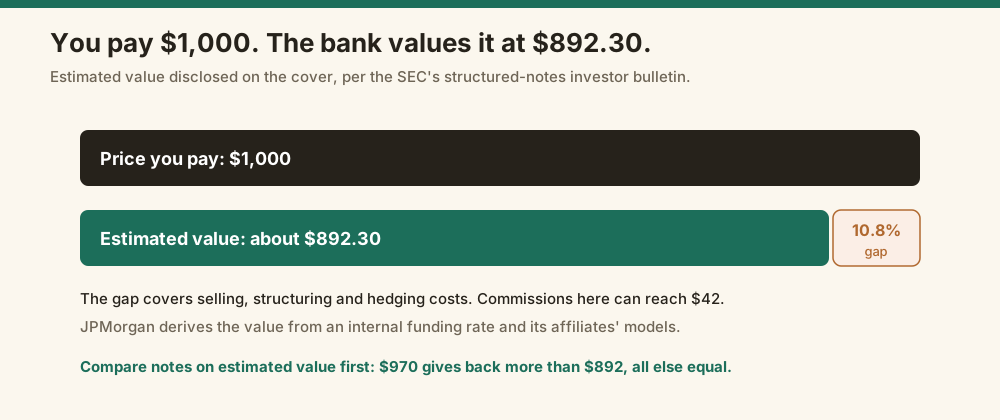
The estimated value is the issuer's own figure for what the note is worth on day one, and it's almost always below the price you pay. The SEC's investor bulletin on structured notes says issuers disclose it on the cover so you can gauge that gap. The difference covers selling, structuring, and hedging costs built into the price.
In the JPMorgan example, $1,000 buys a note the bank values at about $892.30. You're down 10.8% on day one, on paper.
I don't think that makes the note a scam. It's the price of a packaged payoff you can't easily build yourself.
I do wish the number were less homemade, though. JPMorgan says its estimated value comes from an internal funding rate and its affiliates' own pricing models. Useful for comparing notes, but it isn't an independent appraisal.
But it does mean you start behind. And because these notes rarely trade actively, the SEC bulletin tells investors to be ready to hold to maturity or sell at a discount.
The estimated value is the single best number for comparing two notes. A note valued at $970 is giving you more of your money back than one at $892, all else equal.
Watch for one more cost that never shows up as a fee. The JPMorgan note tracks an index with a 6.0% per year daily deduction, which the filing says will "generally be a drag" on performance.
Indexes like that, often called decrement indexes, subtract a fixed rate every day. The deduction makes the options cheaper for the issuer to hedge, and you pay for it in index returns. Six percent a year is a high bar for any index to clear.
How is a 424B2 different from a 424B3, 424B5, and the others?
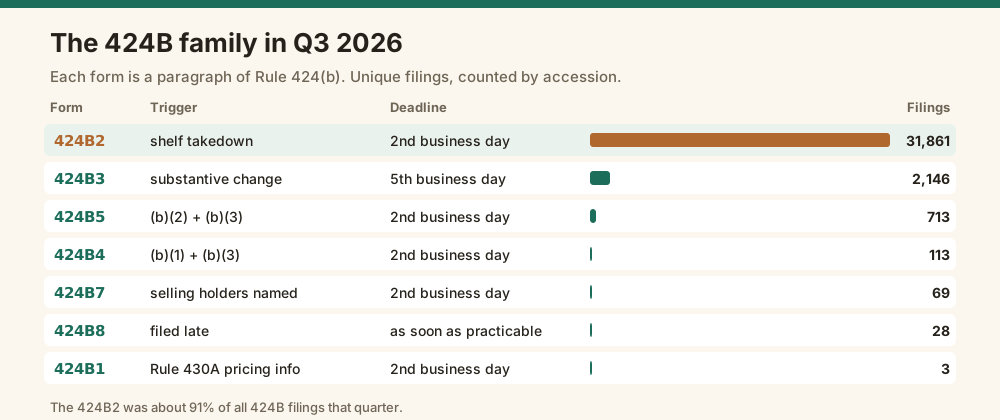
Each 424B form number matches a paragraph of Rule 424(b), and the paragraph says what triggered the filing and how fast it's due. A 424B2 covers shelf takedowns. A 424B3 reflects a substantive change, due within five business days. A 424B5 combines the 424B2 and 424B3 triggers. A 424B4 mixes (b)(1) and (b)(3), and is common for IPO final prospectuses.
Here's the full family with the Q3 2026 filing counts, again counting each accession once:
| Form | What triggers it (Rule 424(b)) | Deadline | Q3 2026 filings |
|---|---|---|---|
| 424B1 | Info omitted under Rule 430A (pricing after effectiveness) | 2nd business day | 3 |
| 424B2 | Shelf takedown on a delayed basis (Rule 415) | 2nd business day | 31,861 |
| 424B3 | Substantive change from the last prospectus | 5th business day | 2,146 |
| 424B4 | Both (b)(1) and (b)(3) | 2nd business day | 113 |
| 424B5 | Both (b)(2) and (b)(3) | 2nd business day | 713 |
| 424B7 | Names selling securityholders omitted earlier | 2nd business day | 69 |
| 424B8 | A prospectus filed late under any paragraph | As soon as practicable | 28 |
Nothing else comes close: the 424B2 made up about 91% of all 424B filings that quarter.
When a 424B8 shows up, give it a glance. It means the issuer missed one of the other deadlines and is filing late.
How fast must a 424B2 prospectus be filed?
A 424B2 prospectus must be filed by the second business day after the earlier of two dates: the day the offering price is set, or the day the prospectus is first used. A note that prices on a Monday is due by Wednesday. If the issuer misses it, the filing goes in as a 424B8 instead, "as soon as practicable" after discovering the miss.
Preliminary versions exist because of that deadline.
The JPMorgan filing above is marked "preliminary pricing supplement" and "subject to completion." Some numbers, like the final estimated value and the exact call premium, get filled in at pricing.
A final pricing supplement follows as a separate 424B2, with the blanks filled in.
If you're tracking a specific note, match on the CUSIP. The preliminary and final versions usually carry the same one.
How do you pull 424B2 filings in bulk?
Pull 424B2 filings in bulk from EDGAR's quarterly full-index file, which lists every filing by form type for free, or through an API that filters by company and form. The index is fine for counting, like the 31,861 above. For a specific issuer's recent 424B2s with document links, an API call is faster than parsing the index.
EDGAR's index files live at sec.gov/Archives/edgar/full-index/. Filter the form.idx lines that start with "424B2," and dedupe by accession.
This is the short script behind the 31,861 count:
import re, urllib.request

url = "https://www.sec.gov/Archives/edgar/full-index/2026/QTR3/form.idx"
req = urllib.request.Request(url, headers={"User-Agent": "Your Name you@example.com"})
lines = urllib.request.urlopen(req).read().decode("latin-1").splitlines()

accessions = {line.strip().split("/")[-1] for line in lines if line.startswith("424B2 ")}
print(len(accessions))   # unique 424B2 filings in the quarter
The SEC blocks requests without a descriptive User-Agent, so put your real name and email in that header.
Keep the .strip(). Index lines carry trailing spaces, and without it the same filing counts more than once. My first run printed 47,695 instead of 31,861 for exactly that reason.
If you'd rather skip the parsing, Edgrapi's filings endpoint filters by form:
import requests

KEY = {"X-API-Key": "edgr_your_key"}
r = requests.get("https://api.edgrapi.com/v1/filings/JPM",
                 headers=KEY, params={"form": "424B2", "limit": 5})
for f in r.json()["filings"]:
    print(f["filed"], f["accession"], f["url"])
To pull the document itself, pass the accession to the download endpoint with the company's CIK:
doc = requests.get("https://api.edgrapi.com/v1/download", headers=KEY,
                   params={"accession": "0001918704-26-031900", "cik": "19617"})
print("estimated value" in doc.text)
The cik matters here. Banks often file 424B2s through an agent, so the first block of the accession number belongs to the agent, not the bank.
Once the filings are in code, three projects are worth building. The first is a watcher that alerts when a new note links to an index or stock you care about.
The second is a table of estimated values by issuer, so you can see which banks leave the biggest gap between price and value.
The third is plain compliance work: archiving every pricing supplement a firm sold to clients, matched by CUSIP.
The SEC filings API guide covers the other filters, and full-text search finds 424B2s by phrase, like "MerQube" or "autocallable."
Read the estimated value before the coupon
A Form 424B2 prospectus is one sale off a shelf, and for 99% of them it's a bank structured note. Read it in order: what it is, who owes you, the estimated value, the fees, then the risk to principal. The estimated value tells you how far behind you start. Open the next 424B2 your advisor sends and find that number first.
Frequently asked questions
What is a 424B2 filing?
A 424B2 is a prospectus supplement filed with the SEC under Rule 424(b)(2) when an issuer sells securities off a shelf registration. It sets the final terms of that one sale: the security, price, amount, and dates. It's due within two business days of pricing. In Q3 2026, there were 31,861 of them, and about 99% came from banks issuing structured notes.
Does a 424B2 mean a company is selling more stock?
Usually not. For banks, a 424B2 almost always covers structured notes. For other companies, it usually covers bonds, like AT&T's 4.1 billion euros of notes filed July 27, 2026. Share sales off a shelf more often use a 424B5 or 424B4. Read the cover page: the first lines name the security being sold.
What is the difference between a 424B2 and a 424B5?
A 424B2 covers a shelf takedown under Rule 424(b)(2). A 424B5 covers a filing that triggers both (b)(2) and (b)(3), meaning a takedown that also reflects a substantive change from the last prospectus. Both are due by the second business day. In Q3 2026, the SEC received 31,861 424B2s and 713 424B5s.
What is the estimated value in a structured note pricing supplement?
It's the issuer's own estimate of what the note is worth when it's issued. It usually sits below the price, because the price includes selling, structuring, and hedging costs. In a JPMorgan pricing supplement filed October 20, 2026, a $1,000 note had an estimated value of about $892.30. The SEC says issuers disclose it so investors can see that gap.
Are structured notes in a 424B2 FDIC insured?
No. Structured notes described in a 424B2 are not bank deposits and are not insured by the FDIC, even when a bank issues them. Your repayment depends on the issuer's credit and, where there is one, the guarantor's. Many notes also put some or all of your principal at risk if the linked index or stock falls.
How do I find a company's 424B2 filings?
Search the company on SEC EDGAR and filter the filing list to form type 424B2, or use an API that filters by ticker and form. Edgrapi's /v1/filings/{ticker}?form=424B2 returns each filing's date, accession number, and document link. For every 424B2 in a quarter, EDGAR's free full-index form file lists them all.