Lockheed Martin Government Contracts: Look Up Any Company
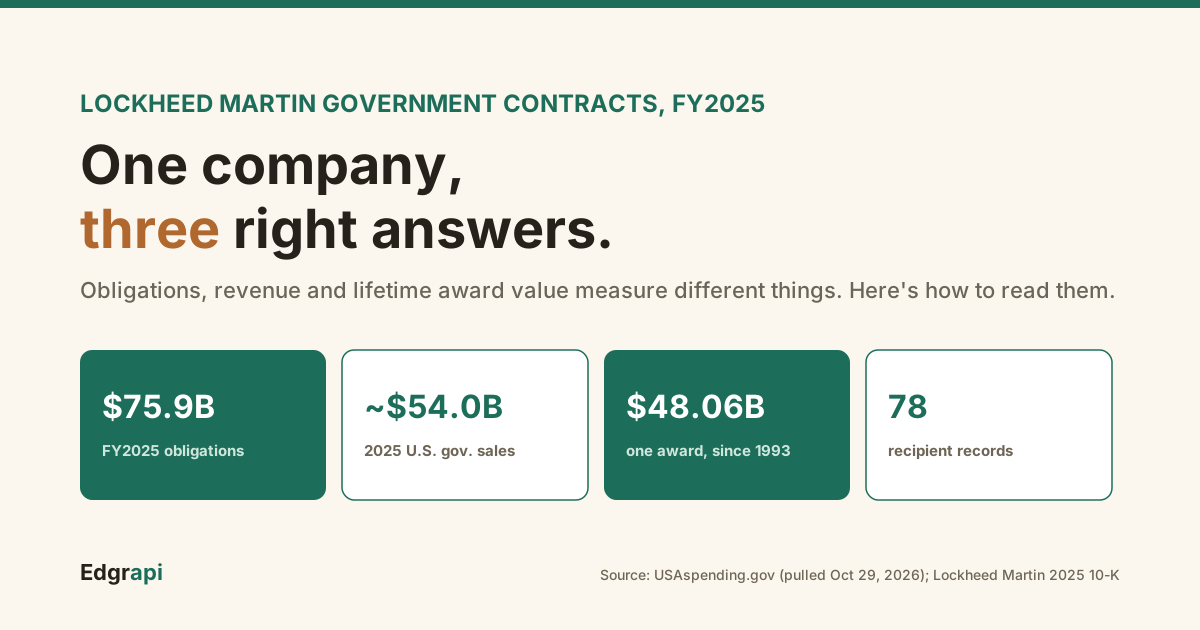
Lockheed Martin's federal contract obligations in fiscal 2025 came to $75.9 billion. Its own 10-K puts its U.S. government sales closer to $54 billion.
Both numbers are right. Lockheed Martin government contracts totaled $75.9 billion in fiscal 2025 by USAspending's count of obligations, the money agencies committed that year. Its 10-K reports revenue, what it earned as it did the work. I pulled the official data for Lockheed, Palantir and SpaceX, and below is how to look up any company yourself.
How much does Lockheed Martin get in government contracts?
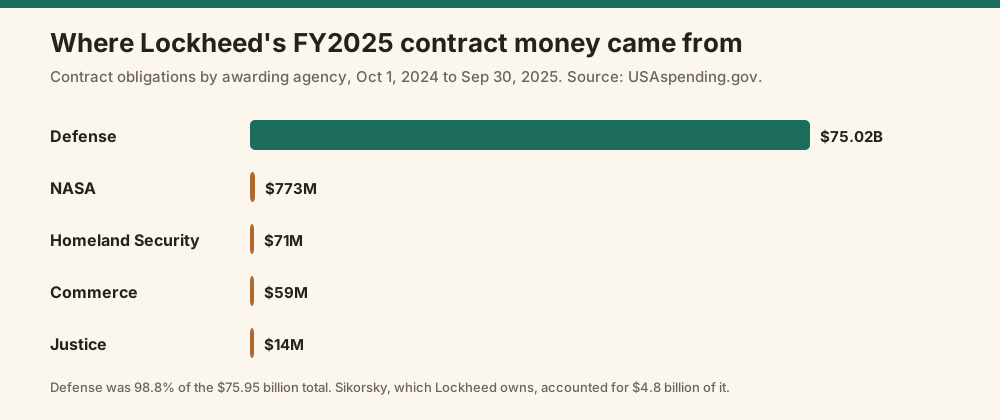
Lockheed Martin received $75.9 billion in federal contract obligations in fiscal year 2025, which ran from October 1, 2024 to September 30, 2025. That total comes from USAspending.gov and spans 78 recipient entities, including Sikorsky Aircraft. The Defense Department accounted for $75.0 billion of it, NASA for $773 million, with smaller amounts from Homeland Security, Commerce and Justice.
Those 78 entities are the first trap. USAspending lists Lockheed under dozens of legal names and two separate "Lockheed Martin Corporation" records.
The biggest single record took $34.1 billion. The second took $10.4 billion. Look up only one and you'll miss more than half.
Here's fiscal 2025 by awarding agency:
| Agency | Lockheed Martin obligations, FY2025 |
|---|---|
| Department of Defense | $75.02 billion |
| NASA | $773 million |
| Homeland Security | $71 million |
| Commerce | $59 million |
| Justice | $14 million |
Sikorsky alone, which Lockheed owns, took $4.8 billion.
Why do Lockheed Martin's contract numbers disagree?
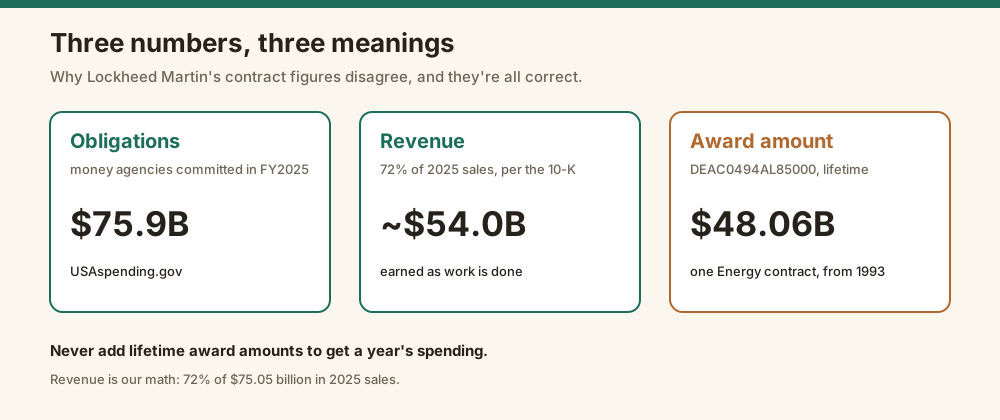
Lockheed Martin's contract figures disagree because people quote three different measures. Obligations are what agencies committed in a year: $75.9 billion in fiscal 2025. Revenue is what Lockheed earned from the government: its 10-K says 72% of its 2025 sales, about $54 billion. Award amounts are lifetime totals, so one contract can show $48 billion.
The 10-K wording is specific. Lockheed "derived 72% of our total consolidated sales from the U.S. Government in 2025, including 63% from the Department of War." Its 2025 revenue was $75.05 billion, so 72% is about $54.0 billion by my math.
Obligations run ahead of revenue because agencies commit money before the work is done. A multiyear contract can be funded in one year and earned over several.
Then there's the award amount, the number most lookups show first. Search Lockheed's fiscal 2025 awards by size and the top result is a Department of Energy contract, DEAC0494AL85000, at $48.06 billion. It started in 1993.
That's not 2025 money. It's the contract's lifetime value, listed because it had activity in the year.
The next two are Defense contracts: N0001917C0001, a Navy award described as "LRIP LOT 12 ADVANCE ACQUISITION CONTRACT," at $35.14 billion, and N0001902C3002 at $34.17 billion.
How much does Palantir get in government contracts?
Palantir received $1.02 billion in federal contract obligations in fiscal 2025, across two entities: Palantir USG Inc. with $745 million and Palantir Technologies Inc. with $276 million. The Defense Department was the biggest customer at $716 million, followed by Homeland Security, Treasury, State and HHS. Fiscal 2026 obligations reached $1.99 billion, though that year's data isn't complete yet.
Palantir's own reporting is on a different basis again. Its second-quarter 2026 earnings release says "U.S. government revenue grew 90% year-over-year and 18% quarter-over-quarter to $809 million."
That's one quarter of revenue, not a year of obligations. Don't add it to the USAspending figure.
Palantir's largest awards with fiscal 2025 activity, by lifetime amount:
- W911QX24F0053, Defense, $293 million: "Task order #1 for Maven Smart System"
- 70CTD022FR0000170, Homeland Security, $171 million: investigative case management
- FA880623C0002, Defense, $130 million: a letter contract for commercial data as a service
How much does SpaceX get in government contracts?
SpaceX received $3.01 billion in federal contract obligations in fiscal 2025. The Defense Department committed $1.65 billion and NASA $1.35 billion, with small amounts from other agencies. Fiscal 2026 obligations reached $2.96 billion so far, but Defense data for the latest months isn't published yet, so that number will rise.
Bigger headline numbers for SpaceX are usually cumulative contract values added up over many years. They aren't one year's obligations.
SpaceX's largest awards with fiscal 2025 activity, by lifetime amount:
- NNK17MA01T, NASA, $3.55 billion: the Commercial Crew Program
- 80MSFC20C0034, NASA, $3.23 billion
- FA881125FB001, Defense, $538 million: National Security Space Launch Phase 3 Lane 1
That NASA crew contract alone is bigger than SpaceX's entire fiscal 2025 obligations, which tells you the two measures can't be swapped.
How do Lockheed, Palantir and SpaceX compare?
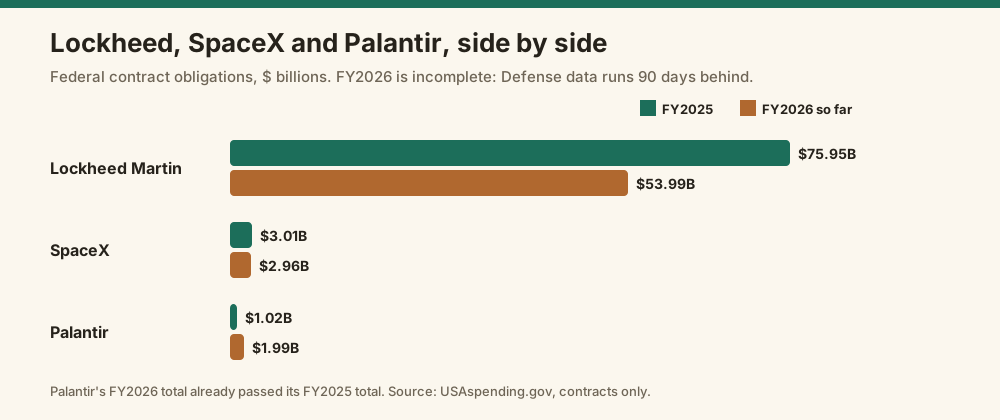
Lockheed Martin received about 25 times SpaceX's federal contract obligations in fiscal 2025 and about 74 times Palantir's. The mix differs too. Defense made up nearly 99% of Lockheed's total, about 70% of Palantir's and about 55% of SpaceX's, where NASA supplied most of the rest. Palantir's fiscal 2026 obligations nearly doubled, even before Defense data was complete.
| Company | FY2025 obligations | Defense share | FY2026 so far |
|---|---|---|---|
| Lockheed Martin | $75.95 billion | 98.8% | $53.99 billion |
| SpaceX | $3.01 billion | 54.9% | $2.96 billion |
| Palantir | $1.02 billion | 70.1% | $1.99 billion |
The fiscal 2026 column needs care. All three are Defense contractors, so the latest months are still missing from all three.
Even so, Palantir's number already passed its full 2025 total. Lockheed's sits about $22 billion short of its 2025 figure, and that gap should narrow as the delayed Defense data arrives.
Scale changes how you search, too. Lockheed shows up under dozens of records and Palantir under two, so the bigger the contractor, the more a one-name search misses.
Who are the largest government contractors?
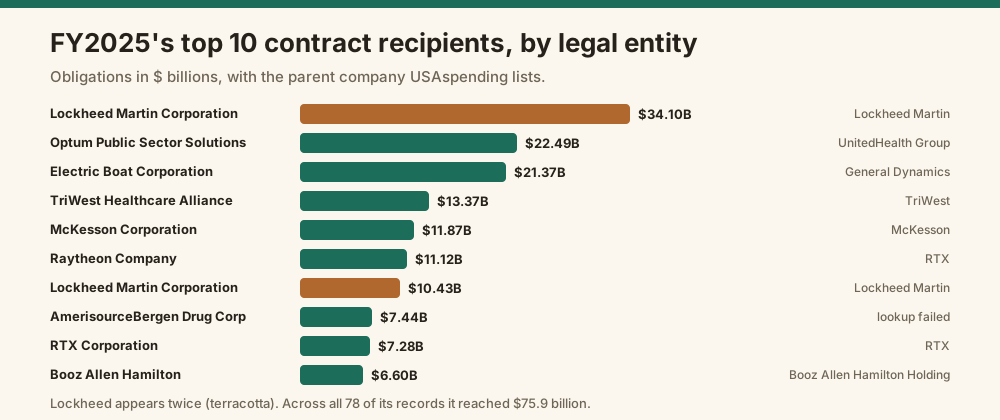
The largest federal contract recipient in fiscal 2025 was Lockheed Martin Corporation, with $34.1 billion on its biggest single record, according to USAspending.gov. Next came Optum Public Sector Solutions at $22.5 billion and Electric Boat at $21.4 billion. But rankings by legal entity scatter big companies: Lockheed appears twice in the top ten, and Raytheon and RTX appear separately.
Here's fiscal 2025's top ten by recipient, with the parent company USAspending lists for each:
| Rank | Recipient | FY2025 obligations | Parent company |
|---|---|---|---|
| 1 | Lockheed Martin Corporation | $34.10B | Lockheed Martin |
| 2 | Optum Public Sector Solutions | $22.49B | UnitedHealth Group |
| 3 | Electric Boat Corporation | $21.37B | General Dynamics |
| 4 | TriWest Healthcare Alliance | $13.37B | TriWest |
| 5 | McKesson Corporation | $11.87B | McKesson |
| 6 | Raytheon Company | $11.12B | RTX |
| 7 | Lockheed Martin Corporation | $10.43B | Lockheed Martin |
| 8 | AmerisourceBergen Drug Corp | $7.44B | Lookup failed |
| 9 | RTX Corporation | $7.28B | RTX |
| 10 | Booz Allen Hamilton | $6.60B | Booz Allen Hamilton Holding |
Roll the records up and the order changes. Counted across all 78 of its entities, Lockheed alone reached $75.9 billion.
USAspending also has a parent-level list, but it covers the trailing 12 months, not a fiscal year, so it won't match the table above. And its parents don't always add up: General Dynamics showed $12.2 billion as a parent while its Electric Boat subsidiary showed $12.9 billion on its own.
So check any "top contractors" list, mine included, for two things: how it counts subsidiaries and which year it covers.
How do you look up any company's government contracts?
To look up a company's government contracts, search its name on USAspending.gov, open each matching recipient profile, and filter to contracts for a fiscal year. Check for subsidiaries and alternate legal names, because big companies are split across many records. If you know the company's UEI, its unique entity ID from SAM.gov, search by that instead of the name. A UEI covers one registered entity, unlike CAGE codes, which are assigned per site.
The steps that hold up:
- Search the company name on USAspending.gov and note every recipient that matches, including the ones further down.
- Open each recipient profile and check its parent. Electric Boat's parent is General Dynamics, for example.
- Filter to contracts and set the fiscal year. Federal fiscal years start October 1.
- Read the totals as obligations, not revenue.
The same data is free through the USAspending API, with no key. That's what I used for every number here.
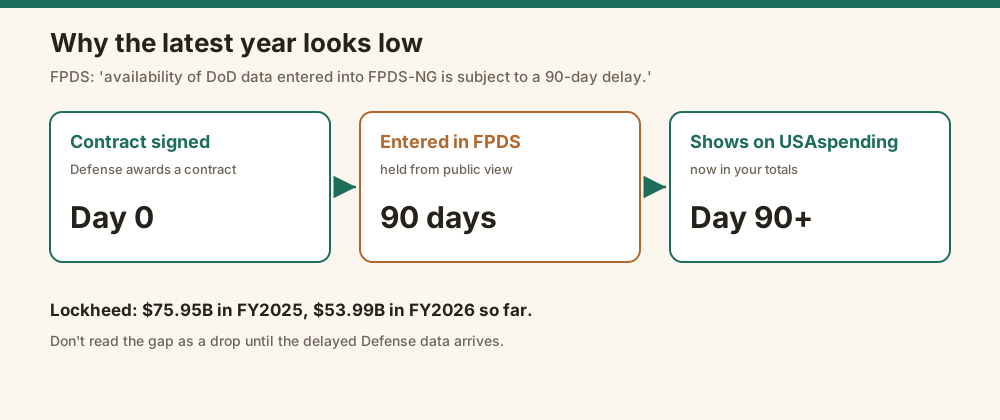
One caution on recent data. The Federal Procurement Data System says plainly that "availability of DoD data entered into FPDS-NG is subject to a 90-day delay." Defense-heavy companies look smaller in the latest quarter until it catches up.
That's why Lockheed's fiscal 2026 total, $54.0 billion so far, sits well below 2025. Don't read it as a drop yet.
How do you pull a company's contracts with code?
Pull a company's yearly contract total from USAspending's free API by searching recipients by name, filtering to contract award types, and adding up every page of results. For a list of the individual awards behind it, query an awards endpoint by recipient. I ran both on October 29, 2026; the totals matched the figures above.
This returns fiscal-year totals:
import requests

URL = "https://api.usaspending.gov/api/v2/search/spending_by_category/recipient/"

def fiscal_year_contracts(company, start, end):
    """Total contract obligations for every recipient whose name matches `company`."""
    total, page = 0, 1
    while True:
        body = {"filters": {"recipient_search_text": [company],
                            "award_type_codes": ["A", "B", "C", "D"],      # contracts only
                            "time_period": [{"start_date": start, "end_date": end}]},
                "limit": 100, "page": page}
        data = requests.post(URL, json=body, timeout=60).json()
        total += sum(r["amount"] for r in data["results"])
        if not data["page_metadata"]["hasNext"]:
            return total
        page += 1

for co in ["Lockheed Martin", "Palantir", "Space Exploration Technologies"]:
    print(co, round(fiscal_year_contracts(co, "2024-10-01", "2025-09-30") / 1e9, 3), "billion")
It printed 75.946, 1.021 and 3.01 billion.
For the awards themselves, Edgrapi's /v1/awards takes a recipient name and returns them as JSON, 2 credits a call:
import requests

r = requests.get("https://api.edgrapi.com/v1/awards",
                 headers={"X-API-Key": "YOUR_KEY"},
                 params={"recipient": "Palantir", "category": "contracts", "start": "2024-10-01",
                         "end": "2025-09-30", "sort": "amount", "limit": 5}, timeout=90)
for a in r.json()["awards"]:
    print(a["award_id"], a["awarding_agency"], round(a["amount"]), a["start_date"])
It returned the same five award IDs USAspending's own search does. Notice the start dates from 2022 and 2023, though. The amount is each award's lifetime total, so add these up and you won't get a fiscal-year figure. Use the first script for that.
I wrote more on the API itself in the USAspending API guide, including its 10,000-record limit.
What mistakes make contract totals wrong?
Most wrong contract totals come from five mistakes: searching one legal name when a company has dozens, adding lifetime award amounts as if they were yearly spending, mixing fiscal and calendar years, comparing obligations with company revenue, and trusting the latest quarter before Defense data catches up. Each one can move a number by billions.
How each one shows up:
- One name: a single Lockheed record shows $34.1 billion, against $75.9 billion across all 78
- Lifetime amounts: one 1993 Energy contract shows $48.06 billion
- Fiscal vs calendar: fiscal 2025 ended September 30, 2025, while company reports use calendar years
- Obligations vs revenue: $75.9 billion obligated against about $54 billion of government sales
- The Defense delay: fiscal 2026 looks low until the 90-day lag passes
Grants are another trap. Filter to contracts, or a university or state can outrank every defense company.
Pull the fiscal year, then name the measure
Run the totals script for the company you care about, then say which number you're quoting: obligations, lifetime award value, or revenue. Most of the bad totals I found came from skipping that step. For award-level detail in your own tools, get a free Edgrapi key and query /v1/awards by recipient.
Frequently asked questions
How much does Lockheed Martin make from government contracts?
Lockheed Martin received $75.9 billion in federal contract obligations in fiscal 2025, according to USAspending.gov. Its 10-K says 72% of its 2025 sales, about $54 billion of $75.05 billion, came from the U.S. government. Obligations count money committed; revenue counts work delivered, so the two differ.
What is Lockheed Martin's largest government contract?
By lifetime value, the largest Lockheed Martin award with fiscal 2025 activity is a Department of Energy contract, DEAC0494AL85000, at $48.06 billion, which began in 1993. Among Defense contracts, N0001917C0001, a Navy award described as "LRIP Lot 12," shows $35.14 billion. These are lifetime totals, not one year's spending.
How much does Palantir get from the government?
Palantir received $1.02 billion in federal contract obligations in fiscal 2025, about $716 million of it from the Defense Department. Fiscal 2026 obligations reached $1.99 billion before Defense data was complete. Separately, Palantir reported $809 million of U.S. government revenue for the second quarter of 2026 alone.
How much money does SpaceX get from the government?
SpaceX received $3.01 billion in federal contract obligations in fiscal 2025: $1.65 billion from the Defense Department and $1.35 billion from NASA. Bigger figures in the news are usually cumulative contract values across many years, not a single year of obligations.
Who is the largest government contractor?
Lockheed Martin is the largest federal contractor by fiscal 2025 obligations, at $75.9 billion across its 78 recipient records on USAspending.gov. The next companies I checked, Boeing, Raytheon and UnitedHealth's Optum, were each near $24 to $25 billion. By single legal entity, its main record led at $34.1 billion, ahead of Optum Public Sector Solutions and Electric Boat. Rankings shift depending on how subsidiaries are counted.
How do I find what government contracts a company has?
Search the company on USAspending.gov, open each matching recipient profile, check the parent company, and filter to contracts for a fiscal year. For bulk or repeat lookups, the free USAspending API returns the same data, and award-level APIs return each contract with its ID, agency and amount.