Quiver Quantitative API: Pricing, Limits and Alternatives (2026)
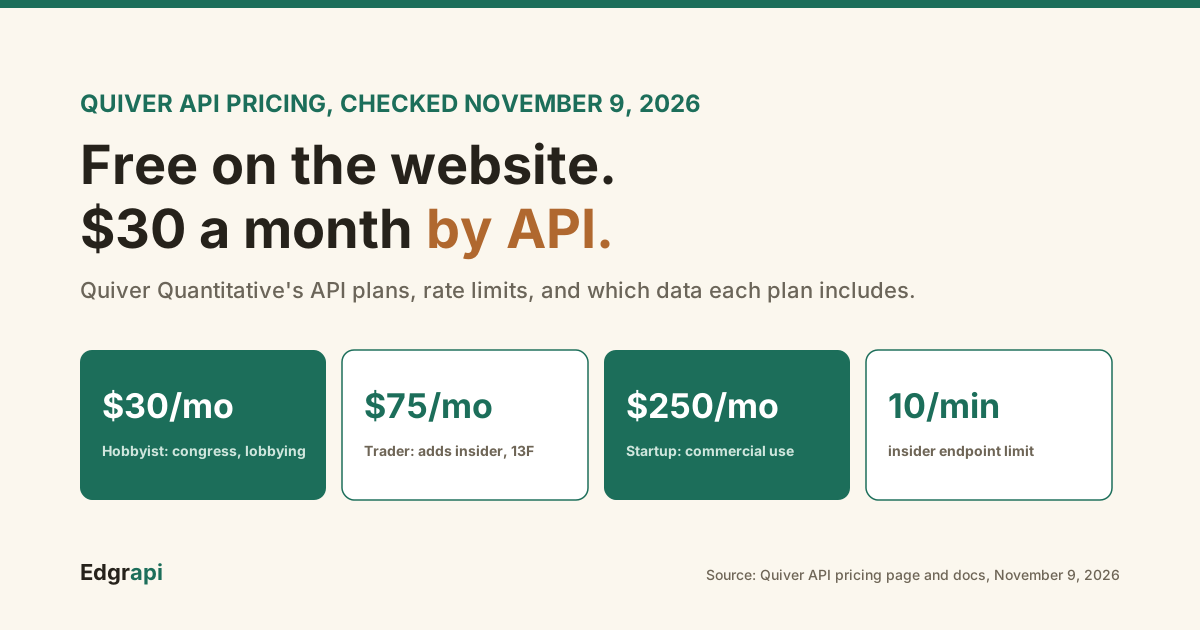
Quiver's congress trading data is free on its website. The same data through its API costs $30 a month.
The Quiver Quantitative API has no free tier. I checked its pricing page on November 9, 2026: Hobbyist costs $30 a month, or $300 a year, and covers congress trades, lobbying and government contracts. Trader costs $75 a month, or $750 a year, and adds insider trades and 13F holdings. Both are personal use only. Commercial use starts at $250 a month on the Startup plan.
What is the Quiver Quantitative API?
The Quiver Quantitative API is a paid REST API for alternative stock market data, mapped to US stock tickers. It covers congressional trades, insider trades from SEC Form 4, hedge fund 13F holdings, corporate lobbying, government contracts, PAC donations, off-exchange trading, patents and layoff notices. History depends on the dataset: congressional trades go back to 2014, corporate lobbying to 1999 and insider trades to 2021, according to Quiver.
It's a separate product from the Quiver website. The site at quiverquant.com shows the data in your browser. The API at api.quiverquant.com sends it to your code as JSON.
Every plan also includes Quiver's MCP server, which lets Claude, ChatGPT or Cursor query the same data. Hobbyist gets 10 of its 18 tools, and Trader gets all 18.
The congress feed is the one most people come for. Quiver's quickstart says its live endpoint returns the most recent trades, "up to 500 from the House and 500 from the Senate."
How much does the Quiver Quantitative API cost?
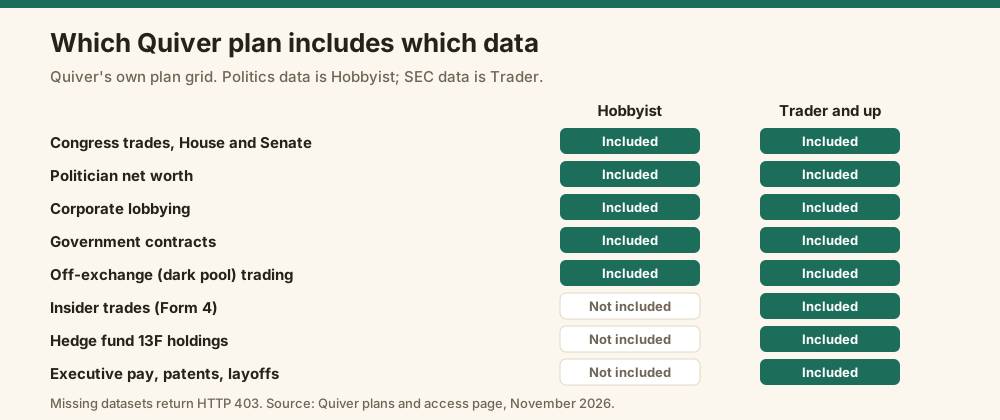
The Quiver Quantitative API costs $30 a month for Hobbyist, $75 for Trader and $250 for Startup, according to Quiver's API pricing page on November 9, 2026. Paying yearly cuts that to $300, $750 and $2,500 a year, which works out to $25, $62.50 and about $208 a month. New Startup subscriptions get 50% off their first year. Enterprise pricing isn't public.
Every plan, side by side:
| Plan | Billed monthly | Billed yearly | Use | Adds |
|---|---|---|---|---|
| Hobbyist | $30/mo | $300/yr | Personal only | Congress, lobbying, contracts, donors, dark pool, prices |
| Trader | $75/mo | $750/yr | Personal only | Insider trades, 13F, top shareholders, patents, pay |
| Startup | $250/mo | $2,500/yr | Commercial, under $1M revenue | All datasets, commercial rights |
| Enterprise | Contact Quiver | Contact Quiver | Commercial, over $1M revenue | All datasets, commercial rights |
Yearly billing saves $60 on Hobbyist and $150 on Trader. The pricing page spells it out: Trader's "full annual price is $750 a year against $900 with monthly payments."
The Startup discount is real money. With 50% off, the first year costs $1,250 billed yearly, or $125 a month billed monthly.
Old prices still float around. The quiverquant package page on PyPI still says "The pricing starts at $10/month." That's not what Quiver's API pricing page shows today, so check the date on anything you read.
Is Quiver Quantitative free?
Quiver's website is free to browse, but its API isn't. A free Visitor account shows live congress trades, insider trades, government contracts and lobbying on quiverquant.com. The API has no free tier: Quiver's docs say a key "only returns data once you have an active plan." When I called the API on November 9, 2026 with no key, and again with a made-up key, both returned HTTP 401.
The website and the API are priced separately.
The website's Premium plan costs $30 a month, or $25 a month billed yearly at $300, according to quiverquant.com. It comes with a free trial: 7 days on monthly, 30 days on yearly.
Premium adds backtesters, a stock screener, politician portfolios and alerts on the website. Programmatic access is sold through the API plans at api.quiverquant.com.
The API has no trial at all. You pick a plan, check out, and then copy your key from the dashboard.
Which Quiver plan includes insider trades and 13F data?
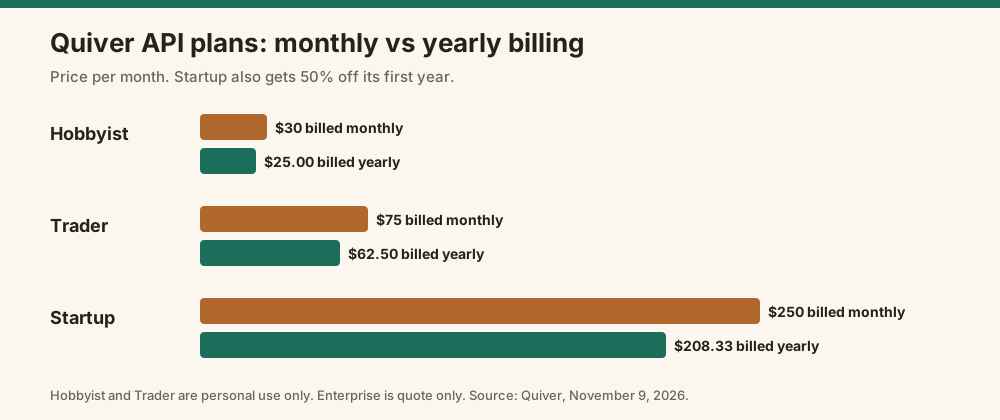
Insider trades and 13F holdings need Quiver's Trader plan, at $75 a month or $750 a year. The cheaper Hobbyist plan covers congressional, political and government data only: congress trades, congress stock holdings, politician net worth, lobbying, PAC donations, government contracts, off-exchange trading and daily prices. If your plan lacks a dataset, the API returns HTTP 403 with "Upgrade your subscription plan to access this dataset."
Quiver's own grid, from its plans and access page:
| Dataset | Hobbyist | Trader and above |
|---|---|---|
| Congress trades, House and Senate | Yes | Yes |
| Politician net worth | Yes | Yes |
| Corporate lobbying | Yes | Yes |
| Government contracts | Yes | Yes |
| Corporate PAC donors | Yes | Yes |
| Off-exchange (dark pool) trading | Yes | Yes |
| Insider trades (Form 4) | No | Yes |
| Hedge fund 13F holdings | No | Yes |
| Executive compensation | No | Yes |
| Patents and layoff notices | No | Yes |
So the split is simple. Politics data is $30. SEC data is $75.
One detail worth knowing: Quiver's insider history starts in 2021. The SEC's own EDGAR database has had electronic Forms 3, 4 and 5 since June 30, 2003.
What are the Quiver API rate limits?
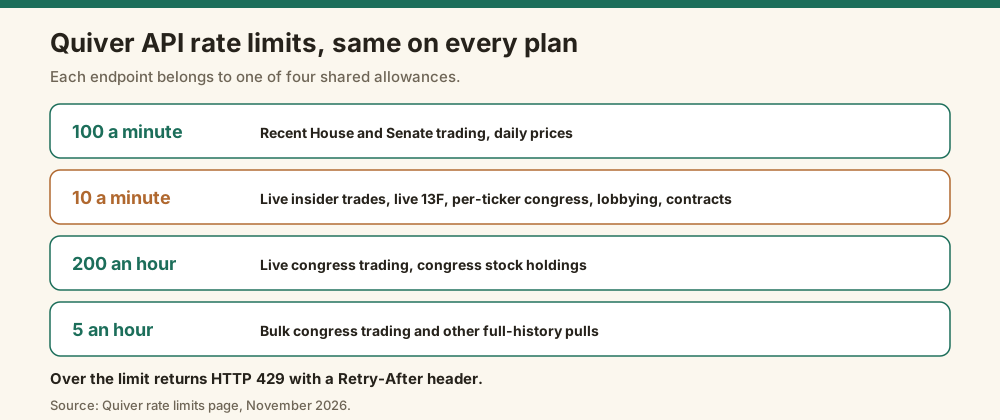
Quiver's API rate limits are set per endpoint, not per plan. Each endpoint allows 100 requests a minute, 10 a minute, 200 an hour or 5 an hour, and Quiver says the limits "are the same on every plan." Endpoints in the same group share one allowance, so heavy use of one slows the rest. Going over returns HTTP 429 with a Retry-After header telling you how long to wait.
Where the main datasets land, from Quiver's rate limits page:
| Endpoint | Limit |
|---|---|
| Recent House trading, recent Senate trading | 100 a minute |
| Live insider trading | 10 a minute |
| Live 13F holdings | 10 a minute |
| Congress trades for one ticker | 10 a minute |
| Live lobbying, recent government contracts | 10 a minute |
| Live congress trading | 200 an hour |
| Bulk congress trading, full history | 5 an hour |
The per-ticker limit is the one that bites. Looping a list of 500 tickers through the congress endpoint at 10 a minute takes close to an hour.
Quiver's advice is to avoid that loop: pull a live or bulk endpoint once and filter it yourself.
Paying more doesn't raise the ceiling either. "Priority Support & Higher Rate Limits" only appears in the commercial column of Quiver's pricing grid.
How much does Quiver cost per year for common projects?
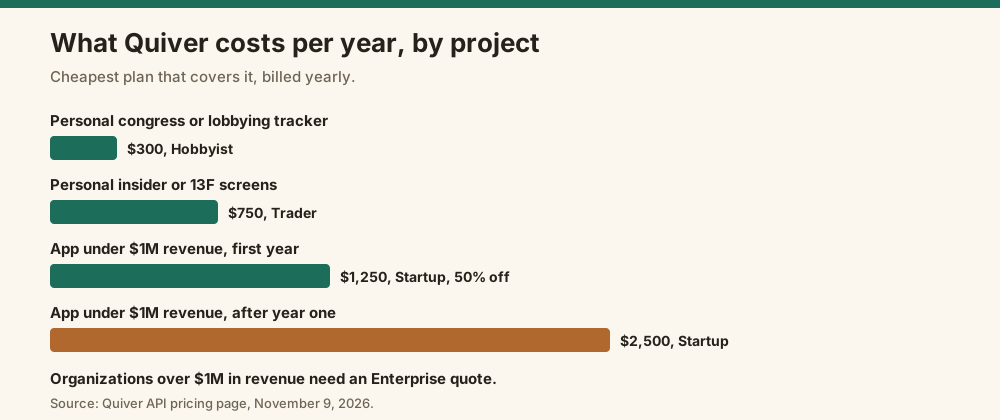
What Quiver costs per year depends on the data and on who sees it. A personal congress-trading tracker costs $300 a year on Hobbyist, billed yearly. Personal insider or 13F research costs $750 a year on Trader. A product for paying customers costs $1,250 in its first year on Startup, with the 50% discount, then $2,500 a year after that, as long as revenue stays under $1 million.
Here's the cheapest Quiver plan for each kind of project, billed yearly:
| Project | Cheapest Quiver plan | Cost per year |
|---|---|---|
| Personal congress trade tracker | Hobbyist | $300 |
| Personal lobbying or contracts research | Hobbyist | $300 |
| Personal insider or 13F screens | Trader | $750 |
| App or newsletter, under $1M revenue | Startup | $1,250 first year, then $2,500 |
| Company over $1M revenue | Enterprise | Quote only |
Monthly billing costs more over a year: $360 for Hobbyist and $900 for Trader.
My take: pay monthly for one month first. The API has no trial, so that month is your test of the rate limits on the endpoints you'll actually use.
The jump from personal to commercial is the big one. Going from Trader to Startup more than triples the yearly price, from $750 to $2,500, once the first-year discount ends.
Can you use Quiver data commercially?
Only on the Startup or Enterprise plan. Quiver's docs say Hobbyist and Trader "are for personal, non-commercial use." Startup costs $250 a month, or $2,500 a year, with 50% off the first year, and it's only for companies with under $1 million in annual revenue. Above that, you need Enterprise, which has no public price. Both include every Hobbyist and Trader dataset.
This matters if you're building an app, a newsletter or a client tool on Quiver data.
A $75 Trader key in a product that customers pay for isn't covered. The jump to Startup is $175 a month at list price.
The $1 million line is the other trap. Cross it and the Startup plan no longer fits, whatever your API usage.
How do you call the Quiver API?
You call the Quiver API by sending your key in an Authorization header as a Bearer token, to endpoints under api.quiverquant.com/beta/. The key sits on your Quiver dashboard, labelled Authorization Token, once you've subscribed. Quiver also has an official Python package, quiverquant, that returns pandas DataFrames. Requests without a valid key get HTTP 401.
The first request from Quiver's quickstart:
curl https://api.quiverquant.com/beta/live/congresstrading \
  -H "Authorization: Bearer $QUIVER_API_KEY"
I ran that without a key on November 9, 2026. It returned HTTP 401 and {"detail":"Authentication credentials were not provided."}.
With a made-up key, it returned 401 and {"detail":"Invalid token."}.
Each congress record carries the member, both the report date and the trade date, the ticker, the buy or sale, and a dollar range like "$1,001 - $15,000." The range is all members have to disclose, so no API can give you exact amounts.
What are the alternatives to the Quiver API?
The main alternatives to the Quiver API are free official sources, other paid APIs, and Edgrapi. Congress, insider and contract data all start as public records: the House and Senate disclosure sites, SEC EDGAR and USAspending. Quiver's value is joining them to tickers in one feed. Financial Modeling Prep sells insider data from $19 a month billed yearly, and full Senate data from $49. Edgrapi sells House, insider and 13F data per call.
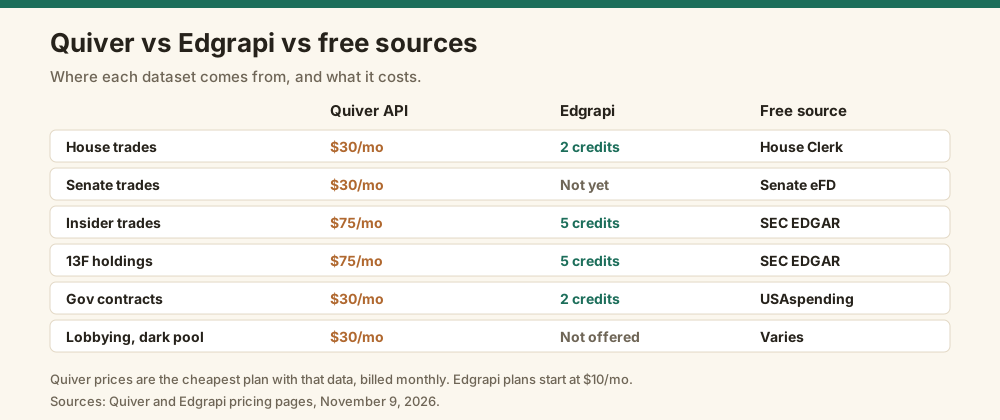
I run Edgrapi, so weigh this table with that in mind:
| Need | Quiver API | Edgrapi | Free source |
|---|---|---|---|
| House trades | Hobbyist, $30/mo | 2 credits a call | House Clerk disclosures |
| Senate trades | Hobbyist, $30/mo | Not yet | Senate eFD site |
| Insider trades (Form 4) | Trader, $75/mo | 5 credits a call | SEC EDGAR |
| 13F fund holdings | Trader, $75/mo | 5 credits a call | SEC EDGAR |
| Government contracts | Hobbyist, $30/mo | 2 credits a call | USAspending API, no key |
| Lobbying, PAC donors, dark pool | Hobbyist, $30/mo | Not offered | Varies |
| Lowest paid price | $25/mo billed yearly | $10/mo, or $7 one-time packs | $0 |
Edgrapi's free plan has 50 one-time credits. Paid plans start at $10 a month for 10,000 credits, per its pricing page.
Here's an insider call on Edgrapi, the dataset Quiver puts on its $75 tier:
import requests

r = requests.get("https://api.edgrapi.com/v1/insider/NVDA", headers={"X-API-Key": "YOUR_KEY"},
                 params={"limit": 3}, timeout=60).json()
for f in r["filings"]:
    for t in f["transactions"]:
        print(f["filed"], f["owner"], t["code_label"], t["shares"], t["price_per_share"])
When I ran it on November 9, 2026, it returned Nvidia's three latest Form 4 filings. Director Tench Coxe reported 500,000-share gifts in filings on November 6 and October 9. General counsel Timothy Teter reported open-market sales on September 23, in three lots between $222.19 and $223.75 a share.
Quiver still wins on breadth. If you need Senate trades, lobbying, PAC donations or dark pool data in one key, Edgrapi doesn't cover them. For more on the free route, see how to track congressional stock trades, and for the API side, the congress trading API guide.
Pick the Quiver plan by dataset and by use
Decide two things before you subscribe: which datasets you need, and whether anyone else will see the results. Politics data alone is Hobbyist at $30 a month. Insider or 13F data means Trader at $75. A product for customers means Startup at $250, or Enterprise. If insider trades and 13F holdings are all you need, get a free Edgrapi key and compare the per-call cost first.
Frequently asked questions
How much does the Quiver Quantitative API cost?
The Quiver Quantitative API costs $30 a month for Hobbyist, $75 for Trader and $250 for Startup, according to Quiver's pricing page on November 9, 2026. Billed yearly, they're $300, $750 and $2,500 a year. Startup gets 50% off its first year. Enterprise pricing isn't public. Hobbyist and Trader are personal use only.
Is the Quiver Quantitative API free?
No. The Quiver Quantitative API has no free tier or free trial, and its docs say an API key only returns data once you have an active plan. Requests without a valid key return HTTP 401. Quiver's website does have a free Visitor account that shows live congress, insider, contract and lobbying data in a browser.
Does Quiver Quantitative have a free trial?
Quiver's website Premium plan has a free trial: 7 days on monthly billing and 30 days on yearly billing, for new accounts. The API plans don't list a trial. You choose a plan on the API pricing page, complete checkout, and then copy your API key from the dashboard.
Which Quiver plan includes insider trading data?
Insider trading data from SEC Form 4 needs Quiver's Trader plan, which costs $75 a month or $750 a year. Trader also adds hedge fund 13F holdings, top shareholders, executive compensation, patents and layoff notices. The $30 Hobbyist plan returns HTTP 403 for those datasets. Quiver's insider history starts in 2021.
What are the Quiver API rate limits?
Quiver's API limits each endpoint to 100 requests a minute, 10 a minute, 200 an hour or 5 an hour, and the limits are the same on every plan. Insider trading and per-ticker congress endpoints allow 10 a minute, and bulk congress history allows 5 an hour. Exceeding a limit returns HTTP 429 with a Retry-After header.
Can I use Quiver data commercially?
Only on Quiver's Startup or Enterprise plans. Hobbyist and Trader are for personal, non-commercial use. Startup costs $250 a month, or $2,500 a year with 50% off the first year, and is limited to companies with under $1 million in annual revenue. Larger organizations need an Enterprise plan, which has no public price.