UEI Number Lookup: Find Any Company's Unique Entity ID
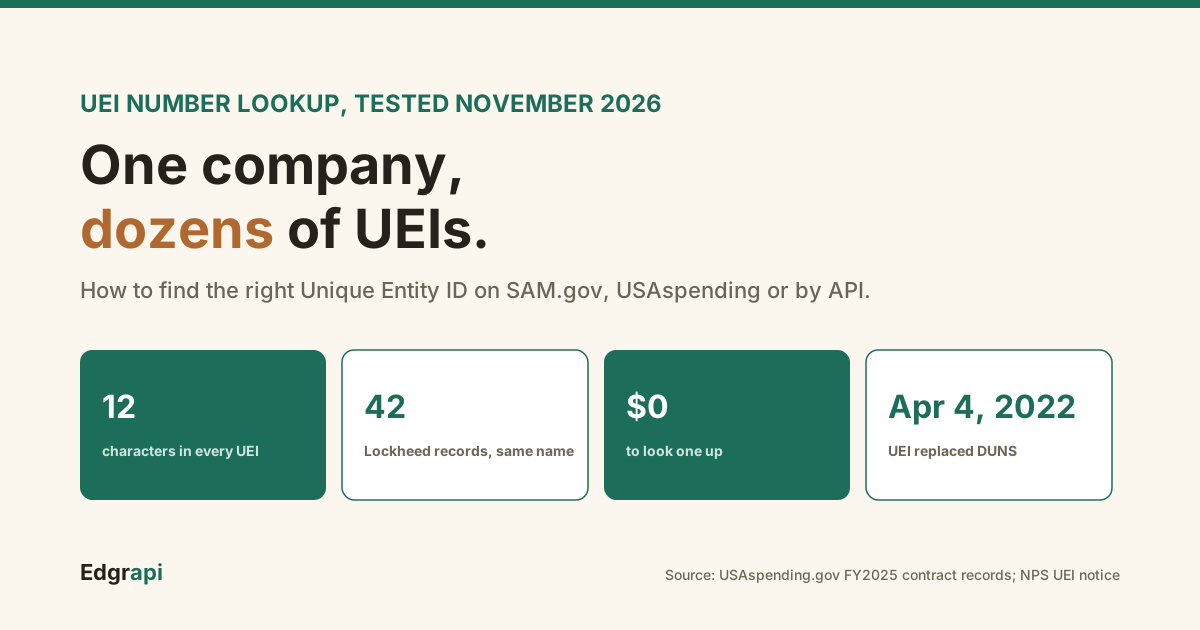
Search USAspending for Lockheed Martin's fiscal 2025 contracts and you'll find 42 records named exactly "Lockheed Martin Corporation." Each has its own UEI.
That's why a UEI number lookup is harder than it sounds. You can find any registered company's Unique Entity ID for free on SAM.gov or USAspending.gov in about a minute. The catch is picking the right one, because big companies hold many. Here's how to look one up, by hand and by API, with every method tested in November 2026.
What is a UEI number?
A UEI, or Unique Entity ID, is the 12-character alphanumeric code SAM.gov assigns to every organization that does business with the federal government. It replaced the 9-digit DUNS number on April 4, 2022. Contracts, grants and award records all identify the recipient by UEI. Getting one, keeping one and looking one up are all free.
The National Park Service's UEI notice says "There is no charge to obtain, maintain, or view an organization's UEI."
You don't even need a full registration to get one. SAM.gov says you "can get a Unique Entity ID for your organization without having to complete a registration," according to its entity registration page.
With only a UEI, though, you "cannot apply directly for federal awards." Bidding on contracts needs the full registration.
How do you look up a UEI number on SAM.gov?
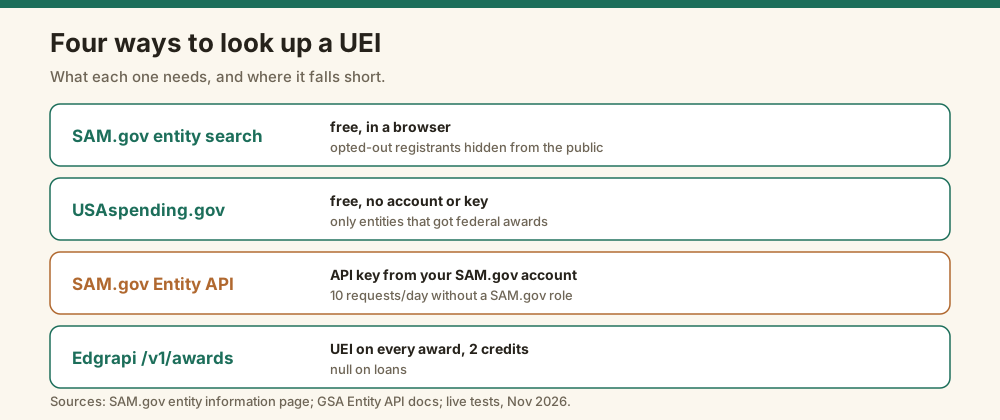
To look up a UEI on SAM.gov, open its entity information search, type the company's legal name, and read the 12-character Unique Entity ID on the matching result. The search is free. Some registrants opt out of public display, and SAM.gov only shows those to signed-in federal users, so a missing company doesn't always mean it has no UEI.
The steps:
- Go to SAM.gov and open Search, then Entity Information
- Type the company's legal business name, or a UEI to confirm one
- Check the city and state on each result, since names repeat
- Read the Unique Entity ID on the record you want
SAM.gov searches active records by default. If nothing comes back, its results page offers to include inactive records, which catches companies whose registration lapsed.
Watch for opt-outs. SAM.gov's entity information page says you "must sign in with your federal email address to view registrants who have opted out of public search."
How do you find a UEI without SAM.gov?
The easiest place to find a UEI outside SAM.gov is USAspending.gov, which shows the UEI on every recipient that has received federal money. Search the company name and each recipient profile lists its UEI, along with whether it's a parent or a subsidiary. You can also search by a UEI to confirm who it belongs to. No account or API key is needed.
I ran both directions. Searching USAspending for G4KDGE4JFFK7 returned exactly one recipient: Lockheed Martin Corporation, with $34.1 billion in fiscal 2025 contracts.
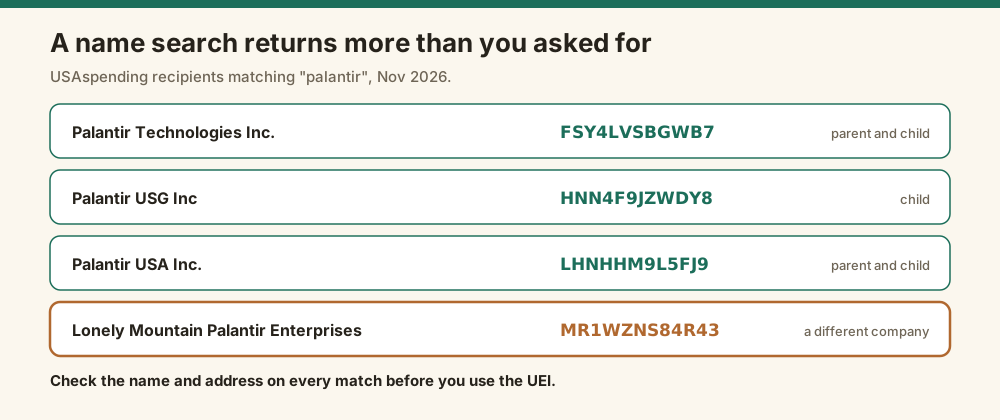
Searching the name "palantir" returned the real companies and some noise:
| Recipient | UEI | Record type |
|---|---|---|
| Palantir Technologies Inc. | FSY4LVSBGWB7 | Parent and child |
| Palantir USG Inc | HNN4F9JZWDY8 | Child |
| Palantir USA Inc. | LHNHHM9L5FJ9 | Parent and child |
| Lonely Mountain Palantir Enterprises | MR1WZNS84R43 | A different company |
That last row is the name-search trap. Any company with "Palantir" in its name shows up, whether or not it's the one you mean.
USAspending only knows companies that received awards. A brand-new registrant with no federal money yet won't appear there, so use SAM.gov for those.
Why does one company have dozens of UEIs?
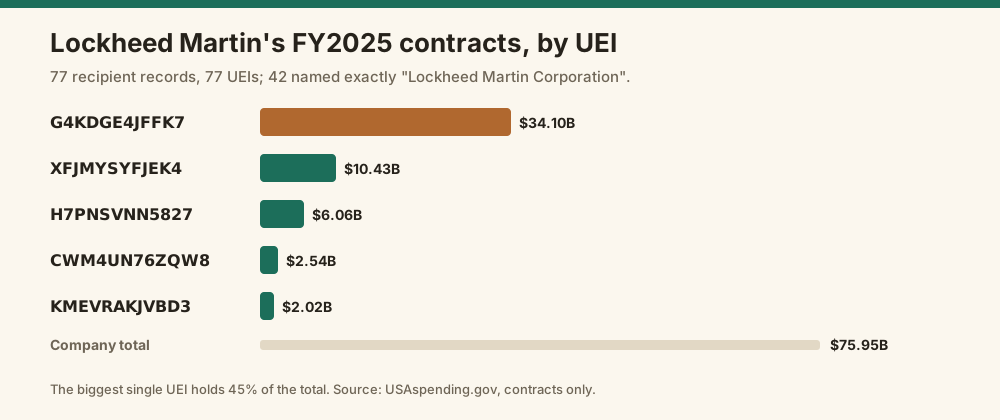
One company can have dozens of UEIs because each UEI belongs to a registered entity, not to the brand. Divisions, subsidiaries and sites that register separately each get their own. A USAspending search for Lockheed Martin's fiscal 2025 contracts returns 77 recipient records with 77 different UEIs, and 42 of them carry the exact same name.
The money is spread unevenly across them:
| UEI | Name on the record | FY2025 contracts |
|---|---|---|
| G4KDGE4JFFK7 | Lockheed Martin Corporation | $34.10 billion |
| XFJMYSYFJEK4 | Lockheed Martin Corporation | $10.43 billion |
| H7PNSVNN5827 | Lockheed Martin Corporation | $6.06 billion |
Pick the wrong one and you see a sliver of the company. Even the largest record holds less than half of Lockheed's $75.9 billion fiscal 2025 total.
The biggest single contract can sit somewhere else again. Lockheed's largest award with fiscal 2025 activity, a $48.06 billion Department of Energy contract counted at lifetime value, is under UEI FYHNA5WC8XD7, not the main one.
So for a whole-company view, collect every UEI, then add them up. I showed how in the Lockheed Martin government contracts breakdown.
How do you find your own UEI?
If your organization is registered in SAM.gov, you already have a UEI, and it's on your entity record when you sign in. SAM.gov says plainly, "If you're already registered, you already have a Unique Entity ID." If you've never registered, you can request a UEI on its own with just your legal business name and physical address.
To read yours, sign in to SAM.gov, open your workspace and go to your entity. The 12-character UEI sits on the record.
Not registered and only need a UEI, say for a grant application that asks for one? SAM.gov lets you request just the ID. For that, you "only need to provide" your "legal business name and physical address," according to its entity registration page.
You can also search your own company in the public tools above. That's a quick way to check what others see when they look you up.
How do you convert an old DUNS number to a UEI?
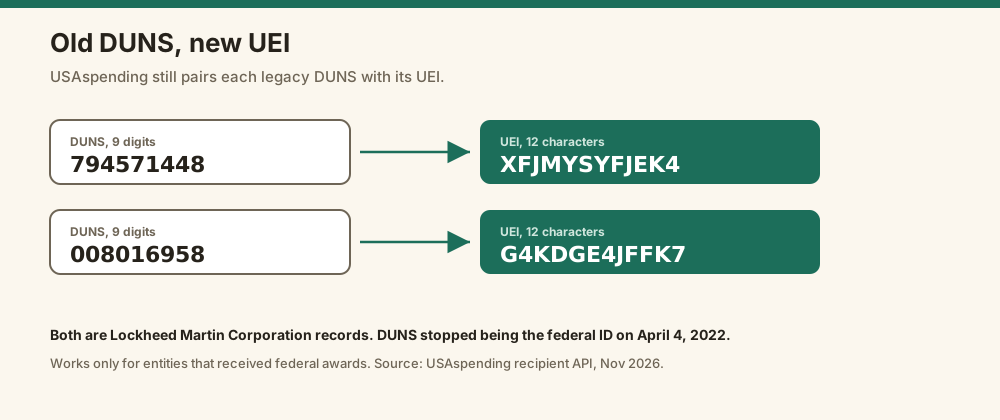
To convert an old DUNS number to a UEI, search the DUNS on USAspending.gov. Its recipient records still carry the legacy 9-digit DUNS next to each UEI, so a DUNS search returns the matching UEI. I tested it: DUNS 794571448 returned Lockheed Martin Corporation's UEI XFJMYSYFJEK4. No account or key is needed.
Lockheed's main contracting entity shows the pairing clearly. Its UEI G4KDGE4JFFK7 sits on the record that once carried DUNS 008016958.
This only works for entities that received federal awards, since that's what USAspending tracks. A DUNS from a company that never got federal money won't map this way.
Older contracts and grant files often list only a DUNS. Converting it is the first step to matching those records with anything filed since April 2022.
What does a valid UEI look like?
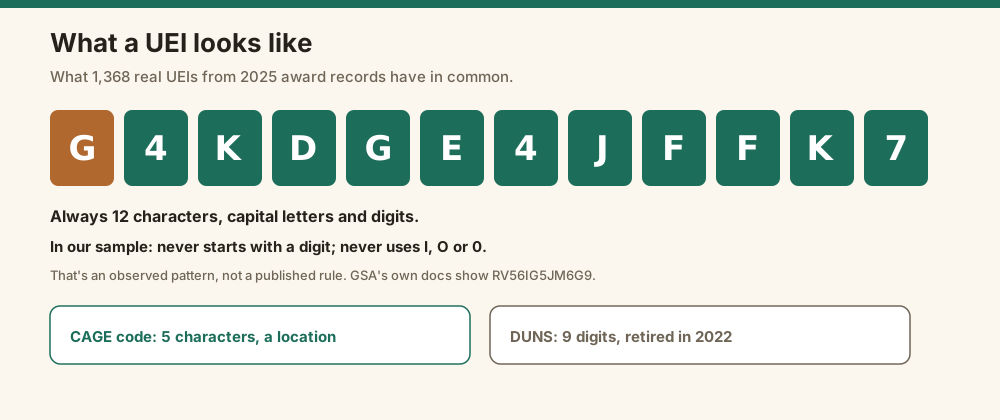
A valid UEI is exactly 12 characters, mixing capital letters and digits. In the 1,368 real UEIs I pulled from 2025 federal award records, every one was 12 characters long, none started with a digit, and none contained the letters I or O or the digit zero. That makes typos easy to spot, though it's an observed pattern, not a published rule.
I checked that caution against GSA's own documentation. Its Entity API example uses the UEI RV56IG5JM6G9, which contains an I.
So treat the pattern as a sanity check, not a validator. If a "UEI" has 11 characters, or starts with a zero, someone copied it wrong. Look it up before you reject it.
Don't confuse it with the other codes on the same record:
| Code | Length | Who assigns it | Identifies |
|---|---|---|---|
| UEI | 12 characters | SAM.gov | A registered entity |
| CAGE | 5 characters | Defense Logistics Agency | A location |
| DUNS | 9 digits | Dun & Bradstreet | Retired in 2022 for federal use |
A UEI names the entity, and a CAGE code names a site. My CAGE code lookup guide covers that side.
How do you look up UEIs with an API?
You can look up UEIs with three APIs. SAM.gov's Entity Management API returns full registration records by UEI, CAGE or name, but needs an API key from your SAM.gov account and limits non-federal users without a SAM.gov role to 10 requests a day. USAspending's API returns recipient UEIs with no key at all. And award APIs like Edgrapi's return each award's recipient UEI alongside the contract.
The SAM.gov limits come from GSA's Entity API documentation:
| Account | Daily requests |
|---|---|
| Non-federal user, no SAM.gov role | 10 |
| Non-federal user with a role | 1,000 |
| Federal user | 1,000 |
| Non-federal system account | 1,000 |
| Federal system account | 10,000 |
Ten a day is fine for checking a teaming partner. It's useless for a list of 500 vendors.
The key itself lives on your SAM.gov account details page, under "Public API Key." The UEI filter accepts up to 100 UEIs in one query, but results come back ten records per page, so checking 100 vendors still takes about 10 requests. On a 10-a-day key, that's your whole day.
For names, USAspending's free API is faster. This finds every UEI behind a company name, with no key:
import requests

r = requests.post("https://api.usaspending.gov/api/v2/recipient/",
                  json={"keyword": "palantir", "award_type": "all", "limit": 10}, timeout=60)
for rec in r.json()["results"]:
    if rec["uei"] and rec["recipient_level"] != "P":        # skip parent rollups and UEI-less rows
        print(rec["uei"], rec["name"])
It printed the three Palantir entities plus Lonely Mountain Palantir Enterprises, so check names before you trust a match.
When you want the UEI attached to the money, Edgrapi's /v1/awards now returns a recipient_uei on every award, 2 credits a call:
import requests

r = requests.get("https://api.edgrapi.com/v1/awards",
                 headers={"X-API-Key": "YOUR_KEY"},
                 params={"recipient": "Lockheed Martin", "category": "contracts", "start": "2024-10-01",
                         "end": "2025-09-30", "sort": "amount", "limit": 5}, timeout=90)
for a in r.json()["awards"]:
    print(a["recipient_uei"], a["recipient"], a["award_id"], round(a["amount"] / 1e9, 2), "B")
It returned the $48.06 billion Energy contract under FYHNA5WC8XD7 and four Defense contracts under G4KDGE4JFFK7. The amounts are lifetime award values, not one year's spending.
One gap: loans come back without a UEI, since many loan recipients are individuals.
What mistakes break a UEI lookup?
Most failed UEI lookups come from five mistakes: trusting the first name match, missing companies that opted out of public search, searching only active records, treating a parent record as the whole company, and expecting UEIs on loan records. Each one either hides the right UEI or hands you the wrong one, and the fix for each takes seconds.
How each one shows up:
- First match: a name search for "palantir" returns an unrelated company
- Opted out: the entity exists, but only signed-in federal users can see it
- Active only: a lapsed registration hides until you include inactive records
- Parent vs child: Lockheed's money is spread across 77 UEIs
- Loans: recipient UEI is empty on loan awards
One more catches people working with older files. A contract or grant record from before April 2022 may list only a DUNS, so convert it to a UEI first, then search.
Check the address on every match. Two entities can share a name, but rarely a street.
Look up the entity, then check the address
Search the company on SAM.gov or USAspending, collect every UEI that matches, and confirm each by address before you use it. For one check, the free tools are enough. For hundreds, use USAspending's keyless API, or get a free Edgrapi key and read recipient_uei straight off each award from /v1/awards.
Frequently asked questions
How do I find a company's UEI number?
Search the company's legal name in SAM.gov's entity information search, or on USAspending.gov if it has received federal awards. Both show the 12-character UEI for free. Large companies often have many UEIs, one per registered entity, so check the city and state on each result before you pick one.
Is a UEI number lookup free?
Yes. Looking up a UEI is free on SAM.gov and USAspending.gov, and so is getting one. Federal guidance says "There is no charge to obtain, maintain, or view an organization's UEI." Be wary of third-party sites that charge to find or register a UEI.
Can I look up a UEI without a SAM.gov account?
Yes, for most companies. USAspending.gov shows recipient UEIs with no account or key, and SAM.gov's entity search is free. The exception is registrants who opted out of public display: SAM.gov shows those only to users signed in with a federal email address, so a missing company may still have a UEI.
Is there an API for UEI lookup?
Yes. SAM.gov's Entity Management API returns UEIs and full registration data but needs an API key, and non-federal users without a SAM.gov role get 10 requests a day. USAspending's recipient API returns UEIs with no key. Edgrapi's /v1/awards returns the recipient UEI on each federal award.
What replaced the DUNS number?
The Unique Entity ID, or UEI, replaced the DUNS number for federal awards on April 4, 2022. SAM.gov assigns the UEI, while DUNS numbers came from Dun & Bradstreet. Entities registered before the switch were given a UEI automatically, and the DUNS number is no longer the federal government's identifier.
How many characters is a UEI?
A UEI is 12 characters long, a mix of capital letters and digits. In 1,368 real UEIs from 2025 federal award records, every one had 12 characters, none started with a digit, and none used the letters I or O or the digit zero. A CAGE code, by contrast, is 5 characters.