Largest Government Contractors in 2026: Who Depends Most on Federal Money
Democrats won both houses of Congress on November 3. The next day the Dow rose about 1,500 points, its biggest gain of the year.
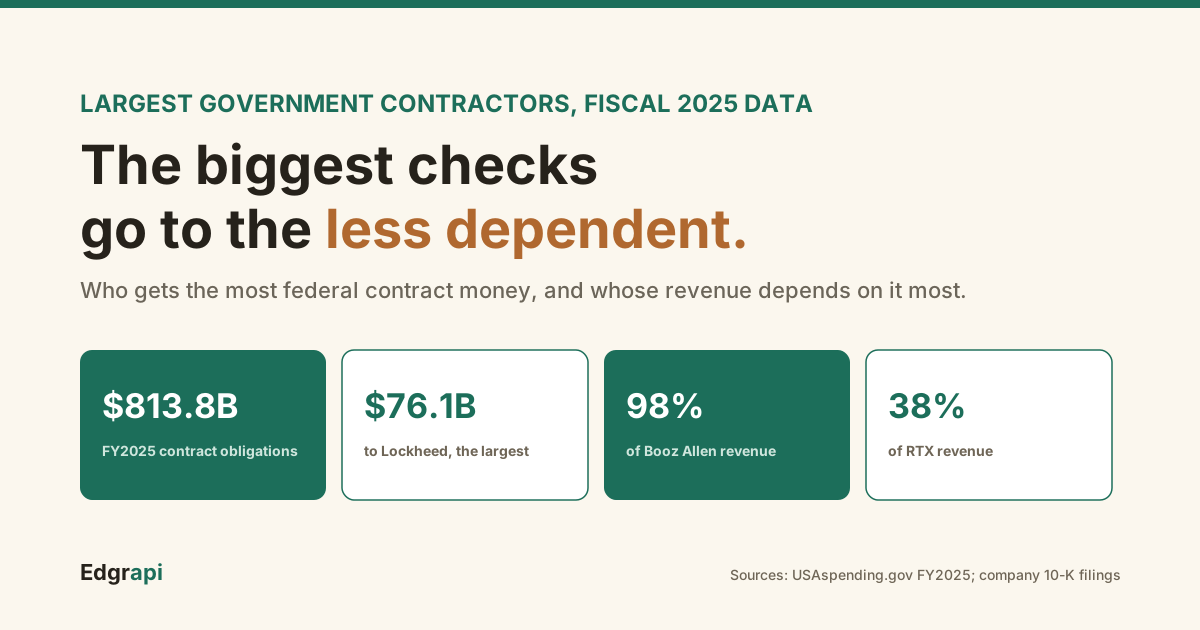
If you own government contractors, the bigger question is simpler: how much of each company's revenue does Washington pay? The largest government contractors by dollars are Lockheed Martin, General Dynamics and RTX. The most dependent are different companies. Booz Allen Hamilton and SAIC each get 98% of revenue from the U.S. government, according to their own 10-Ks, while RTX gets 38%. I ranked both ways with fiscal 2025 data.
Who are the largest government contractors?
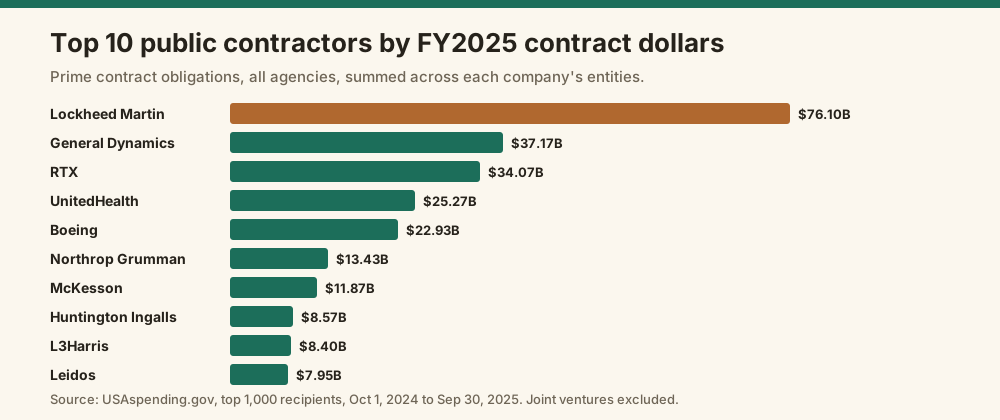
The largest government contractor is Lockheed Martin, with $76.1 billion in federal contract obligations in fiscal 2025 across 22 of its entities, according to USAspending.gov. General Dynamics is second at $37.2 billion and RTX third at $34.1 billion. The federal government obligated $813.8 billion on contracts that year, and the Department of Defense alone accounted for $527.0 billion, or 64.8%.
Here are the top 10 public companies by fiscal 2025 prime contract dollars:
| Rank | Company | Ticker | FY2025 contract obligations |
|---|---|---|---|
| 1 | Lockheed Martin | LMT | $76.10 billion |
| 2 | General Dynamics | GD | $37.17 billion |
| 3 | RTX | RTX | $34.07 billion |
| 4 | UnitedHealth (Optum) | UNH | $25.27 billion |
| 5 | Boeing | BA | $22.93 billion |
| 6 | Northrop Grumman | NOC | $13.43 billion |
| 7 | McKesson | MCK | $11.87 billion |
| 8 | Huntington Ingalls | HII | $8.57 billion |
| 9 | L3Harris | LHX | $8.40 billion |
| 10 | Leidos | LDOS | $7.95 billion |
Big companies don't contract under one name. General Dynamics shows up as 20 separate entities, and one of them, Electric Boat, took $21.37 billion on its own.
Some of the biggest recipients aren't public at all. TriWest Healthcare Alliance, a private company, took $13.37 billion, almost exactly what Northrop Grumman got.
I pulled every number from the free USAspending API, summing the top 1,000 recipients for fiscal 2025, which ran from October 1, 2024 to September 30, 2025. Those 1,000 cover 77.3% of all contract dollars.
Which defense contractor stocks get the most Pentagon money?
The defense contractor stocks with the most Pentagon money in fiscal 2025 were Lockheed Martin at $75.3 billion, General Dynamics at $33.8 billion and RTX at $33.7 billion in Defense Department contract obligations, according to USAspending.gov. Boeing and Northrop Grumman come next. Two companies that aren't weapons makers also crack the top 10: Cencora, a drug distributor, and Humana.
The top 10 public companies by Defense Department contract dollars:
| Rank | Company | Ticker | FY2025 Defense contract obligations |
|---|---|---|---|
| 1 | Lockheed Martin | LMT | $75.30 billion |
| 2 | General Dynamics | GD | $33.79 billion |
| 3 | RTX | RTX | $33.72 billion |
| 4 | Boeing | BA | $21.38 billion |
| 5 | Northrop Grumman | NOC | $13.10 billion |
| 6 | Huntington Ingalls | HII | $8.82 billion |
| 7 | Cencora | COR | $7.44 billion |
| 8 | L3Harris | LHX | $7.32 billion |
| 9 | Humana | HUM | $6.51 billion |
| 10 | Textron | TXT | $4.54 billion |
Almost all of Lockheed's federal money is Pentagon money: $75.3 billion of its $76.1 billion.
The Pentagon list goes deeper than the all-agency one, down to entities with $53.8 million instead of $88.7 million. That's why a few totals, like Huntington Ingalls, come out slightly higher here.
Where does federal contract money go?
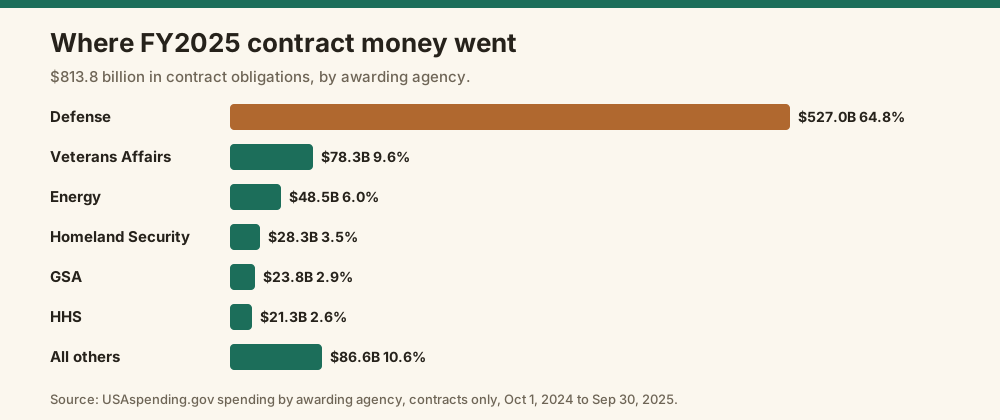
Most federal contract money goes to defense. Of $813.8 billion in fiscal 2025 contract obligations, the Department of Defense accounted for $527.0 billion, or 64.8%, according to USAspending.gov. Veterans Affairs was a distant second at $78.3 billion, then Energy at $48.5 billion. That mix is why the biggest contractors build weapons, and why health companies show up right behind them.
The six biggest buyers:
| Agency | FY2025 contract obligations | Share |
|---|---|---|
| Department of Defense | $527.0 billion | 64.8% |
| Veterans Affairs | $78.3 billion | 9.6% |
| Energy | $48.5 billion | 6.0% |
| Homeland Security | $28.3 billion | 3.5% |
| General Services Administration | $23.8 billion | 2.9% |
| Health and Human Services | $21.3 billion | 2.6% |
The money is concentrated, too. The top 10 recipient entities took $147.7 billion, about 18% of everything.
Energy's list looks odd at first. Many of its biggest recipients run national labs, like the company that manages Sandia, which took $5.67 billion.
Which companies depend most on government contracts?
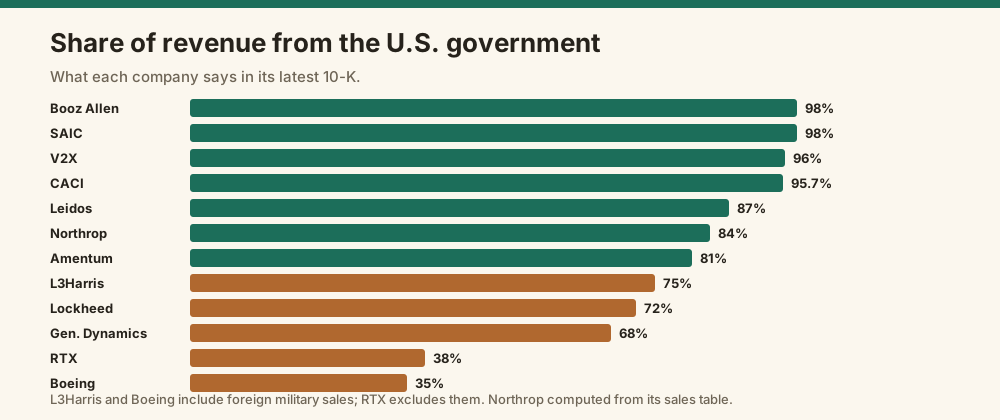
The companies that depend most on government contracts are IT and services firms, not the giant defense primes. Booz Allen Hamilton and SAIC each say 98% of their revenue comes from U.S. government work, V2X says 96% and CACI 95.7%, according to their latest 10-K filings. Lockheed Martin, the biggest contractor by dollars, says 72%. RTX says 38%, excluding foreign military sales.
These are the companies' own numbers, from the customer section of each annual report:
| Company | Ticker | U.S. government share of revenue | Fiscal year |
|---|---|---|---|
| Booz Allen Hamilton | BAH | 98% | Ended March 2026 |
| SAIC | SAIC | 98% | Ended January 2026 |
| V2X | VVX | 96% | 2025 |
| CACI | CACI | 95.7% | Ended June 2025 |
| Leidos | LDOS | 87% | 2025 |
| Northrop Grumman | NOC | 84% | 2025 |
| Amentum | AMTM | 81% | Ended October 2025 |
| L3Harris | LHX | 75%, including foreign military sales | 2025 |
| Lockheed Martin | LMT | 72% | 2025 |
| General Dynamics | GD | 68% | 2025 |
| KBR | KBR | 57% | 2025 |
| Maximus | MMS | 55% | Ended September 2025 |
| Palantir | PLTR | About 42% | 2025 |
| RTX | RTX | 38%, excluding foreign military sales | 2025 |
| Boeing | BA | 35%, including foreign military sales | 2025 |
Two of those I worked out from the filing. Northrop reports $35.18 billion of U.S. government sales out of $41.95 billion total.
Palantir reports $1.9 billion from U.S. government customers, out of $4.48 billion in revenue.
Huntington Ingalls doesn't give one total. It says about 81% of its 2025 revenue came from the U.S. Navy alone.
Maximus has a second layer of exposure. Another 33% of its revenue comes from state and local governments.
Where do you find a company's government revenue share?
You find a company's government revenue share in its 10-K, usually in three places: the Customers part of Item 1, the risk factors, and the revenue note in the financial statements. Most contractors state one clear percentage. General Dynamics writes that "In 2025, 68% of our consolidated revenue was from the U.S. government." KBR gives a table with the dollars and the share for each year.
Read the footnotes on that number. They change what it means.
RTX's 38% excludes foreign military sales. L3Harris's 75% includes them. Boeing's 35% includes them too.
The wording on subcontracts matters as well. Booz Allen counts contracts where it worked "either as a prime contractor or subcontractor," and so do Leidos and SAIC.
You can pull these sentences without opening a single PDF. Search EDGAR's full text for a phrase like "of our revenue" next to "U.S. government," and the 10-Ks come back with the line highlighted.
Why don't contract dollars match revenue?
Contract obligations and revenue measure different things, so they rarely match. USAspending records obligations, the money an agency commits when it signs or funds a contract, and only for prime contracts. Companies report revenue as they do the work, including work as a subcontractor. That's why my USAspending total for Lockheed Martin, $76.1 billion, is higher than its entire 2025 revenue of $75.05 billion.
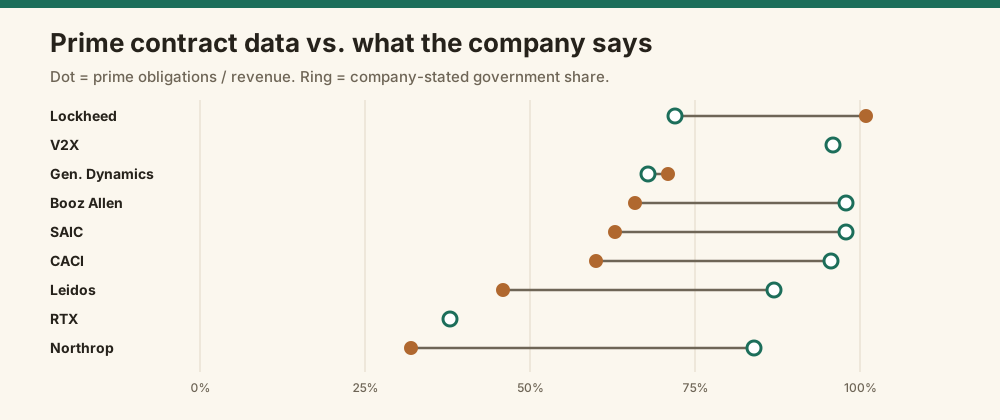
I divided each company's prime obligations by its revenue for the fiscal year closest to fiscal 2025. Then I compared that with what the company says:
| Company | Prime obligations / revenue | Company-stated share | Gap |
|---|---|---|---|
| Lockheed Martin | 101% | 72% | +29 points |
| V2X | 96% | 96% | 0 |
| General Dynamics | 71% | 68% | +3 points |
| Booz Allen Hamilton | 66% | 98% | -32 points |
| SAIC | 63% | 98% | -35 points |
| CACI | 60% | 95.7% | -36 points |
| Leidos | 46% | 87% | -41 points |
| RTX | 38% | 38% | 0 |
| Northrop Grumman | 32% | 84% | -52 points |
Three things drive the gaps.
Subcontracts are the big one. Leidos says its 87% includes work "either as a prime contractor or a subcontractor to others." USAspending's prime records leave that work out.
Foreign military sales cut the other way. Lockheed says its international business runs partly through FMS "contracted through the U.S. Government," so the Pentagon signs those contracts, but Lockheed counts the sales as international.
Then there's timing. An obligation can fund work that stretches over several years, while revenue lands as the work gets done.
Northrop's 52-point gap is the biggest, and the public data doesn't explain all of it. Treat any single-source ranking with care.
Why does Congress matter so much to government contractors?
Congress matters because it controls the money. The Constitution says no money can be drawn from the Treasury except "in Consequence of Appropriations made by Law," so every contract dollar these companies earn starts as a spending bill. Democrats won control of both the House and Senate on November 3, 2026, according to NBC News and CBS News projections, and they take over the committees that write those bills in January 2027.
The money moves through 12 regular appropriations bills a year, each written by the Appropriations Committees in the House and Senate. Defense is the biggest of the 12.
That's where a new majority shows up first: in which programs each bill funds, and how fast the bills pass.
The new majority also inherits the fight over lawmakers' own trading. I covered where that stands in the congressional stock trading ban update.
The companies say this themselves, in their risk factors.
Lockheed Martin's 2025 10-K puts it plainly: "We depend heavily on contracts with the U.S. Government for a substantial portion of our business." It then warns that "delays or reductions in spending" could hurt it.
For a firm at 98%, that warning covers almost the whole company. For RTX at 38%, it covers a bit over a third.
I'm not going to guess what a Democratic Congress will cut or grow. Nobody knows that in November. You can measure who's exposed today, though, and that's what the tables above do.
Which big contractors barely depend on federal money?
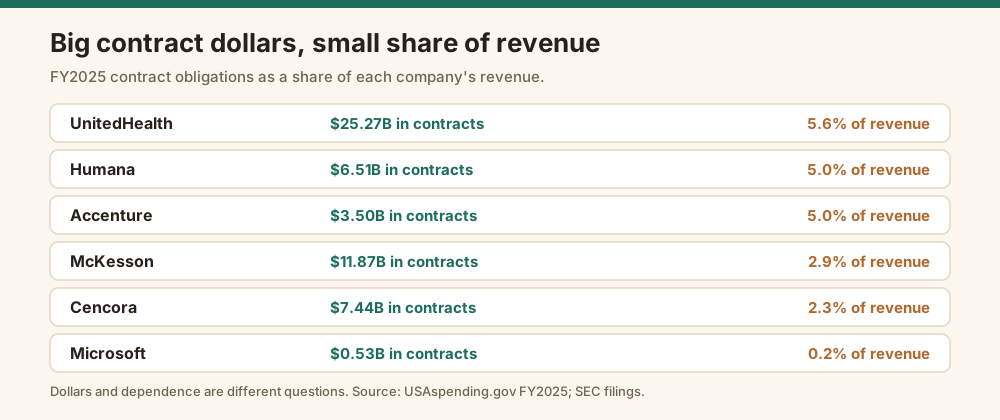
Some of the largest government contractors barely depend on federal money, because the rest of their business is so big. UnitedHealth's Optum units took $25.27 billion in fiscal 2025 contracts, the fourth-most of any public company, yet that's about 5.6% of UnitedHealth's $447.6 billion in revenue. McKesson's $11.87 billion is about 2.9% of its revenue. Dollars and dependence are different questions.
The same goes for other big names:
| Company | FY2025 contract obligations | Revenue | Obligations / revenue |
|---|---|---|---|
| UnitedHealth | $25.27 billion | $447.57 billion | 5.6% |
| Humana | $6.51 billion | $129.66 billion | 5.0% |
| Accenture | $3.50 billion | $69.67 billion | 5.0% |
| McKesson | $11.87 billion | $403.43 billion | 2.9% |
| Cencora | $7.44 billion | $321.33 billion | 2.3% |
| Microsoft | $0.53 billion | $281.72 billion | 0.2% |
Cloud companies look tiny in prime data. Amazon Web Services shows $0.31 billion and Microsoft $0.53 billion.
My read is that a lot of software reaches agencies through resellers. Carahsoft, a reseller, booked $2.05 billion on its own. So a software maker's prime number can understate what the government spends on its products.
How can you check a company's federal exposure yourself?
You can check any company's federal exposure in two steps: pull its contract obligations from USAspending, then divide by revenue from its SEC filings. USAspending's recipient search is free and needs no key. The revenue comes from the company's 10-K, which you can get from the SEC or as clean JSON from an API. Then read the 10-K's customer section for the company's own number.
The steps:
- Pull the company's contract obligations for one fiscal year from USAspending
- Add up every entity name the company uses, minus joint ventures
- Divide by revenue for the fiscal year that best overlaps it
- Compare the result with the percentage in the company's 10-K
If step 1 and step 4 disagree by a lot, that's your cue to read the 10-K closely. The gap usually means subcontract work or foreign military sales.
This sums fiscal 2025 contract obligations for three IT contractors, straight from USAspending:
import requests

URL = "https://api.usaspending.gov/api/v2/search/spending_by_category/recipient/"
body = {"category": "recipient", "limit": 100,
        "filters": {"award_type_codes": ["A", "B", "C", "D"],                  # contracts only
                    "time_period": [{"start_date": "2024-10-01", "end_date": "2025-09-30"}]}}

totals = {}
for page in range(1, 11):                                                    # top 1,000 recipients
    rows = requests.post(URL, json={**body, "page": page}, timeout=120).json()["results"]
    for r in rows:
        if r["name"].startswith(("BOOZ ALLEN", "LEIDOS", "SCIENCE APPLICATIONS")):
            totals[r["name"]] = totals.get(r["name"], 0) + r["amount"]

for name, amt in sorted(totals.items(), key=lambda kv: -kv[1]):
    print(f"{name:48} ${amt / 1e9:.2f}B")
It printed Leidos, Inc. at $7.39 billion, Booz Allen at $7.39 billion, SAIC at $4.56 billion and Leidos Biomedical Research at $0.56 billion. Notice Leidos splits across two entities, so match every name a company uses, and check each entity's UEI before you add it in.
For revenue, Edgrapi's /v1/fundamentals returns the income statement from SEC filings as JSON, 3 credits a call:
import requests

prime = {"BAH": 7.39e9, "LDOS": 7.95e9, "SAIC": 4.56e9}        # from the USAspending pull above
for t, amt in prime.items():
    inc = requests.get(f"https://api.edgrapi.com/v1/fundamentals/{t}", headers={"X-API-Key": "YOUR_KEY"},
                       params={"limit": 1}, timeout=60).json()["income_statement"][0]
    print(t, inc["period"], f"revenue ${inc['revenue'] / 1e9:.2f}B", f"prime = {amt / inc['revenue']:.0%} of revenue")
It returned Booz Allen at $11.22 billion and 66%, Leidos at $17.11 billion and 46%, and SAIC at $7.26 billion and 63%.
If you need the award-level detail behind those totals, I covered that in the government contract API guide. For one company end to end, see the Lockheed Martin contracts breakdown.
What mistakes skew a government contractor ranking?
Most bad government contractor rankings make one of five mistakes: matching only one entity name, counting joint ventures twice, treating obligations as revenue, ignoring subcontract work, and reading fresh Defense data too early. Each one moves a company up or down the list by billions of dollars, and some make a services firm look half as dependent as it really is.
How each one shows up:
- One name: Lockheed's $76.1 billion is spread across 22 entities, including Sikorsky
- Joint ventures: a Raytheon and Lockheed Martin Javelin JV belongs to neither parent, so I left JVs out
- Obligations as revenue: Lockheed's obligations exceed its revenue
- No subcontracts: Northrop's prime ratio is 32%, but it says 84%
- Fresh data: Defense contract data can lag about 90 days, according to the Congressional Research Service
That last one is why I used fiscal 2025. Fiscal 2026 ended on September 30, 2026, so its Defense numbers are still filling in.
My ranking has limits too. It covers the top 1,000 recipient entities, so smaller subsidiaries are missing. It also leaves out joint ventures and the national labs that companies run under management contracts.
Rank by dependence, then read the 10-K
Pick the contractors you own, pull their fiscal 2025 obligations from USAspending, and divide by revenue. Then open each 10-K's customer note, because the company's own percentage beats any outside ranking, including mine. If you'd rather not stitch two APIs together, get a free Edgrapi key and pull contracts from /v1/awards and revenue from /v1/fundamentals with one key.
Frequently asked questions
Who is the largest government contractor?
Lockheed Martin is the largest U.S. government contractor. It received $76.1 billion in federal contract obligations in fiscal 2025 across 22 of its entities, according to USAspending.gov, about twice as much as General Dynamics in second place at $37.2 billion. RTX was third at $34.1 billion. About 72% of Lockheed's 2025 revenue came from the U.S. government, according to its 10-K.
Which companies depend most on government contracts?
IT and services contractors depend most on government contracts. Booz Allen Hamilton and SAIC each report 98% of revenue from U.S. government work, V2X reports 96% and CACI 95.7%, according to their latest 10-Ks. The big defense primes depend less: Lockheed Martin reports 72%, General Dynamics 68%, RTX 38% and Boeing 35%.
What percentage of Lockheed Martin's revenue comes from the government?
Lockheed Martin says it derived 72% of its total 2025 sales from the U.S. government, including 63% from the Department of Defense, according to its 10-K filed January 2026. Its F-35 program alone was 27% of total sales. Lockheed also sells to allied governments, partly through foreign military sales contracted through the U.S. government.
Why does Congress matter to government contractors?
Congress matters because it writes the spending bills that fund every federal contract. The Constitution bars spending money except through appropriations made by law. After the November 2026 midterms, Democrats take control of both chambers in January 2027, so they'll write those bills. Contractors that get 95% or more of revenue from the government feel any change most.
How do I find a company's federal contracts?
Search the company's name on USAspending.gov, the official federal spending site, which is free and needs no account. Its recipient search and free API return contract obligations by entity and fiscal year. Big companies use many entity names, so add up every match, and check UEIs to avoid mixing up companies with similar names.
Are contract obligations the same as revenue?
No. A contract obligation is money an agency commits when it signs or funds a contract, and it can cover several years of work. Revenue is what a company books as it does the work, including subcontracts. Lockheed Martin's fiscal 2025 obligations of $76.1 billion were higher than its total 2025 revenue of $75.05 billion.