How to Track Smart Money: Follow Insider, Fund, and Congress Buying for Free (2026)
Everyone wants to know what the smart money is buying. Here's the thing: it already told you.
Company insiders, billion-dollar funds, activist investors, and members of Congress all have to disclose their trades, on a legal clock, to the SEC or under the STOCK Act. Tracking smart money isn't about a secret data feed. It's about reading four filings before everyone else does, and knowing which ones are fresh and which are already weeks old.
What is "smart money," and where does it leave a trail?
Smart money is the set of traders whose buying carries information: company insiders, large institutional funds, activist investors, and, lately, members of Congress. None of what they do is hidden. Each group is legally required to disclose its trades to the SEC, or under the STOCK Act, on a fixed deadline. So "tracking smart money" really means reading four specific filings and knowing what each one tells you.
Here are the four, and the filing behind each.
- Insiders file a Form 4 when an officer, director, or 10% owner trades their own company's stock.
- Funds file a 13F listing their U.S. stock holdings every quarter.
- Activists file a 13D or 13G when they cross 5% of a company.
- Congress files periodic transaction reports under the STOCK Act for every trade a member makes.
That's the whole map. The rest of tracking smart money is deciding which layer to watch, and how much to trust each one given how late it arrives.
Can you track smart money for free?
Yes, and it's the part most paid tools gloss over. Every one of these filings is public and free on SEC EDGAR, and several free trackers already sit on top of them. The catch is coverage. Most free tools cover one layer, 13F or Congress, not all four, and the raw EDGAR feed is XML you fetch, parse, and rate-limit yourself. Free is real; getting all four in one place is the work.
The free single-layer tools are genuinely good at their one job. A superinvestor tracker aggregates 13F filings so you can compare fund portfolios; a Congress tracker lists members' trades; an insider feed flags Form 4 buys.
What none of them does is give you insider, fund, activist, and Congress data together, cross-referenced, on the same company. For that you either stitch several tools together, or pull the data yourself.
The paid dashboards exist mostly to save you that stitching. You're not paying for secret data, you're paying to skip the assembly.
How do you track institutional buying (13F fund holdings)?
You read 13F filings. Every institutional manager running over $100 million in U.S. equities must disclose its holdings within 45 days of the end of each quarter. That single rule is why you can see what Warren Buffett, Bill Ackman, and Michael Burry own, alongside thousands of other funds. Diff one quarter against the last and you see exactly what each fund added, trimmed, or sold out of.
The read is straightforward: the position sizes are real, and a cluster of respected funds piling into the same name is a genuine signal of consensus.
The limit is the lag. A 13F can be up to 45 days old the moment it's filed, and it only comes four times a year. A fund can buy in January, sell in March, and you still see the position in the mid-February filing. So read 13F for conviction and consensus, never for timing.
The free way in is a superinvestor tracker that follows the well-known funds for you and shows the quarter-over-quarter changes. Our own guide to tracking hedge fund holdings walks through the mechanics.
How do you track insider buying (Form 4)?
You watch Form 4 filings, the fastest and often the most informative smart-money layer. An insider, meaning an officer, director, or 10% owner, must report any trade in their own stock within two business days. So a Form 4 is days old, not weeks, and it names exactly who traded, how much, and at what price. This is the one layer worth checking daily.
The skill is filtering. Insiders sell for a dozen reasons, taxes, a house, diversifying a concentrated position, so a sale usually says little.
An open-market buy is different. It's flagged with transaction code P, and it's the trade that carries a real view, because an insider buys for essentially one reason. A cluster of insiders buying at once is stronger still.
Watch for the P code and the 10b5-1 flag: a purchase off a pre-set plan is routine, an unscheduled open-market buy is the signal. Our post on tracking insider buying covers the filters in depth.
How do you track Congress stock trades?
You read the periodic transaction reports filed under the STOCK Act. Every member of Congress, and many senior staff, must disclose each trade within 45 days, so the data covers Nancy Pelosi and every other member's stock activity. The amounts come in ranges, not exact figures, and the reports are late by design. It's public, but it's neither fast nor precise.
Because the data is weeks old and imprecise, the value isn't front-running a single trade. It's the pattern.
A member trading heavily in a sector their committee oversees, or a burst of buying across several members before a policy move, is more telling than any one disclosure. Read it for context, not timing.
You can browse this free on our Congress trades tracker, or in more depth in the guide to tracking congressional stock trades.
How do you track activist stakes (13D/13G)?
You watch 13D and 13G filings, the early-warning layer. When an investor crosses 5% ownership of a company, they must file within days, far ahead of the next quarterly 13F. A 13D signals an active investor who may push for board seats, a sale, or a strategy change; a 13G is a passive large holder just reporting the size. Either way, it's the earliest public sign that a big player is building a position.
The 13D is the one that moves stocks. It often arrives with an intent, and the market reacts to a known activist showing up on the register.
Because it lands within days of crossing the threshold, a 13D can tip you off months before the position would otherwise surface in a 13F. That speed is the whole reason to watch it. Our 13D/13G guide breaks down the two forms.
What's the catch: how current is smart-money data?
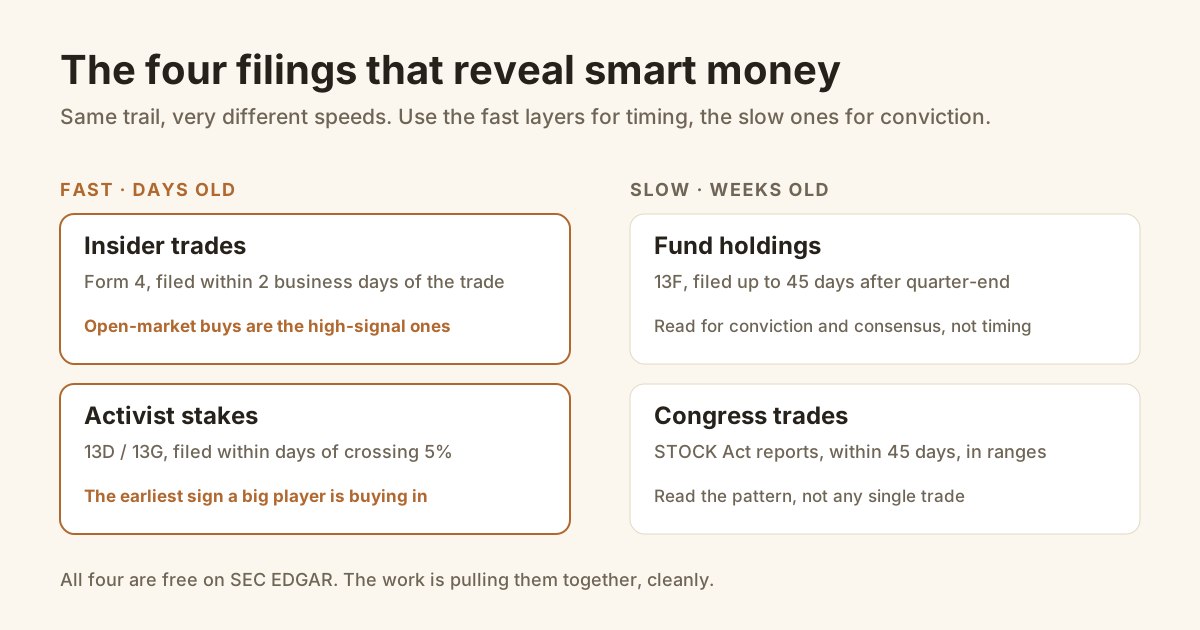
The four layers move at wildly different speeds, and getting this wrong is the most common mistake. Insider Form 4 and activist 13D filings are days old. But 13F holdings and Congress trades can be up to 45 days stale, so a fund's "current" position may already be gone by the time you read it. The rule of thumb: use the fast layers for timing, the slow ones only for conviction.
| Layer | Filing | Deadline | How fresh |
|---|---|---|---|
| Insider trades | Form 4 | 2 business days after the trade | Fast (days) |
| Activist stakes | 13D / 13G | Within days of crossing 5% | Fast (days) |
| Fund holdings | 13F | 45 days after quarter-end | Slow (up to 6 weeks, quarterly) |
| Congress trades | Periodic transaction report | 45 days after the trade | Slow (weeks), amounts in ranges |
This is why an all-in-one tracker can mislead you if it flattens everything into one feed. A fresh insider buy and a six-week-old 13F position are not the same kind of information, and a good tracker keeps them separate.
Does following the smart money actually work?
Sometimes, and as one input, not as a strategy you run blind. The filings are real and the signals are studied, but they carry known limits: insider buying beats insider selling as a signal, 13F holdings are stale, and copying a fund's disclosed position weeks late is not the same as owning its timing. Treat smart-money data as research that narrows where to look, then do your own work.
The most durable finding is the buy-versus-sell asymmetry. Insider open-market buying has long predicted returns better than selling, because a buy carries a single motive while a sale carries many. That's why a cluster of insiders buying reads louder than any 13F, and why the fast insider layer is where most people should start.
The trap is treating a late filing as a live call. By the time a 13F prints, the fund has had up to 45 days to change its mind, and a 13D tells you an activist arrived but not what they'll do next. None of this is investment advice, and a real filing can still lead to a bad trade. Use it to build a watchlist and a set of questions, not a portfolio on autopilot.
Free tracker vs build-your-own vs paid dashboard: which should you use?
Use a free single-layer tracker if you only care about one signal; build your own if you want all four and control the logic; pay for a dashboard if you'd rather rent a finished view. The free tools each nail one layer. A clean API lets you pull insider, fund, and activist data together and wire your own alerts. Paid dashboards aggregate it, but you're renting their interface, not owning the data.
| Option | Layers covered | Price | Raw data / API |
|---|---|---|---|
| Free 13F tracker (superinvestor tools) | Fund holdings only | Free | No |
| Free Congress tracker (e.g. Capitol Trades) | Congress trades only | Free | No |
| Paid dashboard (e.g. Kavout) | Insider + Congress + analyst ratings | Paid subscription | Limited |
| Build your own on Edgrapi | Insider + 13F + activist by API, Congress via the free tracker | Free tier, 100 credits/month | Yes, clean JSON and an MCP server |
The honest split: if you want one layer and a nice UI, a free single-purpose tracker is the fastest answer, use it. If you want to combine insider, fund, and activist signals on the same watchlist, or feed them to an AI research agent, that's the case for pulling the data yourself.
How do you build a free smart-money tracker?
You build one by pulling the three fast-to-clean SEC layers from one API, plus Congress from a free tracker. Get a free key, call the insider, holdings, and activist endpoints for the names you follow, store each result, and diff every new filing against the last. No XBRL parsing, no rate-limit handling. An afternoon gets you a working tracker; an alert on new filings makes it something you actually use.
The core is three calls, one key.
import requests

KEY = {"X-API-Key": "edgr_your_key"}
def edgr(path):
    return requests.get("https://api.edgrapi.com" + path, headers=KEY).json()

# the three fast-to-clean smart-money layers, one key
insider  = edgr("/v1/insider/NVDA")        # who's buying, Form 4
holdings = edgr("/v1/holdings/berkshire")  # what a fund owns, 13F
activist = edgr("/v1/activist/AAPL")       # who crossed 5%, 13D/13G

buys = [t for f in insider["filings"]
          for t in f.get("transactions", []) if t.get("code") == "P"]
print(len(buys), "open-market insider buys")
Each call returns clean JSON, already parsed: the insider and transaction code, each fund position with its share count, and each activist filer with the stake size. You add the logic, follow a watchlist, alert on new filings, rank by conviction, and the parsing is the part you never touch.
For the Congress layer, point people at the free Congress tracker, or fold in a dedicated Congress source, since that one isn't part of the API yet.
Get a free API key and pull your first insider, 13F, and activist filings in a minute, no card required.
Start with the fast layer
Don't try to watch all four at once on day one. Start with insider Form 4, the freshest and highest-signal layer, and get an alert when someone buys their own stock on the open market. Then layer in 13F for conviction, 13D for early activism, and Congress for color. The smart money already filed with the SEC. Tracking it is just reading the filings before the rest of the market gets around to it.
Frequently asked questions
What does 'smart money' mean in stocks?
Smart money is the money whose trades carry information: company insiders, large institutional funds, activist investors, and members of Congress. The label is loose, but in practice it means the players who have to disclose their trades to the SEC or under the STOCK Act, so you can actually see what they did. Following smart money means reading those disclosures, Form 4, 13F, 13D/13G, and Congressional reports.
Is following smart money actually profitable?
It can be a useful input, not a guaranteed edge. The strongest evidence is around insider buying, which has historically predicted returns better than insider selling. Fund 13F holdings and Congress trades are weeks old by the time you see them, so they work better for conviction and context than for timing. Treat it as research that narrows your watchlist, and remember none of it is investment advice.
What's the best free smart money tracker?
It depends on the layer. For fund holdings, a free superinvestor 13F tracker; for Congress, a free Congress-trade tracker; for insiders, a Form 4 feed. Each free tool tends to cover one layer well. If you want insider, fund, and activist signals on the same watchlist, you either combine several tools or pull the data from an API and build your own.
How often is 13F and smart-money data updated?
It varies a lot by layer. Insider Form 4 filings appear within two business days of a trade, and activist 13D filings within days of crossing 5%. But 13F fund holdings come only quarterly and up to 45 days after quarter-end, and Congress trades within 45 days. So half the smart-money picture is near real-time and half is weeks stale.
Can I get smart-money data as an API?
Yes, for most of it. Insider trades, 13F holdings, and 13D/13G activist stakes are available as clean JSON from hosted SEC APIs, so you can pull them without parsing EDGAR's XML. Congressional trade data usually comes from a separate source. Edgrapi's free tier gives you the insider, holdings, and activist endpoints, plus a free congress API (/v1/congress, US House STOCK Act data) and the web tracker.
Is it legal to track and copy insider and Congress trades?
Yes. These are public disclosures the SEC and Congress are required to publish, and reading or acting on them is legal. What's illegal is trading on material non-public information, which is the opposite of this: you're using data that's already public. Copying a disclosed trade weeks later carries plenty of risk, but it isn't insider trading, and none of it is investment advice.