SAM.gov API Alternatives: 7 Options Compared (2026)
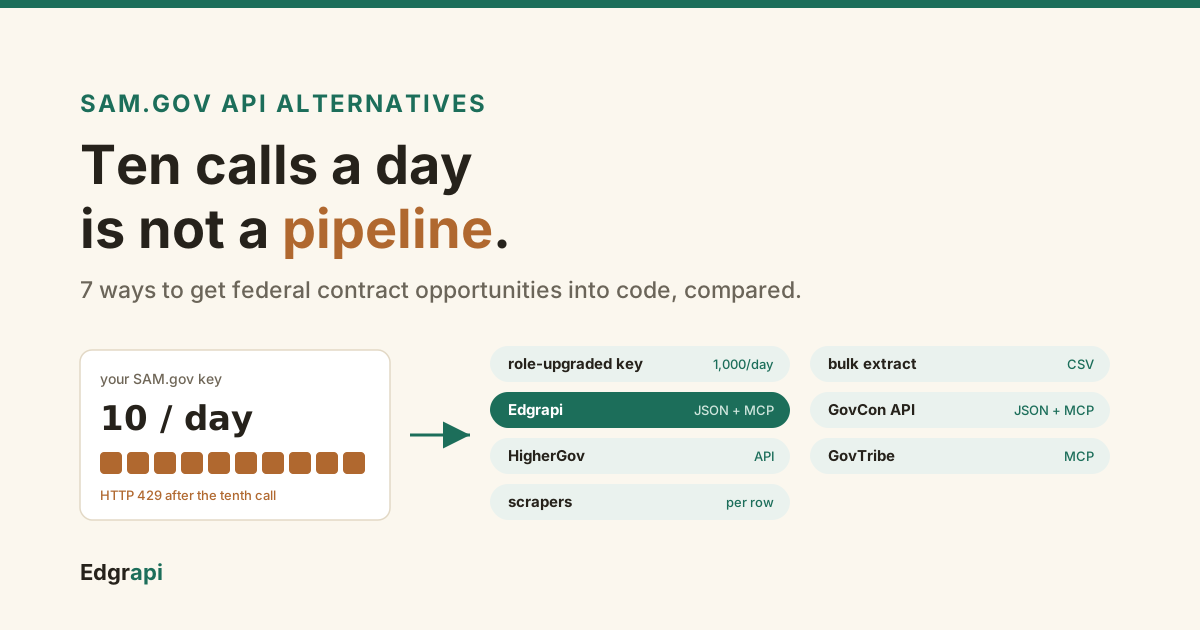
Ten calls a day. That is what a fresh SAM.gov API key gets you, and you can burn it before lunch.
The best SAM.gov API alternatives depend on what you are fighting. If it is the daily cap, first raise your own key from 10 to 1,000 calls a day for free. If you need clean JSON, more federal sources, or an AI agent tool, a normalized API like Edgrapi, GovCon API, or HigherGov does that work for you. Scrapers are cheap, but nothing you depend on should run on one.
I build on this data every day. So this list is written for people who call APIs, and the dashboards only show up where they ship one.
What are the best SAM.gov API alternatives in 2026?
The best SAM.gov API alternatives in 2026 are a role-upgraded SAM.gov key (free, 1,000 calls a day), the SAM.gov bulk extract, Edgrapi, GovCon API, HigherGov, GovTribe's MCP, and Apify scrapers. They fall into four groups: two official routes that stay free, developer APIs from about $120 a year, research platforms from $500 to $1,500 a year, and pay-per-row scrapers.
The whole field fits on one screen.
| Option | Needs your own SAM key? | Rate limit | Format | MCP for agents | Starting cost |
|---|---|---|---|---|---|
| SAM.gov API, role-upgraded key | Yes | 1,000 a day | Raw SAM JSON | No | Free |
| SAM.gov bulk extract | No | None (one file) | CSV | No | Free |
| Edgrapi | No | Credit-metered | Flat JSON | Yes | Free 50 credits, then $10/mo |
| GovCon API | No | 1,000 per hour | JSON | Yes | $19/mo |
| HigherGov API | No | Not published | JSON | Not listed | $500/yr |
| GovTribe MCP | No | Credit-billed | Agent tools | Yes | $1,500/yr + credits |
| Apify scrapers | Varies | Per run | JSON/CSV | No | ~$1.38 per 1,000 rows |
Every one of these reads the same federal source underneath. So the real choice is who holds the key and who cleans up SAM's JSON for you.
Why do developers look for a SAM.gov API alternative?
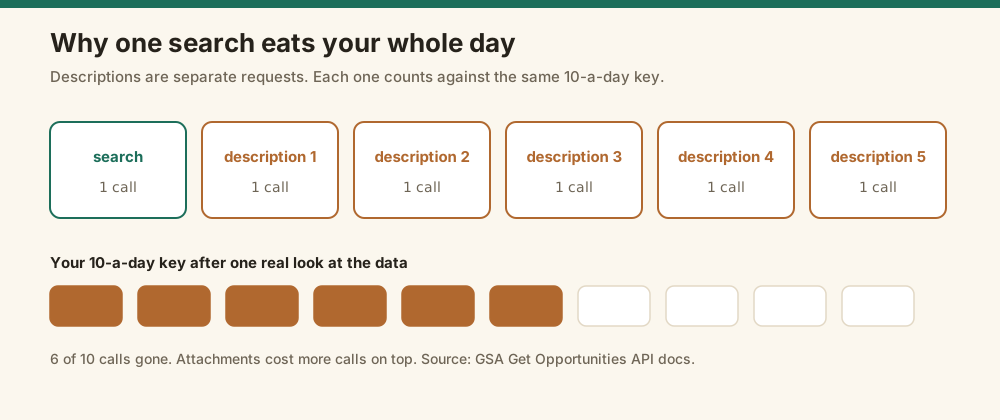
Developers look for a SAM.gov API alternative because the default key stops at 10 requests a day, and a single search quietly spends several of them. A non-federal key with no SAM.gov role gets 10 a day under GSA's own rate-limit table. Each notice's full description is another request on top, so one useful search can use up the day before you've written code worth keeping.
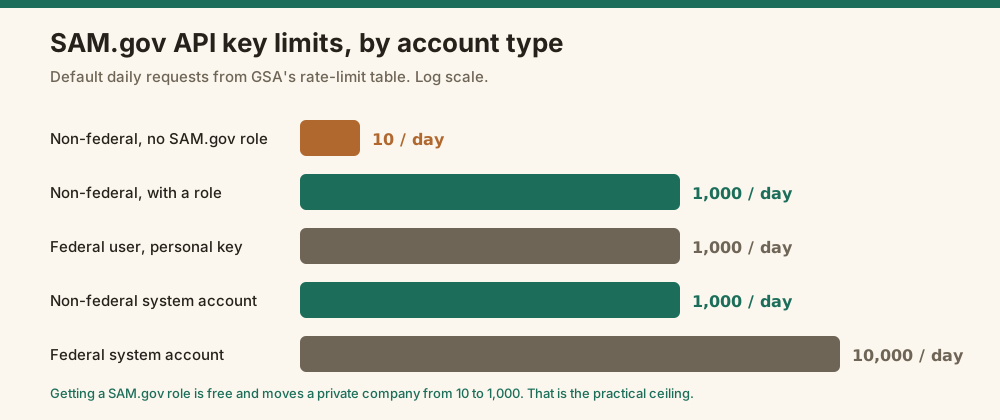
Those numbers are GSA's, not mine. Its API key rate limits table lists 10 requests a day for a non-federal user with no role, 1,000 with a role, and 10,000 only for a federal system account.
Why bother? Because the money is real. Federal agencies obligated a record of about $808 billion in contracts in fiscal 2025, up 4.8%, according to Bloomberg Government's year-end analysis.
Most of that work starts life on SAM.gov. Under FAR 5.101, any proposed contract action expected to exceed $25,000 has to be synopsized on the government's point of entry.
Hundreds of billions in contracts, and a key that lets you look ten times a day. That gap is why this list exists.
There's a second problem hiding behind the cap. The Get Opportunities API docs say the description comes back as a link, and you append your key to download it.
That means one search plus five descriptions is six calls. On a 10-a-day key, you get one real look at the data. Then you wait until tomorrow.
Can you fix the SAM.gov API rate limit without leaving SAM.gov?
Yes. The cheapest SAM.gov API alternative is a better SAM.gov key. Once you hold a role in SAM.gov, usually by registering your entity or getting added to one, a personal key jumps from 10 to 1,000 requests a day for free. Non-federal system accounts get 1,000 as well. Only federal system accounts reach 10,000, which makes 1,000 a day the practical ceiling for a private company.
Do this first, even if you plan to pay for something later.
A thousand calls a day is plenty for a nightly sync. Pull one day's postings with postedFrom and postedTo, page with limit up to 1,000 records per call, and store everything locally.
One day's pull against the official endpoint looks like this.
GET https://api.sam.gov/opportunities/v2/search
    ?api_key=YOUR_SAM_KEY
    &postedFrom=10/13/2026&postedTo=10/13/2026
    &ncode=541511&limit=1000&offset=0
Look at the dates. SAM wants MM/dd/yyyy in those two fields, so 2026-10-13 has to become 10/13/2026 first. Our own code converts every date before each call for exactly this reason.
There are two rules to know before you build on it.
The posted-date window can't span more than one year per query. And the key has to ride along on every request, including the description links.
The catch is everything SAM.gov doesn't do. You still get SAM's nested JSON, its MM/dd/yyyy dates, and one source. If you also need who won past contracts, that's a different API with a different shape.
I walked through the key setup step by step in how to get a SAM.gov API key, and the limits in detail in SAM.gov API rate limits.
The 7 SAM.gov API alternatives, ranked for developers
Between them, these seven options cover every practical way to get federal contract opportunities into code. My ranking is by how much work each takes off your plate per dollar, with brand size ignored. Free official routes lead, followed by normalized developer APIs, then research platforms, then scrapers. Each entry covers what it does well and where it falls short.
1. A role-upgraded SAM.gov key
The one most people skip. It's free, it's official, and it gives you 1,000 calls a day, which is room for a nightly sync of one day's postings with plenty to spare. You still parse SAM's JSON yourself.
2. The SAM.gov bulk extract
GSA publishes a Contract Opportunities extract through SAM.gov Data Services. It's one big file, no per-call cap.
The trade is freshness and shape. You download a CSV, load it, and diff it yourself. Check the file's date and row count before you trust a pipeline to it.
3. Edgrapi
This one is mine, so weigh my take on it accordingly.
Edgrapi's /v1/opportunities returns SAM.gov notices as flat JSON, and the SAM key it uses is ours, so your 10-a-day cap never comes into it. Filter by NAICS, set-aside, state, notice type, or title. Each call costs 2 credits, and an empty result costs nothing.
GET https://api.edgrapi.com/v1/opportunities?naics=541511&set_aside=SBA&state=VA
Authorization: Bearer YOUR_EDGRAPI_KEY
You get back flat records with the notice id, title, NAICS, set-aside, deadline, place of performance, and the sam.gov link. Dates are ISO.
The same key also reads USAspending awards, Grants.gov grants, House stock trades, and SEC filings, and it all works as an MCP server. Free tier: 50 credits. Starter: $10 a month for 10,000 credits, which is 5,000 opportunity calls.
Where it's weaker: no bid protests, wage determinations, or forecasts.
4. GovCon API
GovCon API is the strongest procurement specialist I've found. It's $19 a month for 1,000 requests an hour, with a 14-day trial at 50 requests a day.
It goes deeper into procurement than anything else here, with subawards, exclusions, wage determinations, forecasts, and GAO bid protests, plus an MCP server. Honestly, if I needed protest data, I'd start there.
5. HigherGov API
HigherGov's pricing page lists API access on every plan, starting with Starter at $500 a year. The API takes an api_key parameter and covers opportunities, contracts, grants, awardees, documents, and contract vehicles.
You're paying for a research platform and getting the API as a bonus. That's a good deal if your team will use the platform too.
6. GovTribe MCP
GovTribe starts at $1,500 a year for federal-only Launch. Its MCP server lets Claude and other AI tools search opportunities, awards, and vendors.
But MCP and GovTribe AI are billed in credits on top of the subscription, at 9 cents a credit pay-as-you-go. Think of it as a capture platform that happens to have an agent door.
7. Apify scrapers
Pay-per-result actors like this SAM.gov scraper start around $1.38 per 1,000 rows and say they need no key.
Fine for a one-off pull. Risky for anything recurring, which the next section explains.
Is there a SAM.gov API that doesn't need an API key?
Not an official one. Every request to the SAM.gov Get Opportunities API needs an api_key. Leave it off and GSA's docs say you get "No api_key was supplied." That leaves three keyless routes: the SAM.gov bulk extract, a wrapper like Edgrapi or GovCon API that holds the key for you, or a scraper. I'd only build a business on the first two.
Scraper listings rarely mention this part.
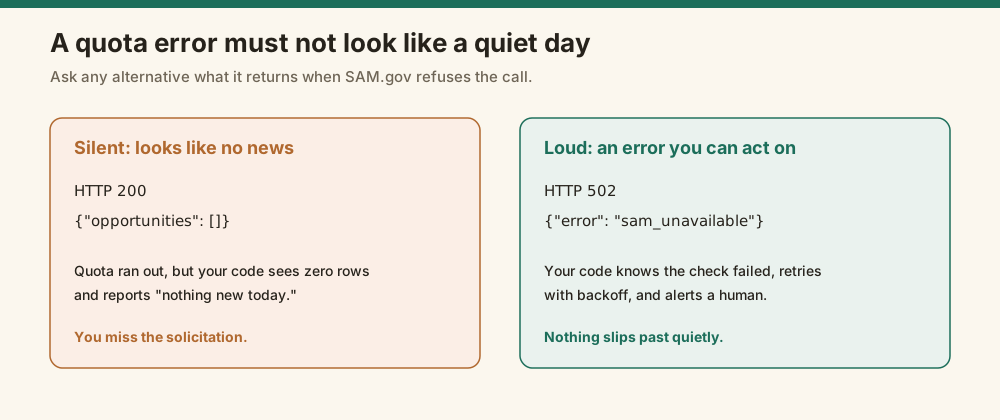
Any wrapper that holds one key inherits SAM.gov's caps. If that key runs dry, you get errors. A badly built tool gives you something worse: silence.
One Apify actor's own changelog describes exactly that. When the quota ran out, runs finished as clean zero-row results, which looked like "no new opportunities."
A missed solicitation looks identical to a quiet day. You only find out when a competitor wins it.
So whoever you pick, ask one question: what does your API return when SAM.gov says no? You want a loud error. Edgrapi, for example, sends a 502 with sam_unavailable in the body when SAM refuses a call, so your code can't mistake it for an empty day.
curl -H "X-API-Key: edgr_your_key" "https://api.edgrapi.com/v1/awards?recipient=lockheed"What should you check before you switch from the SAM.gov API?
Before you switch from the SAM.gov API, check five things: what the alternative returns when SAM.gov rate-limits it, how fresh its data is, which federal sources share one key, how it bills empty results, and whether you can export your data if you leave. A pricing page answers none of these, so ask the vendor or test the free tier against a known notice.
None of these show up on a pricing page, so test them yourself.
Start with errors. Run one filter you know has results and one you know is empty, and compare.
The two responses should look different. If both come back as an empty list, walk away.
Then freshness. SAM.gov posts notices through the day. A tool that syncs once a night can be up to 24 hours behind, which is fine for a 30-day response window and painful for a 5-day one.
Count your integrations too. If you need open bids today and award history next quarter, a tool that only does opportunities means building a second integration later.
Read the billing rules for empty results. Some APIs charge per call no matter what comes back. On Edgrapi, an empty result costs zero credits, so a broad daily poll that finds nothing is free.
And check the exit. If the only way to get your data out is a dashboard export capped at a few thousand rows, that tells you who owns your pipeline.
Which SAM.gov alternatives work with AI agents over MCP?
Three of the seven speak the Model Context Protocol, so AI agents can use them directly: Edgrapi, GovCon API, and GovTribe. Claude, or a Claude Code session, calls their tools and searches live opportunities right inside a conversation. With the raw SAM.gov API, the bulk extract, HigherGov, or a scraper, you write the glue code yourself first.
Contract search is a back-and-forth job, which is why MCP matters here. "Find small-business software contracts in Virginia closing this month" becomes three filters and one call, done by the agent.
Where they differ is billing and what sits behind each one.
GovTribe charges MCP usage in credits on top of an annual plan. GovCon API includes MCP in its monthly plans. Edgrapi meters MCP calls with the same credits as REST, and one key reaches opportunities, awards, grants, and SEC data.
If you want the setup, I covered it in the government data MCP server guide.
What does a government contract data API cost?
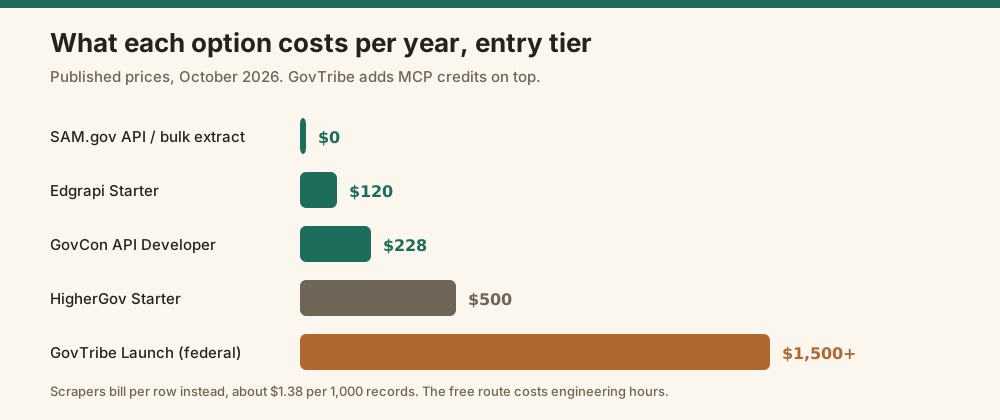
A government contract data API runs from free to several thousand dollars a year. You pay nothing for the official SAM.gov API or the bulk extract. Normalized developer APIs cost roughly $10 to $40 a month. HigherGov bundles its API into a $500-a-year plan, while GovTribe starts at $1,500 a year before MCP credits. Scrapers bill per row, around $1.38 per 1,000.
At the entry tier, using each vendor's published price as of October 2026, the yearly math works out like this.
| Option | Entry price | Per year |
|---|---|---|
| SAM.gov API or bulk extract | Free | $0 |
| Edgrapi Starter | $10/mo | $120 |
| GovCon API Developer | $19/mo | $228 |
| HigherGov Starter | $500/yr | $500 |
| GovTribe Launch (federal) | $1,500/yr + credits | $1,500+ |
That table only shows the sticker price, though.
A home-built pipeline on the free API costs engineering hours: retries, date parsing, dedupe on notice id, and a second integration for award data. If that's a weekend you'd enjoy, the free route wins.
If it isn't, $10 to $20 a month is cheaper than one afternoon of your time.
Which SAM.gov API alternative should you pick?
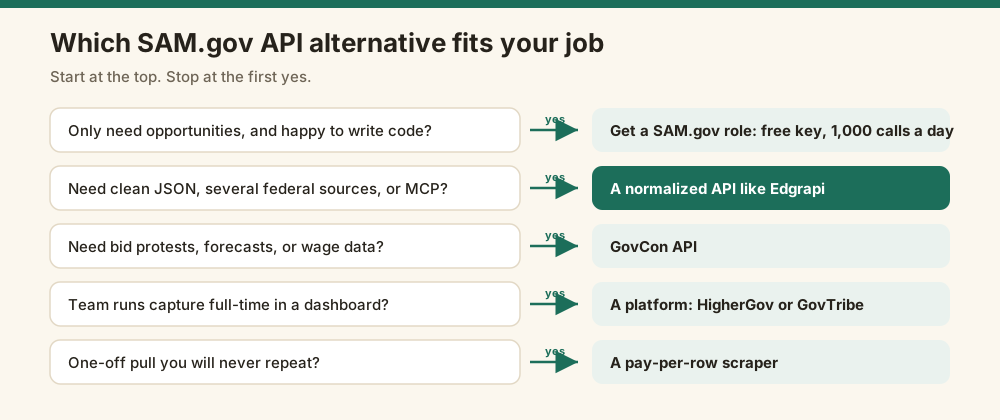
Pick by the job. If you only need opportunities and can write code, get a SAM.gov role and use the free 1,000-a-day key. If you need clean JSON, several federal sources, or an agent tool on one key, use Edgrapi. If you need procurement depth like protests and forecasts, use GovCon API. If your team runs capture full-time, a platform like HigherGov or GovTribe earns its price.
In practice, I'd decide like this.
Building a bid-matching feature into a product? Normalized JSON saves you the most code.
If your BD team already lives in a dashboard all day, buy the platform and treat its API as a bonus.
For a weekend prototype, the free key and a SQLite file are all you need. I'd start there even if you plan to pay later, because you'll learn what the raw data looks like.
And if an AI agent is the end user, pick something with MCP so you skip the tool-wrapping code.
And if you also care about who won past contracts, remember that's USAspending, not SAM.gov. An alternative that covers both saves a second integration.
Raise your key first, then pay only for what SAM.gov won't do
Start by getting a SAM.gov role today, because a free jump from 10 to 1,000 calls a day solves most cap problems. Then list what's still missing: clean JSON, award history, grants, an agent tool, or protest data. Pay for the one alternative that covers that gap. If it's several sources on one key, grab a free Edgrapi key and run your first opportunities call in under a minute.
Frequently asked questions
What are the best alternatives to the SAM.gov API?
The best alternatives to the SAM.gov API are a role-upgraded SAM.gov key with 1,000 free calls a day, the SAM.gov bulk extract, normalized APIs like Edgrapi and GovCon API, HigherGov's API on its $500-a-year plan, GovTribe's MCP, and Apify scrapers. Developers who need clean JSON and several federal sources on one key usually land on a normalized API.
How do I get around SAM.gov's 10 requests per day limit?
Get a role in SAM.gov. GSA's rate-limit table raises a non-federal personal key from 10 to 1,000 requests a day once you have a role, usually by registering your entity. Then cache results, pull one day of postings at a time, and page with up to 1,000 records per call. Or use a wrapper that holds its own key.
Is there a SAM.gov API that doesn't need an API key?
No official one. SAM.gov's Get Opportunities API requires an api_key on every request. Keyless routes are the SAM.gov bulk extract through Data Services, a normalized API like Edgrapi or GovCon API that holds the key for you, or a scraper. Scrapers can fail silently when their shared quota runs out, so avoid them for recurring jobs.
Which SAM.gov alternative has an MCP server for AI agents?
Edgrapi, GovCon API, and GovTribe all run MCP servers that let AI agents like Claude search federal contract opportunities directly. GovCon API includes MCP in its $19-a-month plan, GovTribe bills MCP in credits on top of a $1,500-a-year subscription, and Edgrapi meters MCP with the same credits as its REST API.
How much does a government contract data API cost?
The official SAM.gov API is free. Normalized developer APIs cost about $10 to $40 a month, such as Edgrapi Starter at $10 and GovCon API Developer at $19. HigherGov includes API access from $500 a year, and GovTribe starts at $1,500 a year plus MCP credits. Pay-per-row scrapers run around $1.38 per 1,000 records.
Why does my SAM.gov API call return 429?
A 429 means your key went over its rate limit. A non-federal key without a SAM.gov role gets only 10 requests a day, and each description download counts as a request. Wait for the window to reset, add a role to reach 1,000 a day, back off on retries, and never treat a 429 as an empty result.