What Is SEC Form 144? Who Files It, When, and Rule 144 Limits (2026)
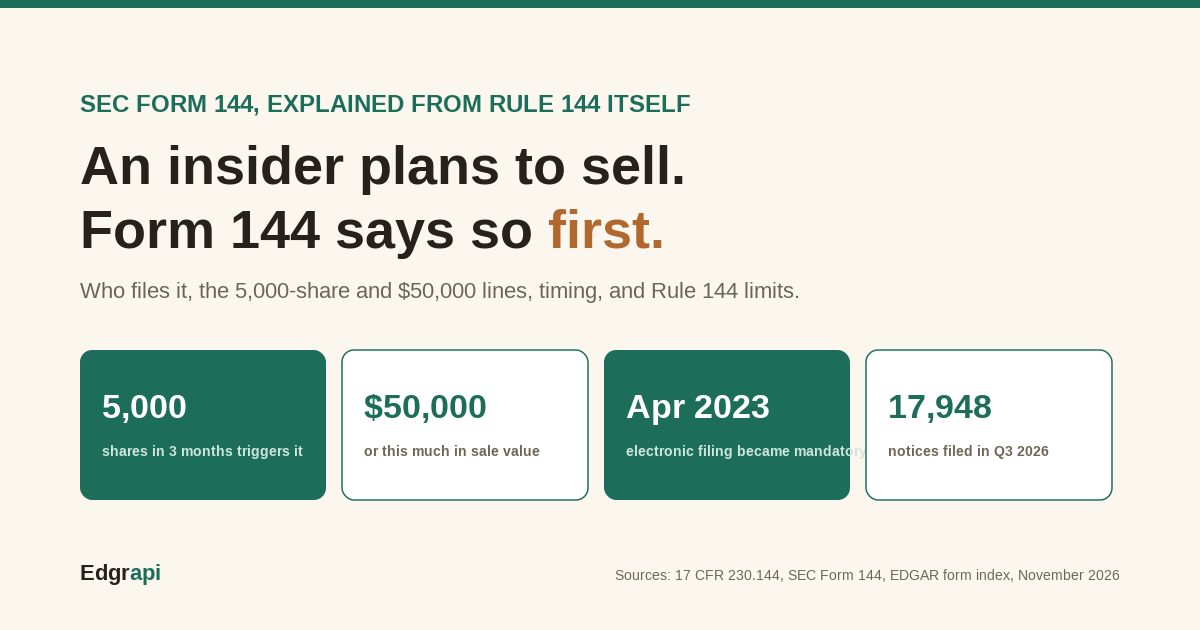
On November 4, 2026, Microsoft's chief marketing officer gave the SEC notice of a plan to sell 16,153 shares worth about $8.7 million. Six days later, 5,000 of them were sold.
SEC Form 144 is a notice an affiliate of a public company, such as an officer, director or large shareholder, files before selling restricted or control stock under Rule 144. It's required when the sale exceeds 5,000 shares or $50,000 in any three months, and it's filed when the sell order goes to the broker. It shows intent to sell, not a completed sale.
What is SEC Form 144?
SEC Form 144 is the "Notice of Proposed Sale of Securities" that a company insider files under Rule 144 of the Securities Act of 1933. It tells the SEC and the public that an affiliate plans to sell restricted or control securities, how many, roughly when, through which broker, and how they got the shares. It's a notice of intent, filed before or as the sale happens.
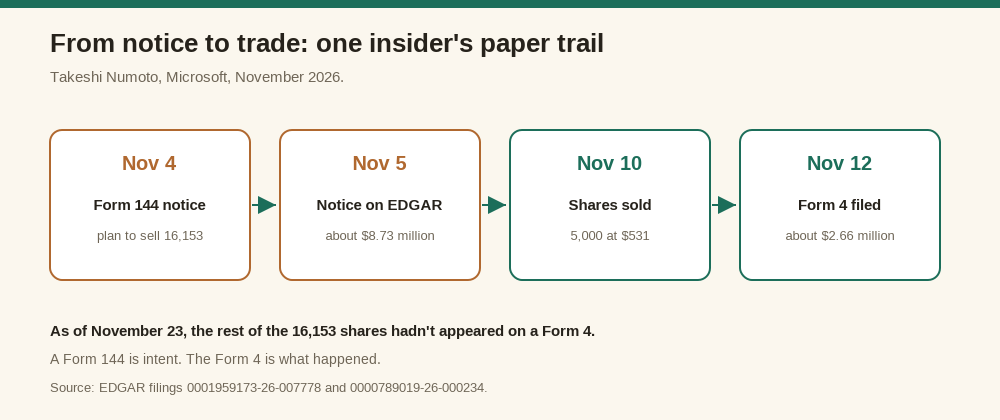
Form 144 sits at the front of the insider-selling paper trail. The notice comes first, the trade happens, then the insider reports the completed sale on a Form 4.
Most of what you'll see are executives selling stock they received as pay. Microsoft's notice from Takeshi Numoto lists the shares as a stock award and compensation.
The form has been filed on EDGAR, the SEC's public database, since 2023. That makes each notice public within minutes and readable as structured XML.
Who has to file a Form 144?
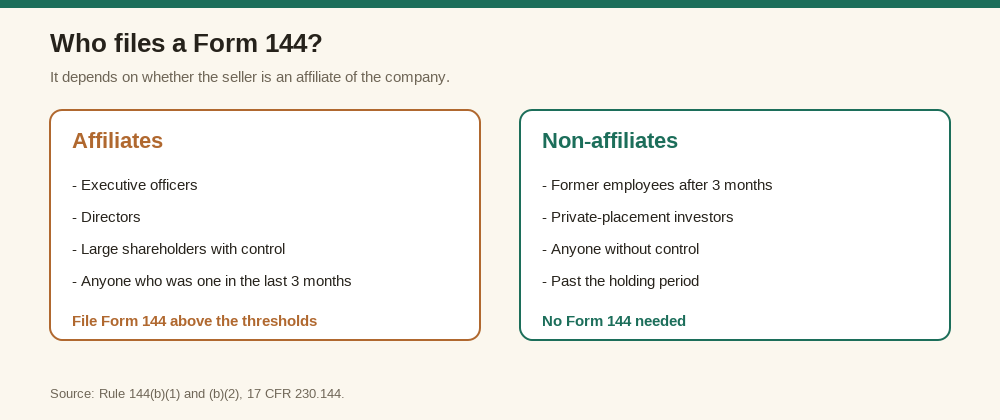
Affiliates of the company file Form 144. An affiliate is someone who controls the company, is controlled by it, or is under common control with it, which in practice usually means executive officers, directors and large shareholders. Under Rule 144(b)(1), non-affiliates selling restricted stock after the holding period don't file a Form 144 at all.
That split matters. A former employee selling vested shares a year after leaving the company typically has no Form 144 obligation.
An officer selling the same kind of shares does, because Rule 144(b)(2) makes affiliates meet every condition of the rule, including the notice.
Affiliate status isn't a title test. Someone can stop being an affiliate when they leave a role, but Rule 144 treats them as one for three months afterward.
When is a Form 144 required?
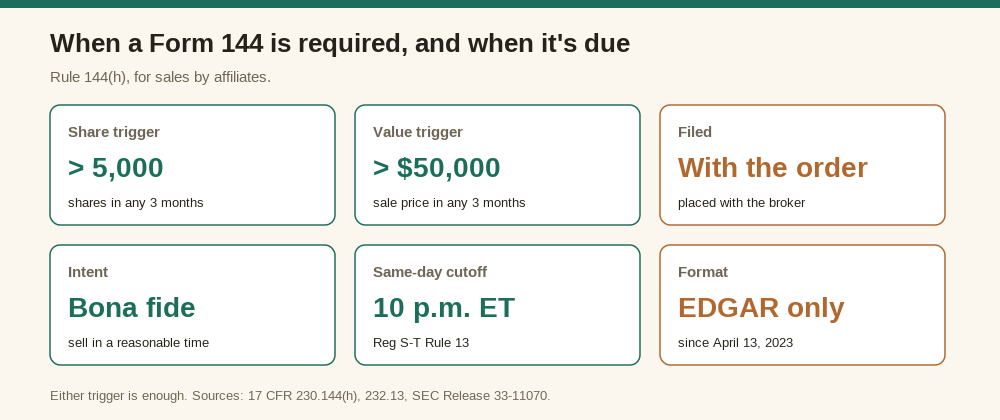
A Form 144 is required when an affiliate plans to sell more than 5,000 shares, or shares with a total sale price above $50,000, in any three-month period, under Rule 144(h). Both limits count every sale of that security by the seller over the three months, including earlier orders. Below both thresholds, no notice is needed.
The $50,000 line is low for a public company executive. At Microsoft's share price in November 2026, about 93 shares cleared it.
So most affiliate sales of any real size need a notice. That's why EDGAR sees thousands every month.
The threshold also explains the small Form 144s you'll find, a few thousand dollars over $50,000. Those are sellers who crossed the line by a little and had to file anyway.
When is a Form 144 due?
A Form 144 must be filed at the same time the seller places the sell order with a broker, or executes the sale directly with a market maker, under Rule 144(h)(3). The seller must have a bona fide intention to sell within a reasonable time after filing. Notices filed on EDGAR by 10 p.m. Eastern count as filed that day.
That timing is different from most insider forms. A Form 4 comes after the trade, within two business days, while a Form 144 comes with the order.
Electronic filing became mandatory on April 13, 2023. The SEC's 2022 rule gave filers six months after the October 13, 2022 EDGAR Filer Manual update to switch from paper.
Before that, most notices arrived on paper and were hard to find. The SEC's release counted 20,864 paper Form 144 filings in 2020 alone.
The 10 p.m. cutoff comes from Regulation S-T Rule 13, which lists Form 144 alongside Forms 3, 4 and 5 and Schedules 13D and 13G.
What does a Form 144 disclose?
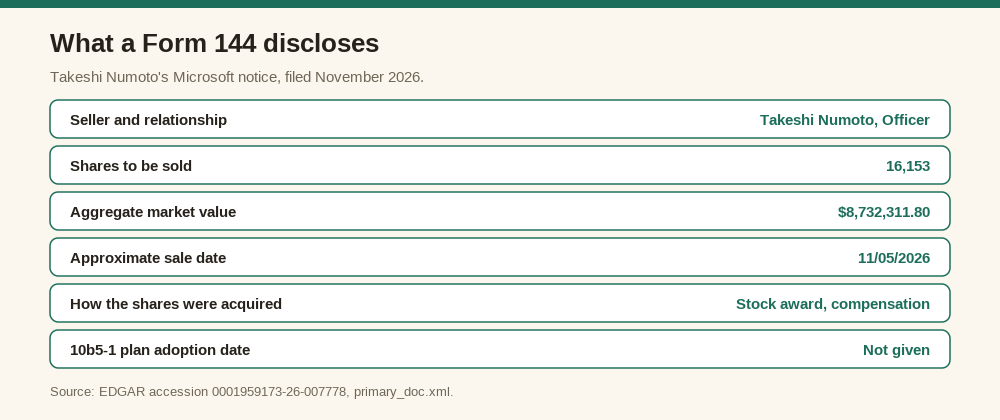
A Form 144 discloses the seller, their relationship to the company, the class and number of shares to be sold, their aggregate market value, the approximate sale date, the broker, how and when the seller acquired the shares, and any sales in the past three months. If the seller relies on a Rule 10b5-1 trading plan, it also gives the date the plan was adopted.
Here are the main fields, with the values from Numoto's Microsoft notice:
| Field | What it means | Microsoft example |
|---|---|---|
| Seller and relationship | Who is selling and why they're an affiliate | Takeshi Numoto, Officer |
| Shares to be sold | Units in this sale | 16,153 |
| Aggregate market value | Value at notice time | $8,732,311.80 |
| Approximate sale date | When the sale is expected | 11/05/2026 |
| How acquired | Stock award, option exercise, purchase | Stock award and compensation |
| Past three months | Earlier sales to aggregate | Reported separately |
| 10b5-1 plan date | When a trading plan was adopted, if used | Not given |
That 10b5-1 date is worth reading. On a November 2026 NVIDIA notice from executive Timothy Teter, it shows a plan adopted on May 22, 2026.
Signing the form is also a representation. Per the official Form 144, the seller states they don't know of material adverse information about the company that hasn't been disclosed, as of the plan date if they use one.
curl -H "X-API-Key: edgr_your_key" "https://api.edgrapi.com/v1/insider/AAPL"What is Rule 144?
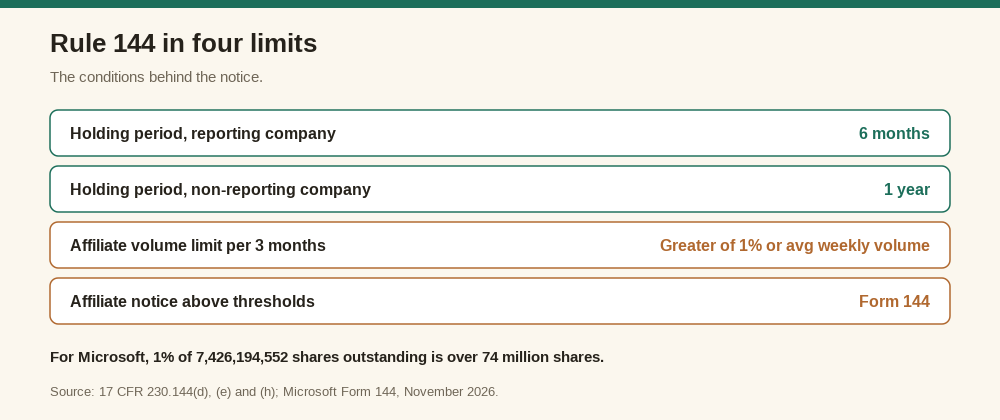
Rule 144 is the SEC rule that lets holders sell restricted and control securities publicly without registering the sale, if they meet its conditions. Restricted stock from a reporting company must be held at least six months, or one year for a non-reporting company. Affiliates also face a volume limit, manner-of-sale rules and the Form 144 notice, per 17 CFR 230.144.
The holding period starts when the shares are acquired from the company or an affiliate, per Rule 144(d). Stock awards to employees are often already registered, so the holding period matters more for private placements.
The volume limit applies only to affiliates. Under Rule 144(e), sales in any three months can't exceed the greater of 1% of the shares outstanding or the average weekly trading volume over the four calendar weeks before the notice.
For a mega-cap, that limit is huge. Microsoft's notice lists 7,426,194,552 shares outstanding, so 1% is over 74 million shares.
For a thinly traded small cap, the limit can bite. That's where the volume test decides how much an insider can sell in a quarter.
Rule 144 governs the sale. Form 144 is only the notice that goes with it. The SEC's own Rule 144 glossary entry walks through the conditions in plain English.
How is a Form 144 different from a Form 4?
A Form 144 is a notice of a planned sale, filed with the sell order under the Securities Act. A Form 4 reports a completed trade, filed within two business days after it under Section 16 of the Exchange Act. A Form 144 can cover shares that are never sold, or sold in pieces, so the Form 4 is the record of what actually happened.
Numoto's two filings show the gap:
| Form 144 | Form 4 | |
|---|---|---|
| Filed | November 5, 2026 | November 12, 2026 |
| What it says | Plans to sell 16,153 shares | Sold 5,000 shares on November 10 at $531 |
| Value | About $8.73 million | About $2.66 million |
| Legal basis | Securities Act Rule 144 | Exchange Act Section 16 |
As of November 23, the November 12 Form 4 was the only one Numoto had filed since the notice. The rest of the 16,153 shares hadn't shown up as sold.
That's normal. A notice can be followed by several Form 4s over weeks, or by fewer shares than planned.
My Form 4 explainer covers the trade report side, including the transaction codes.
How many Form 144s are filed?
EDGAR's form index lists 17,948 Form 144 filings in the third quarter of 2026, plus 220 amendments, almost exactly the 17,934 filed in the third quarter of 2024. That's roughly 70,000 notices a year. By November 20, the fourth quarter of 2026 already had 8,088.
I counted these from EDGAR's quarterly form index myself:
| Quarter | Form 144 | Form 144/A |
|---|---|---|
| Q3 2024 | 17,934 | 248 |
| Q3 2026 | 17,948 | 220 |
| Q4 2026 (to November 20) | 8,088 | 80 |
Compare that with the 20,864 paper filings the SEC counted for all of 2020. Electronic filing put every one of those notices on EDGAR, where anyone can read them the day they're filed.
How do you read a Form 144 as an investor?
Read the seller and relationship first, then the share count and market value against what they already own, then the acquisition type and the 10b5-1 date. A sale under an older trading plan says less about the insider's current view than an ad hoc sale. Then check the later Form 4s to see what was actually sold.
Context changes everything here. An executive selling 16,153 shares of Microsoft, a company with 7.4 billion shares outstanding, is routine pay liquidation.
The same dollar amount from a director of a small company, outside any plan, right before earnings, reads differently.
Clusters matter more than single notices. Several insiders filing Form 144s for the same company in the same week is more telling than any one notice.
And don't treat a notice as a done deal. As Numoto's filings show, the planned number and the sold number can differ.
How do you pull Form 144 filings with code?
Every electronic Form 144 on EDGAR has a primary_doc.xml with the notice fields as tags. Fetch it from the filing's folder and read the seller, share count, market value, sale date and plan adoption date. For a feed of notices by ticker, use EDGAR's daily index or a parsed API.
Here's a short reader for one notice:
import re, requests

UA = {"User-Agent": "Your Name your-email@example.com"}   # the SEC asks every client to identify itself

def read_144(cik, accession):
    folder = "https://www.sec.gov/Archives/edgar/data/%d/%s/" % (int(cik), accession.replace("-", ""))
    xml = requests.get(folder + "primary_doc.xml", headers=UA, timeout=30).text
    def tag(name):
        m = re.search(r"<(?:\w+:)?%s>(.*?)</" % name, xml, re.S)
        return m.group(1).strip() if m else None
    return {"seller": tag("nameOfPersonForWhoseAccountTheSecuritiesAreToBeSold"),
            "relationship": tag("relationshipToIssuer"), "shares": tag("noOfUnitsSold"),
            "market_value": tag("aggregateMarketValue"), "approx_sale_date": tag("approxSaleDate"),
            "plan_adopted": tag("planAdoptionDate")}

print(read_144(789019, "0001959173-26-007778"))   # a Microsoft officer's notice, November 2026
I ran it against Numoto's notice. It returned Officer, 16,153 shares, $8,732,311.80, a sale date of 11/05/2026, and no plan date.
Keep requests under the SEC's limit of 10 a second if you loop over many filings.
If you'd rather skip the XML, Edgrapi's /v1/form144 endpoint returns a ticker's notices as JSON for 3 credits a call. That's what I build, so weigh that. My Form 144 API guide covers matching notices to Form 4s in code.
Check the Form 4 before you draw a conclusion
When a Form 144 shows up in a feed, look at who filed it, the 10b5-1 date and the size against the company's float, then wait for the Form 4s. The notice tells you what an insider intends, and the Form 4 tells you what they did. Treat the gap between the two as information too.
Frequently asked questions
Who is required to file a Form 144?
Affiliates of a public company file Form 144, which usually means executive officers, directors and large shareholders who control or are under common control with the company. They must file before selling more than 5,000 shares or $50,000 of stock in any three months under Rule 144. Non-affiliates past the holding period don't file one.
When must a Form 144 be filed?
At the same time the seller places the sell order with a broker, or executes the sale directly with a market maker, under Rule 144(h)(3). The seller must intend to sell within a reasonable time. Notices are filed electronically on EDGAR, which became mandatory on April 13, 2023, and count as filed that day if sent by 10 p.m. Eastern.
What is the difference between Form 144 and Form 4?
A Form 144 is a notice of a planned sale, filed with the sell order under Rule 144 of the Securities Act. A Form 4 reports a completed trade within two business days under Section 16 of the Exchange Act. An insider can file a Form 144 and then sell fewer shares, or sell in pieces over several Form 4s.
Does a Form 144 mean the stock will go down?
No. A Form 144 shows an insider intends to sell, but most notices are routine sales of stock received as compensation, often under a 10b5-1 trading plan adopted months earlier. A single notice says little about the share price. Clusters of notices from several insiders, or large ad hoc sales, are more worth a closer look.
What is the Rule 144 holding period?
Six months for restricted securities of a company that has filed SEC reports for at least 90 days, and one year for a company that hasn't, under Rule 144(d). The clock starts when the shares are acquired from the company or an affiliate. Affiliates also face a volume limit of the greater of 1% of shares outstanding or average weekly volume.
Where can I find Form 144 filings?
On SEC EDGAR, under the company's filings or the seller's own filer page, with form type 144. Every electronic notice has a primary_doc.xml with the fields as tagged data. EDGAR's form index listed 17,948 Form 144s in the third quarter of 2026, and parsed APIs like Edgrapi return them by ticker as JSON.