WhaleWisdom Alternatives for 13F Data, Tested (2026)
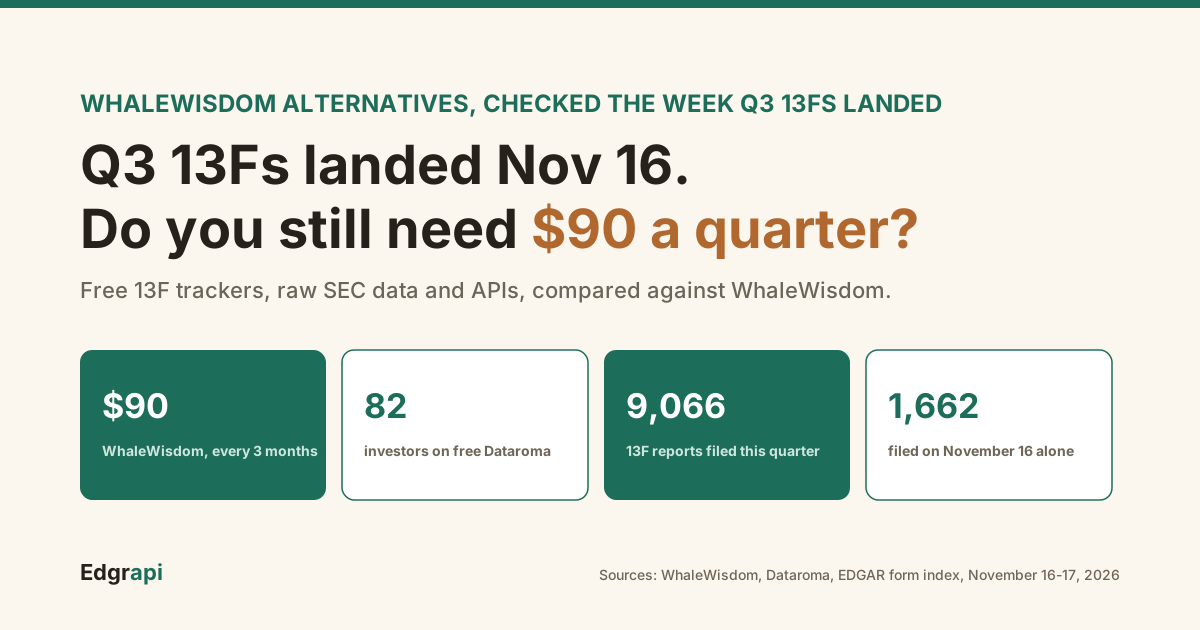
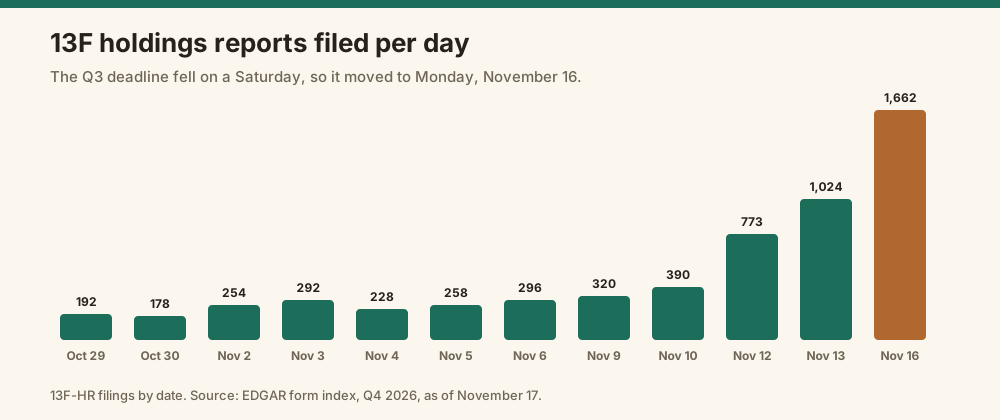
On Monday, November 16, 2026, 1,662 investment managers filed their 13F reports with the SEC. Berkshire Hathaway was one of them.
The best WhaleWisdom alternatives for 13F data depend on what you need. For free fund tracking, Dataroma covers 82 well-known investors and 13f.info covers every 13F filer, and both had Q3 2026 data within a day of the deadline. For raw data, the SEC's EDGAR is free. For code, a 13F API like Edgrapi or sec-api.io beats WhaleWisdom's 20-requests-a-minute API.
What is WhaleWisdom, and what does it cost?
WhaleWisdom is a 13F research site that tracks hedge fund and institutional holdings from SEC filings, with a backtester, stock screener, heat map, Excel add-in and developer API. Its standard plan costs $90 every three months, per its subscribe page on November 17, 2026, with no trial period and no refunds. Free users get recent quarters only: its API gives non-subscribers the last 8 quarters.
The free tier is generous for casual browsing. Its API documentation says non-subscribers get "the last 8 quarters worth of data not including the current quarter."
Subscribers get all quarterly 13F data. That full history is what you pay for, along with the backtester.
The billing terms are strict. The subscribe page lists one plan, $90 every 3 months, and says there is no trial period and no refunds once you subscribe.
That works out to $360 a year. It's reasonable for someone who backtests 13F strategies every week, and a lot for someone who checks Berkshire twice a year.
Which WhaleWisdom alternatives are free?
Four strong free WhaleWisdom alternatives exist. Dataroma tracks 82 superinvestors' portfolios. 13f.info searches every 13F filing and compares quarters. HedgeFollow tracks more than 10,000 funds plus insider and congressional trades. And SEC EDGAR publishes every 13F free. Edgrapi's superinvestor tracker is also free to search, with full portfolios on a $2.99 monthly plan.
Each one fits a different habit:
- Dataroma: a curated list of 82 well-known investors, like Buffett, Ackman and Klarman. Best for following a few names.
- 13f.info: every 13F filer, quarter-over-quarter comparisons, the holding history of any position, and which managers hold a given stock. It also shows 13D and 13G filings.
- HedgeFollow: says it tracks 10,000+ funds and 100,000+ insiders, and adds insider and congressional trade trackers. A free account lets you follow funds, and I found no paid tier on the site on November 17.
- SEC EDGAR: the source itself. Free and complete, but you read raw filings.
Dataroma's list is narrow on purpose. If the fund you care about isn't one of its 82, use 13f.info.
13f.info is the closest free match to WhaleWisdom's core 13F pages. It doesn't have WhaleWisdom's backtester.
How do the WhaleWisdom alternatives compare?
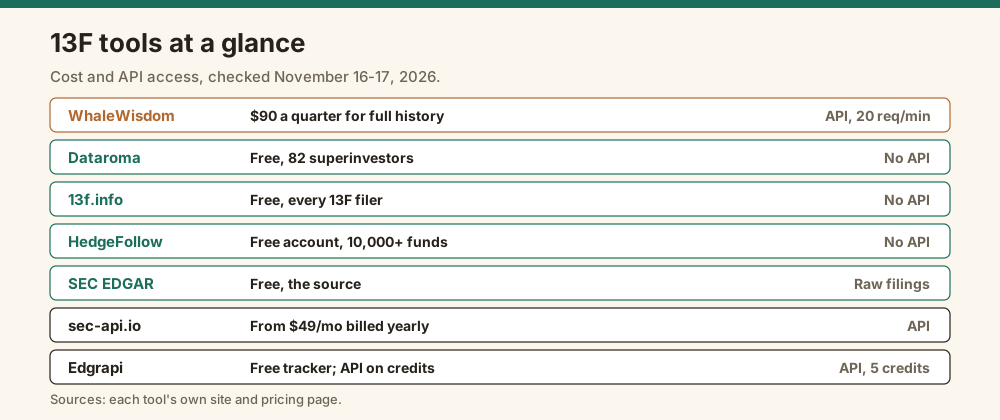
WhaleWisdom alternatives differ on coverage, history, price and whether they offer an API. Free sites like Dataroma, 13f.info and HedgeFollow cover browsing and alerts. WhaleWisdom's paid plan adds full history and a backtester at $90 a quarter. For code, the choice is between WhaleWisdom's API, sec-api.io from $49 a month billed yearly, Edgrapi's credit-based API, or the free SEC data itself.
Here's how they line up, checked November 16 and 17, 2026:
| Tool | Coverage | Cost | API | Had Berkshire's Q3 2026 13F (checked Nov 16-17)? |
|---|---|---|---|---|
| WhaleWisdom | All 13F filers | Free, recent quarters; $90 a quarter for full history | Yes, 20 requests a minute | Not checked |
| Dataroma | 82 superinvestors | Free | No | Yes, Q3 updates posted Nov 16 |
| 13f.info | All 13F filers | Free | No | Yes, Berkshire Q3 listed |
| HedgeFollow | 10,000+ funds | Free account | No | Not checked |
| SEC EDGAR | Everything filed | Free | Yes, raw filings | Yes, the source |
| sec-api.io | All filings | 100 free calls; $49/mo billed yearly | Yes | Not checked |
| Edgrapi | All 13F filers | Free tracker search; API on credits | Yes | Yes, Berkshire Q3 |
"Not checked" means I didn't verify that tool's Q3 timing. I'm not assuming it was late.
If you only browse, a free site covers you. The paid options earn their price when you need history, backtests or an API.
Where do 13F trackers get their data?
Every 13F tracker gets its data from the same place: Form 13F filings on SEC EDGAR. Managers with $100 million or more in Section 13(f) securities must file one, within 45 days after each quarter ends. EDGAR's index listed 9,066 original 13F holdings reports filed for the third quarter of 2026 as of November 17. The trackers differ in parsing, history and extras, not in the underlying data.
The SEC's Form 13F FAQ sets the $100 million threshold. The 45-day window is why every Q3 report lands by mid-November.
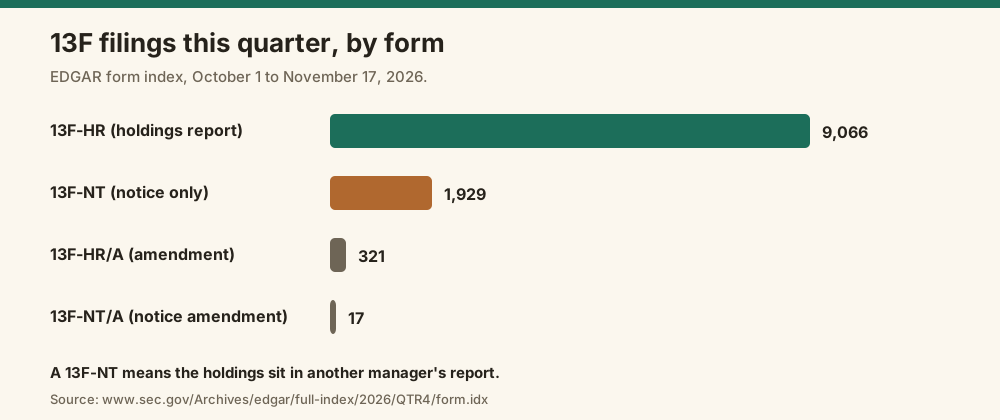
This quarter the deadline fell on Saturday, November 14, so it moved to Monday. That's why 1,662 reports arrived on November 16 alone.
Here's the filing count from EDGAR's quarterly form index, by type, as of November 17:
| Form | Filed this quarter |
|---|---|
| 13F-HR (holdings report) | 9,066 |
| 13F-NT (notice, holdings reported by another manager) | 1,929 |
| 13F-HR/A (amendment) | 321 |
| 13F-NT/A (notice amendment) | 17 |
Notice filings are a trap for beginners. A 13F-NT means the holdings sit in another manager's report, so looking up that filer shows nothing.
Because everyone reads the same filings, the numbers should match across tools. When they don't, it's usually a parsing choice, like how options or share classes are counted.
How fast do 13F tools update after the deadline?
Fast, for the ones that parse filings directly. Berkshire Hathaway filed its Q3 2026 13F on November 16. Dataroma updated its superinvestor pages that day, and when I checked on November 17, both 13f.info and Edgrapi's tracker showed Berkshire's Q3 report. The SEC's bulk 13F data sets are slower: the newest file, posted September 14, covers filings from June through August.
That bulk set is useful for research across thousands of funds. The latest one is a 100.7 MB ZIP.
But it trails the filings by months. If you want this quarter's 13Fs, read the filings or use a tool that parses them as they arrive.
Berkshire's report is a good test case. Through Edgrapi's API, it showed 30 positions worth $304.2 billion, with Apple still the largest at $75.9 billion and Bank of America cut by 5.7%.
Any of the fast tools would show you the same thing. The point is that you don't have to wait for a quarterly data dump.
curl -H "X-API-Key: edgr_your_key" "https://api.edgrapi.com/v1/insider/AAPL"How do you pull a 13F from EDGAR yourself?
To pull a 13F yourself, read the fund's filing list from the SEC's free submissions API, find the newest 13F-HR, open its folder's index.json, and parse the information table XML inside it. You need only a User-Agent header with your name and email. I ran the script below on Berkshire Hathaway on November 17, 2026, and it returned its November 16 filing.
import requests, xml.etree.ElementTree as ET

HEADERS = {"User-Agent": "Jane Smith jane@example.com"}
CIK = "0001067983"  # Berkshire Hathaway

subs = requests.get(f"https://data.sec.gov/submissions/CIK{CIK}.json", headers=HEADERS).json()
recent = subs["filings"]["recent"]
i = recent["form"].index("13F-HR")
acc = recent["accessionNumber"][i].replace("-", "")

folder = f"https://www.sec.gov/Archives/edgar/data/{int(CIK)}/{acc}/"
files = requests.get(folder + "index.json", headers=HEADERS).json()["directory"]["item"]
table = next(f["name"] for f in files if f["name"].endswith(".xml") and "primary_doc" not in f["name"])

root = ET.fromstring(requests.get(folder + table, headers=HEADERS).content)
ns = {"t": root.tag.split("}")[0].strip("{")}
rows = root.findall("t:infoTable", ns)
print(len(rows), "rows,", sum(int(r.find("t:value", ns).text) for r in rows), "dollars")
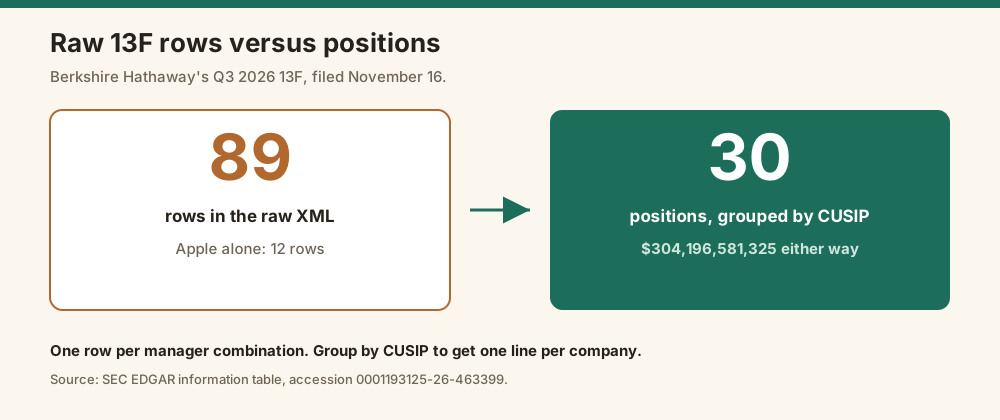
It printed 89 rows worth $304,196,581,325. That's the same total Edgrapi's API returned, so the two agree to the dollar.
But notice the row count. The raw filing has 89 rows, while the API showed 30 positions.
That's because a big filer like Berkshire reports the same stock in several rows, one for each combination of its managers. Apple alone appears in 12 rows. To get one line per company, you group rows by CUSIP and sum them, which gives exactly 30.
Then you map each CUSIP to a ticker and compare against last quarter's filing to see what changed. That's the work every 13F tool does for you, WhaleWisdom included.
If you skip the User-Agent header, the SEC returns 403. I covered that error in my SEC EDGAR 403 guide.
Which WhaleWisdom alternative has an API?
Three WhaleWisdom alternatives offer a 13F API: SEC EDGAR's free filing access, sec-api.io, whose $49-a-month personal plan includes institutional holdings data, and Edgrapi's /v1/holdings endpoint. WhaleWisdom's own API limits usage to 20 requests per minute and asks you to sign each request with a shared key and a secret key. Free sites like Dataroma, 13f.info and HedgeFollow don't offer an API.
WhaleWisdom's API isn't bad. It's just built around its own subscription and an older request-signing scheme.
If you're coding, the trade-offs look like this:
- SEC EDGAR, free: you parse the XML information tables and map CUSIPs to tickers yourself
- sec-api.io: broad SEC coverage; 100 free calls total, then from $49 a month billed yearly
- Edgrapi: a fund's latest 13F as JSON, with tickers resolved and every position labeled new, added, reduced or unchanged versus the prior quarter, 5 credits a call
Here's the Edgrapi call I ran for Berkshire:
curl -H "X-API-Key: edgr_your_key" "https://api.edgrapi.com/v1/holdings/berkshire?limit=10"It accepts a fund name, a CIK or a ticker. My 13F API guide covers the response in detail, and my hedge fund tracking guide covers the do-it-yourself route.
What can't 13F data tell you?
13F data can't show short positions, most non-equity holdings, or anything that happened after the quarter ended. The SEC's own FAQ says managers should not include short positions on Form 13F, and reports arrive up to 45 days after the quarter closes. So a 13F is a delayed, long-only snapshot. Every tracker, WhaleWisdom included, has the same blind spots.
That matters if you copy trades. By the time Berkshire's Q3 report appeared on November 16, the quarter had been over for seven weeks.
A fund that went short a stock looks, in 13F data, like a fund that simply sold it. You can't tell the difference from the filing.
Fresher signals exist. A 13D stake must be disclosed within days, and insider trades on Form 4 within two business days. My 13D and 13G guide covers those.
The SEC also notes on filings that it hasn't necessarily reviewed the data. Treat odd numbers as possible filing errors before you treat them as signals.
Which WhaleWisdom alternative should you use?
Use Dataroma if you follow a handful of famous investors, 13f.info if you want every 13F filer and quarter comparisons for free, and HedgeFollow if you also want insider and congressional trades in one place. Keep WhaleWisdom if you rely on its backtester or full history. For code, use the SEC's free data, sec-api.io, or Edgrapi's 13F API.
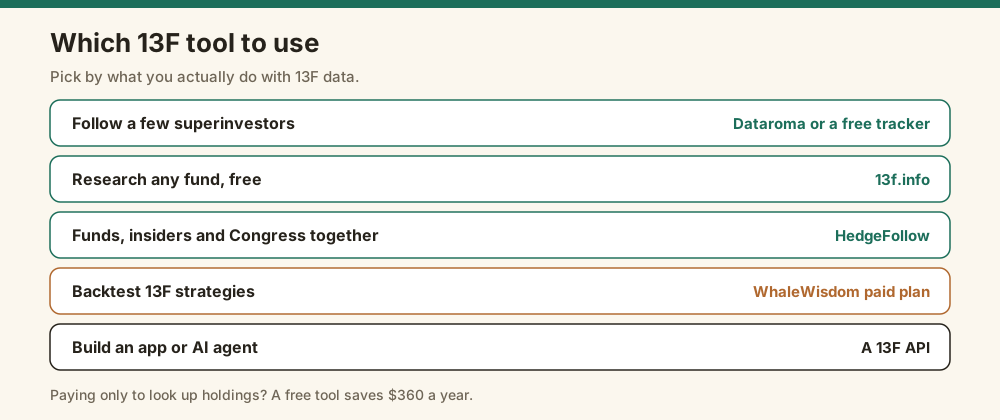
My picks by situation:
- Follow a few superinvestors: Dataroma, or Edgrapi's free superinvestor tracker
- Research any fund for free: 13f.info
- Hedge funds, insiders and Congress in one place: HedgeFollow
- Backtest 13F strategies: WhaleWisdom's paid plan
- Build an app or an AI agent on 13F data: a 13F API
If you're paying WhaleWisdom only to look up holdings, a free tool will save you $360 a year.
Start free, then pay for what you actually use
Try Dataroma or 13f.info on the two or three funds you check most, and see whether you miss anything WhaleWisdom gave you. If the answer is the backtester or full history, WhaleWisdom's $90 a quarter is fair. If it's data inside your own code, use a 13F API instead and pay per call.
Frequently asked questions
Is WhaleWisdom free?
Partly. WhaleWisdom is free to browse for recent quarters, and its API gives non-subscribers the last 8 quarters of 13F data, not counting the current quarter. Full history, the backtester and other premium tools need its standard plan, which cost $90 every three months on November 17, 2026, with no trial and no refunds.
What is a free alternative to WhaleWisdom?
The best free alternatives to WhaleWisdom are 13f.info, which covers every 13F filer with quarter comparisons, Dataroma, which tracks 82 superinvestors, and HedgeFollow, which adds insider and congressional trades. All three are free. SEC EDGAR is also free, since it's where every 13F filing comes from, though you read the raw filings yourself.
Are 13F filings publicly available?
Yes. Every Form 13F is public on SEC EDGAR, free, with no account needed. Investment managers with $100 million or more in Section 13(f) securities must file within 45 days after each quarter ends. EDGAR listed 9,066 original 13F holdings reports filed for the third quarter of 2026 as of November 17.
How much does WhaleWisdom cost?
WhaleWisdom's standard plan costs $90 every three months, or $360 a year, per its subscribe page on November 17, 2026. The page lists no trial period and says there are no refunds once you subscribe. You can cancel anytime, and the cancellation takes effect when the current period ends.
Does WhaleWisdom have an API?
Yes. WhaleWisdom has a developer API limited to 20 requests per minute, and each request is signed with a shared access key and a secret access key. Subscribers get all quarterly 13F data through it, and non-subscribers get the last 8 quarters, not counting the current quarter.
When are 13F filings due?
13F filings are due within 45 days after the end of each calendar quarter, so Q3 reports were due November 14, 2026. Because that date fell on a Saturday, the deadline moved to Monday, November 16, when 1,662 managers filed, according to EDGAR's filing index.