What Is a Schedule 13D? Filing Rules, Deadlines and 13D vs 13G (2026)

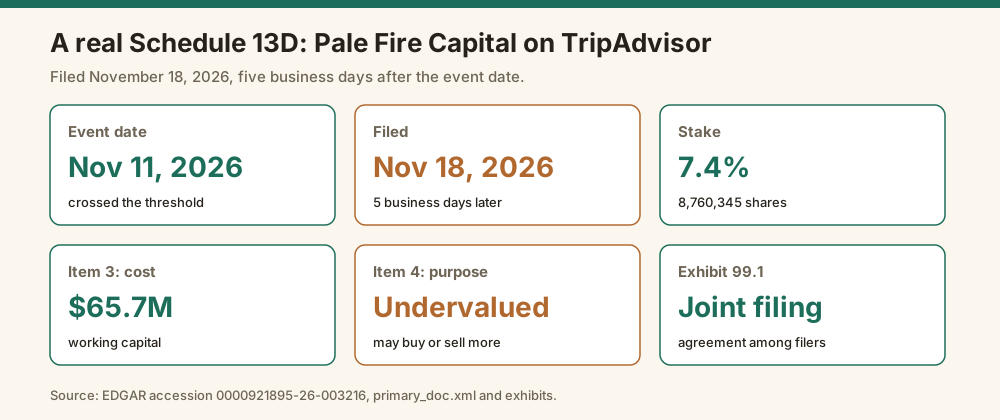
On November 18, 2026, a Czech investment group told the SEC it owned 7.4% of TripAdvisor. It had crossed the line a week earlier, and the law gave it five business days to say so.
A Schedule 13D is the SEC filing an investor must make within five business days of acquiring more than 5% of a public company's voting stock with any intent to influence control. It discloses who the investor is, how much they own, how they paid, and what they plan to do. Investors without control intent can usually file the shorter Schedule 13G instead.
What is a Schedule 13D filing?
A Schedule 13D is a beneficial ownership report filed with the SEC under Section 13(d) of the Securities Exchange Act. Anyone who acquires more than 5% of a class of a company's registered voting equity must file one, unless they qualify for the shorter Schedule 13G. It names the owner, the size of the stake, the source of the money, and the investor's plans for the company.
People call it the activist filing, and that's mostly fair. A 13D is how the market learns that someone big might push for board seats, a sale, or a new strategy.
But not every 13D comes from an activist. Founders, insiders and strategic buyers file them too, because the 13G shortcut isn't open to anyone who might influence control.
The filing lives on EDGAR, the SEC's public database, next to the company's own 10-Ks and 8-Ks. Since December 2024 the main body of every 13D is structured XML, so you can read the key fields with code.
Who has to file a Schedule 13D?
Anyone who beneficially owns more than 5% of a class of voting equity securities registered under Section 12 of the Exchange Act must file a Schedule 13D, per SEC Rule 13d-1. That includes individuals, funds, companies and groups acting together. Investors who qualify as passive, qualified institutional or exempt can file the shorter Schedule 13G instead.
"Beneficial owner" is broader than it sounds. It covers anyone with voting or investment power over the shares, directly or through a fund, trust or agreement.
Groups count as one owner. If three funds agree to act together on a company, their stakes add up, and each one can end up filing.
That's why many 13Ds list several reporting persons. Pale Fire Capital's TripAdvisor filing names its SICAV fund, its investment company, its holding company and the people who control them, all at 7.4%.
What is the Schedule 13D filing deadline?
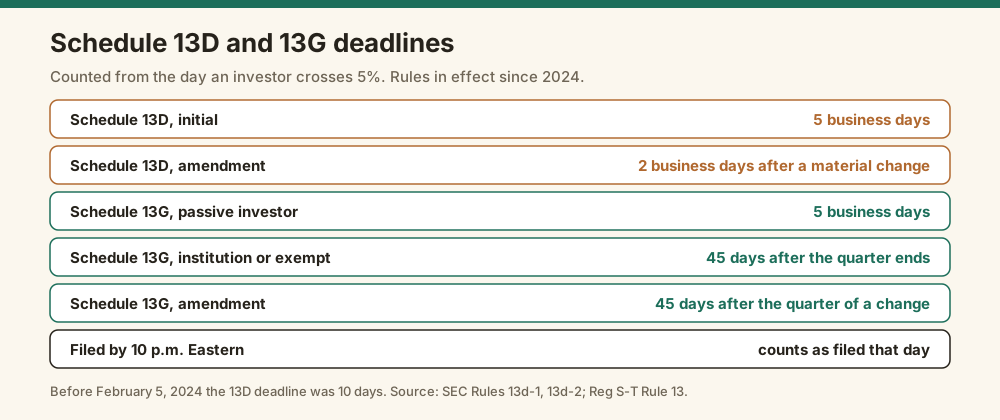
An initial Schedule 13D is due within five business days after the investor crosses 5%, under SEC Rule 13d-1(a). Amendments are due within two business days of a material change. Both deadlines took effect on February 5, 2024, replacing a 10-day window that had stood since 1968, per the SEC's fact sheet on the rule. Filings sent by 10 p.m. Eastern count as filed that day.
The SEC's press release on the 2023 amendments quotes then-Chair Gary Gensler saying it "shouldn't take 10 days" for the public to learn about an attempt to influence control of a company.
The effective date comes from the rule's publication in the Federal Register on November 7, 2023, plus 90 days.
Business days skip weekends and federal holidays. The TripAdvisor stake is a clean example: the event date was November 11, 2026, Veterans Day, and the filing went in on November 18, exactly five business days later.
The 10 p.m. cutoff comes from Regulation S-T Rule 13, which now covers Schedules 13D and 13G alongside Forms 3, 4 and 5. Before the change, most filings had to be in by 5:30 p.m.
What's in a Schedule 13D?
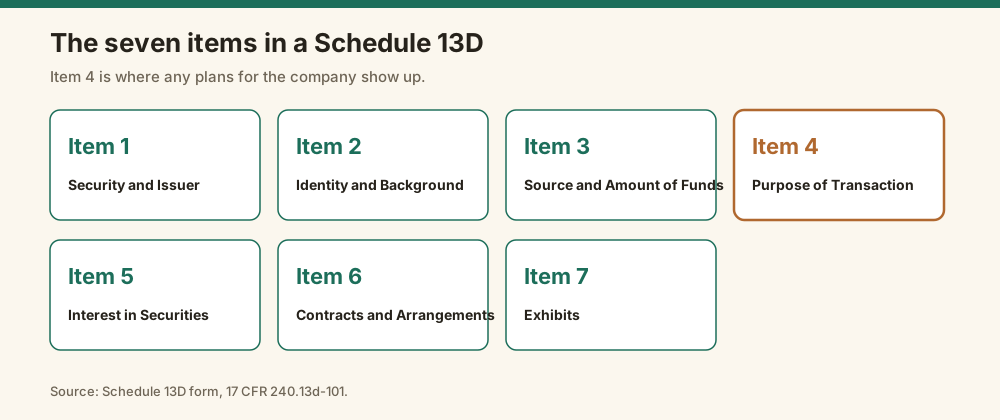
A Schedule 13D has seven items: the security and issuer, the filer's identity and background, the source and amount of funds, the purpose of the transaction, the filer's interest in the company's securities, any related contracts or arrangements, and exhibits. Item 4, the purpose of the transaction, is the one investors read first, because it's where activist plans show up.
Here's what each item covers, per the form in 17 CFR 240.13d-101:
| Item | Name | What it tells you |
|---|---|---|
| 1 | Security and Issuer | Which company and class of stock |
| 2 | Identity and Background | Who the filers are, and any past violations |
| 3 | Source and Amount of Funds | How much the stake cost and where the money came from |
| 4 | Purpose of Transaction | What the investor plans to do |
| 5 | Interest in Securities | Shares, percent of class, recent trades |
| 6 | Contracts and Arrangements | Derivatives, voting deals, lending agreements |
| 7 | Exhibits | Joint filing agreements, letters, presentations |
On the TripAdvisor filing, Item 3 says Pale Fire paid about $65.7 million in working capital for 8,760,345 shares. Item 4 says it bought them believing the shares "were undervalued."
That Item 4 is close to boilerplate. Plenty of 13Ds start that way and add a letter to the board in a later amendment.
The exhibits are where activist campaigns get loud. When an investor attaches a letter or a slide deck to a 13D, it's usually making a public demand.
What's the difference between a 13D and a 13G?
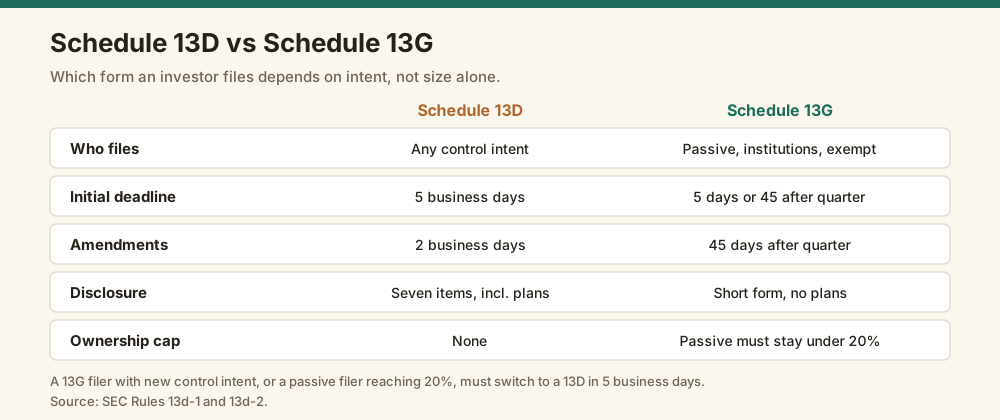
A Schedule 13D is for investors who might influence control of a company, and a Schedule 13G is a shorter form for investors who won't. Passive investors with less than 20% file a 13G within five business days. Qualified institutional and exempt investors file within 45 days after the quarter they cross 5%. A 13D needs far more detail, especially about plans.
Here's how the two compare after the 2023 amendments:
| Schedule 13D | Schedule 13G | |
|---|---|---|
| Who files | Investors with any control intent | Passive investors, qualified institutions, exempt investors |
| Initial deadline | 5 business days | 5 business days (passive); 45 days after quarter-end (institutions, exempt) |
| Amendment deadline | 2 business days after a material change | 45 days after the quarter of a material change |
| Disclosure | Seven items, including plans | Short form, no plans section |
| Ownership cap | None | Passive filers must stay under 20% |
The switch from 13G to 13D is where people get caught. Rule 13d-1(e) says a 13G filer who develops control intent must file a 13D within five business days.
The 20% line works the same way. A passive filer who reaches 20% must file a 13D within five business days, and can't vote those shares or buy more until 10 days after that 13D is filed.
So a fund changing its 13G to a 13D on the same company is news in itself. It usually means the fund has stopped being passive.
My 13F filing explainer covers the quarterly holdings reports funds file separately.
curl -H "X-API-Key: edgr_your_key" "https://api.edgrapi.com/v1/insider/AAPL"When do you have to amend a Schedule 13D?
You must amend a Schedule 13D within two business days of any material change to the facts in it, under SEC Rule 13d-2(a). Buying or selling 1% or more of the class is automatically material, and smaller changes can be material depending on the facts. A new plan, a board demand or a new agreement usually counts too. Amendments are filed on EDGAR as Schedule 13D/A.
Amendments are where most of the action is. In the third quarter of 2026, EDGAR's form index shows 1,952 13D amendments against 540 new 13Ds.
That ratio makes sense. A fund files one 13D when it crosses 5%, then amends every time its stake moves 1% or its plans change.
13G amendments run on a slower clock. Under Rule 13d-2(b), a 13G filer amends within 45 days after the end of any quarter in which something material changed.
How many Schedule 13D filings are there?
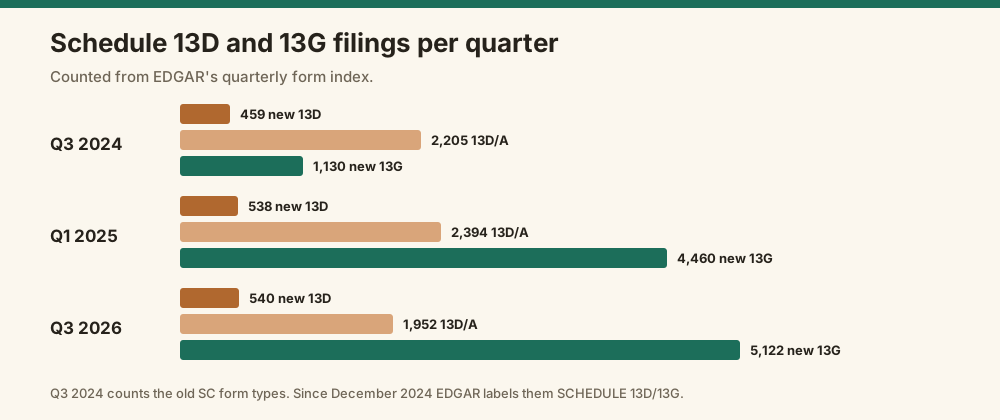
EDGAR's form index for the third quarter of 2026 lists 540 new Schedule 13D filings and 1,952 amendments, against 5,122 new Schedule 13G filings and 8,074 13G amendments. Since the structured-data rules took effect in December 2024, EDGAR labels these forms SCHEDULE 13D and SCHEDULE 13G instead of the older SC 13D and SC 13G.
I counted these from EDGAR's quarterly form index myself:
| Quarter | New 13D | 13D/A | New 13G | 13G/A |
|---|---|---|---|---|
| Q3 2024 | 459 | 2,205 | 1,130 | 1,844 |
| Q1 2025 | 538 | 2,394 | 4,460 | 9,230 |
| Q3 2026 | 540 | 1,952 | 5,122 | 8,074 |
Q3 2024 counts only the old SC form types. A few dozen filings that quarter already used the new SCHEDULE labels.
The form-name change matters if you search EDGAR by form type. A script that filters on "SC 13D" quietly misses almost everything filed since early 2025.
The jump in 13G filings since 2024 is consistent with the new quarterly deadlines for institutions, which used to file once a year.
How do you read a Schedule 13D as an investor?
Read Item 4 first for the investor's plans, then Item 5 for the exact stake and recent trades, then the exhibits for any letter or demand. Compare against earlier amendments, because the change in language matters more than any single filing. A 13D is a disclosure of intent, not a promise, and many filers never push for anything.
Watch for the shift. A 13D that starts with "undervalued" and later adds a letter about board seats is an escalating campaign.
The SEC's own glossary entry is a short plain-English version if you want the official summary.
And keep the filer type in mind. A 13D from a company founder after an IPO means something very different from one filed by a hedge fund known for proxy fights.
My guide on how to track smart money puts 13Ds next to insider Form 4s and 13F holdings.
How do you pull Schedule 13D filings with code?
Every Schedule 13D on EDGAR since December 2024 has a primary_doc.xml file with the cover page and items as tagged fields. You can fetch it from the filing's folder and read the event date, percent of class and purpose directly. For a market-wide feed of new filings, use EDGAR's daily index or a parsed API.
Here's a short reader for one filing:
import re, requests

UA = {"User-Agent": "Your Name your-email@example.com"}   # the SEC asks every client to identify itself

def read_13d(cik, accession):
    folder = "https://www.sec.gov/Archives/edgar/data/%d/%s/" % (int(cik), accession.replace("-", ""))
    xml = requests.get(folder + "primary_doc.xml", headers=UA, timeout=30).text
    def tag(name):
        m = re.search(r"<(?:\w+:)?%s>(.*?)</" % name, xml, re.S)
        return re.sub(r"\s+", " ", m.group(1)).strip() if m else None
    return {"event_date": tag("dateOfEvent"), "percent": tag("percentOfClass"),
            "shares": tag("aggregateAmountOwned"), "purpose": (tag("transactionPurpose") or "")[:200]}

print(read_13d(1526520, "0000921895-26-003216"))   # Pale Fire Capital's 13D on TripAdvisor
I ran it against the TripAdvisor filing. It returned an event date of 11/11/2026, 7.4%, 8,760,345 shares, and the "undervalued" purpose text.
The folder path works under the company's CIK or any filer's CIK on that filing. The SEC also caps request rates at 10 a second, so pace any loop.
If you'd rather not parse XML, Edgrapi's /v1/activist endpoint returns the market-wide feed as JSON. That's what I build, so weigh that, but each record carries the issuer, CUSIP, event date, top percent and every reporting person.
A call costs 5 credits. The 13D and 13G API guide shows the requests and filters.
Read the filing, not the headline
When a 13D hits the news, open the filing on EDGAR and read Items 4 and 5 before you react. Check whether it's a new 13D or an amendment, how far past 5% the stake goes, and whether there's a letter attached. Then pull the filer's earlier 13Ds on other companies, because their history tells you more than one filing will.
Frequently asked questions
Who needs to file a Schedule 13D?
Anyone who acquires beneficial ownership of more than 5% of a class of a public company's registered voting equity must file a Schedule 13D, unless they qualify for the shorter Schedule 13G. That includes individuals, funds, companies and groups acting together. Investors with any intent to influence control of the company must use the 13D.
How long do you have to file a Schedule 13D?
Five business days after crossing 5%, under SEC Rule 13d-1(a). Amendments are due within two business days of a material change, and buying or selling 1% of the class is automatically material. These deadlines took effect on February 5, 2024. Before that, investors had 10 days for the initial filing.
What is the difference between a 13D and a 13G?
A 13D is the full ownership report for investors who might influence control, with seven items including their plans. A 13G is a short form for passive investors under 20%, qualified institutions and exempt investors. Passive 13G filers have five business days, and institutions have 45 days after the quarter-end.
What is a Schedule 13D/A?
A Schedule 13D/A is an amendment to an earlier 13D. Filers must submit one within two business days of any material change, such as buying or selling 1% or more of the class, changing their plans, or signing a new agreement. In the third quarter of 2026, EDGAR logged 1,952 13D amendments against 540 new 13Ds.
Is a 13D filing good for a stock?
Not necessarily. A 13D shows that an investor owns more than 5% and might seek influence, but it doesn't predict the share price. Some 13Ds lead to board changes or a sale, while many filers never push for anything. Read Item 4 for stated plans and watch later amendments for any escalation.
Where can I find Schedule 13D filings?
On SEC EDGAR, either through a company's filing list or the full-text search. Since December 2024, EDGAR labels them SCHEDULE 13D, so search that form type along with the older SC 13D for earlier years. For code, each filing's primary_doc.xml holds the key fields, and parsed APIs like Edgrapi return them as JSON.