What Is SEC EDGAR? A Plain-English Guide (2026)
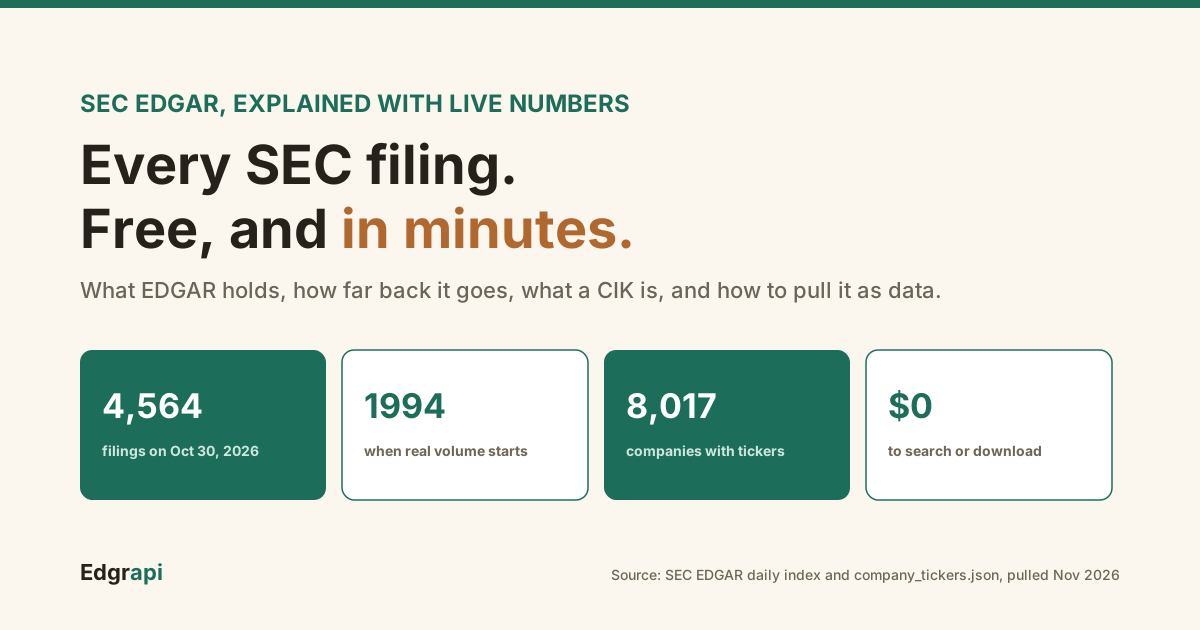
On October 30, 2026, companies, funds and insiders sent 4,564 filings to the SEC. Each one was free to read, usually within minutes.
They all went through EDGAR. SEC EDGAR is the Securities and Exchange Commission's system for receiving filings and its free public database of them. EDGAR stands for Electronic Data Gathering, Analysis, and Retrieval. Annual reports, insider trades, IPO prospectuses and fund holdings all land there. Here's what's on it, how far back it goes, and how to use it, checked against the SEC's own data.
What is SEC EDGAR?
SEC EDGAR is the Securities and Exchange Commission's electronic filing system and the public database it feeds. Companies and others use it to submit documents required under the Securities Act of 1933, the Securities Exchange Act of 1934, the Trust Indenture Act of 1939 and the Investment Company Act of 1940. Anyone can search and read the filings for free, and the SEC says it handles about 4,700 filings a day.
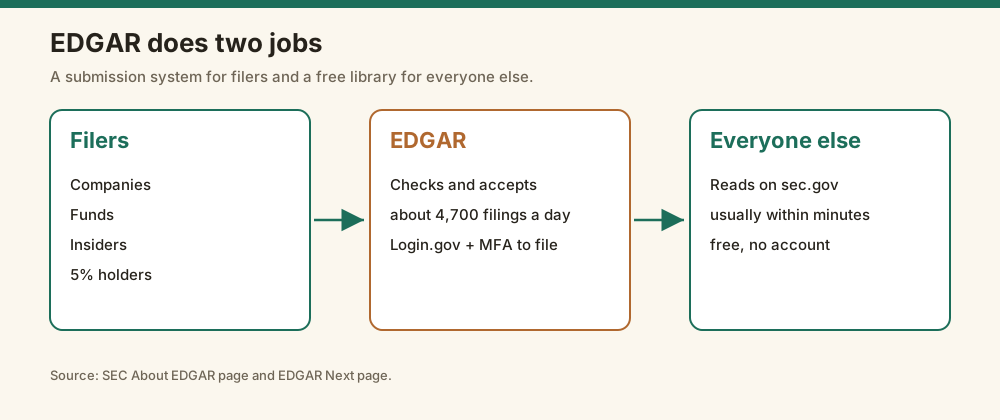
EDGAR does two jobs, and people mix them up.
For filers, it's the submission system. A company's lawyers or filing agent upload the document, and EDGAR checks and accepts it.
For everyone else, it's a library. The same filing shows up on sec.gov, usually within minutes.
For scale, the SEC's About EDGAR page says the system serves "3,000 terabytes of data to the public annually" and adds about 40,000 new filers a year.
Is SEC EDGAR free?
Yes. SEC EDGAR is completely free to search and read, with no account, subscription or key. The SEC's own page says "Access to EDGAR's public database is free." That includes the search pages, every filing document, and the SEC's data APIs. Paid services exist, but they sell convenience, analysis or a cleaner API, not access to the filings themselves.
Free didn't always mean instant. Before May 2002, filings took "at least 24 hours" to appear on the SEC's website, according to the SEC's 2002 announcement.
Since then, filings post "within minutes of filing." A student and a hedge fund read the same feed.
There's one rule for automated access. The SEC asks scripts to send a User-Agent header and stay under 10 requests per second. In my tests, requests with no User-Agent got a 403 error.
What can you find on EDGAR?
EDGAR holds the filings public companies, funds and insiders must make with the SEC. That includes annual reports on Form 10-K, quarterly reports on Form 10-Q, current-event reports on Form 8-K, insider trades on Form 4, IPO registrations on Form S-1, fund holdings, ownership stakes over 5% and proxy statements. Private companies mostly don't appear, apart from a few notices like Form D.
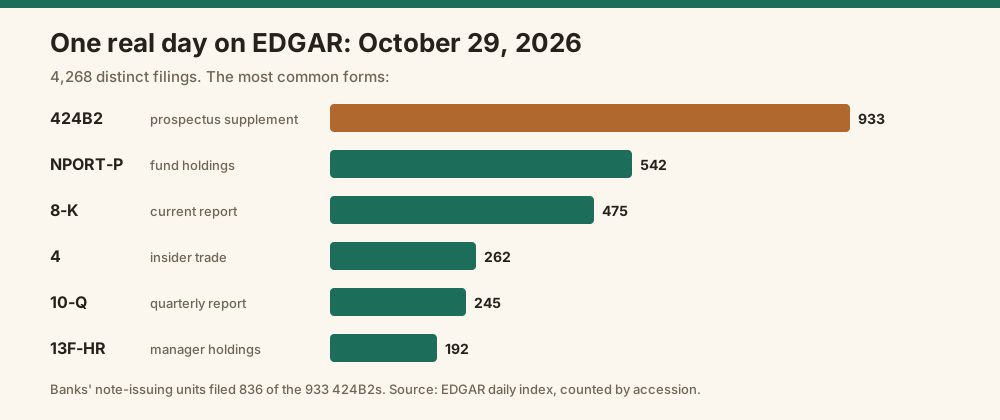
Here's the mix I counted on a real day. On October 29, 2026, EDGAR received 4,268 distinct filings. The most common forms:
| Form | What it is | Filings, Oct 29, 2026 |
|---|---|---|
| 424B2 | Prospectus supplement, often for structured notes | 933 |
| NPORT-P | Monthly fund portfolio holdings | 542 |
| 8-K | Company current report | 475 |
| 4 | Insider trade | 262 |
| 10-Q | Quarterly report | 245 |
| 13F-HR | Institutional manager holdings | 192 |
The top form isn't a 10-K or an insider trade. It's the 424B2, and banks file most of them when they issue notes. That day, JPMorgan's note-issuing unit alone filed 140, and the top 10 filers, all banks, filed 836 of the 933.
Each of the big forms has its own guide here: the Form 10-K, the Form 8-K, Form 4, the 13F and the S-1. For the full list, see types of SEC filings.
How far back does EDGAR go?
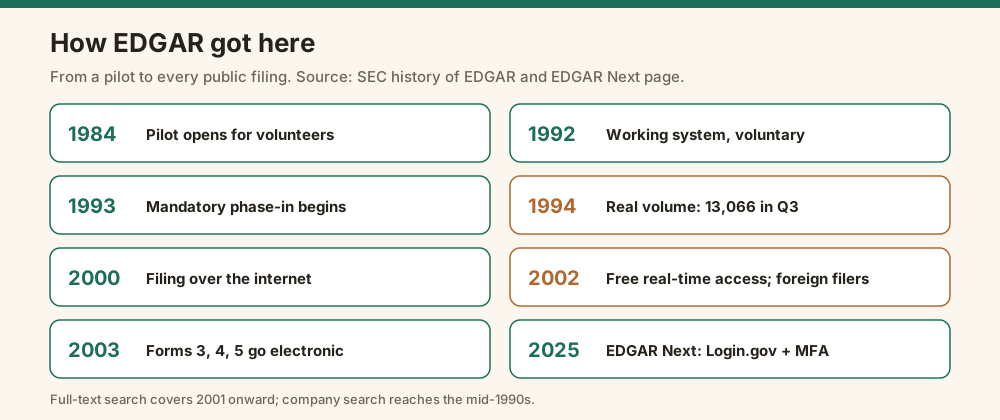
EDGAR's filings start in earnest in 1994. The SEC ran a pilot from 1984, opened the working system for voluntary filers in July 1992 and began phasing in mandatory electronic filing on April 26, 1993. EDGAR's own index files show 4 filings in early 1993, 20 by late 1993 and 13,066 in the third quarter of 1994, when volume took off.
The phase-in was slow on purpose. The SEC moved filers over in groups, paused for a test period in 1994 and restarted the phase-in on January 30, 1995, according to its history of EDGAR.
Other filers joined later:
- Foreign companies had to file on EDGAR from November 4, 2002
- Insiders' Forms 3, 4 and 5 went electronic on June 30, 2003
- Filing over the internet became possible on May 30, 2000
So for anything before about 1994, EDGAR usually has nothing. Older paper filings sit outside it.
Apple is a good example. Its oldest filing on EDGAR is from January 26, 1994, filed under its old name, Apple Computer Inc.
Searching inside filings has a shorter reach. EDGAR full-text search only covers 2001 onward. I tested every search tool and its limits in SEC EDGAR search tools compared.
What is a CIK number on EDGAR?
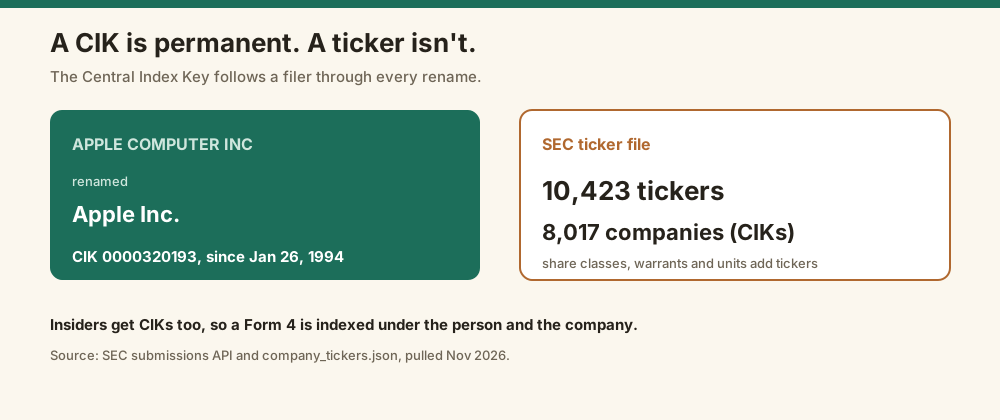
A CIK, or Central Index Key, is the permanent ID number EDGAR gives every filer: a company, a fund or a person. Apple's CIK is 320193, written 0000320193 when padded to 10 digits. Tickers change when companies rename or merge, but the CIK stays the same, so it's the safest way to find a filer's whole history on EDGAR.
Tickers and CIKs don't line up one to one. The SEC's ticker file lists 10,423 tickers, but only 8,017 distinct companies, because many companies have several share classes or securities.
Insiders get CIKs too. When a CEO files a Form 4, the filing sits under both the person's CIK and the company's.
That's also why EDGAR's daily index double-counts. On October 30, 2026, it listed 5,958 rows but only 4,564 distinct filings.
I wrote a full walkthrough of finding and using CIKs in the CIK lookup guide.
What does an EDGAR filing look like?
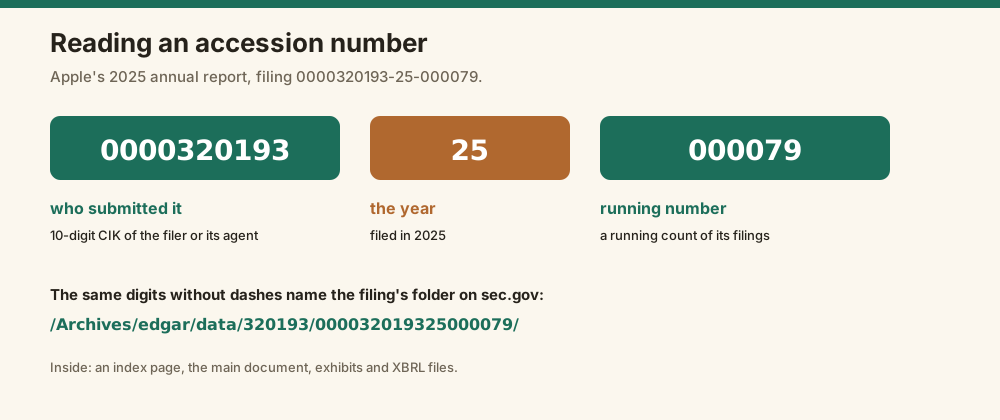
Every EDGAR filing is a folder with an accession number, an index page, a main document and any exhibits. The accession number is the filing's unique ID. Apple's 2025 annual report is 0000320193-25-000079: the 10-digit CIK of whoever submitted it, the two-digit year, and a running sequence number. The same digits, without dashes, name the filing's folder on sec.gov.
Open that folder and you'll usually find:
- An index page listing every file in the filing
- The main document, often HTML, like Apple's aapl-20250927.htm
- Exhibits such as contracts, subsidiaries lists and certifications
- XBRL data files, for filings with financial statements
The first block of the accession number isn't always the company. When a law firm or filing agent submits for a client, its own CIK goes there. Apple filed its 10-K itself, so its own CIK leads.
How do you search EDGAR?
You search EDGAR with the SEC's free tools on sec.gov. Use company search to find a filer by name, ticker or CIK and list its filings. Use full-text search to find words inside filings filed since 2001. Use the latest filings page to see new submissions as they arrive. All three work in a browser with no login.
A quick way to find a company's latest annual report:
- Open EDGAR company search on sec.gov
- Type the ticker, for example AAPL
- Pick the company from the results
- Filter the form type to 10-K
- Open the newest filing and click the main document
Watch the advice you get from AI tools here. When I asked Perplexity, it said full-text search covers "the last four years" and to use uppercase AND between terms.
Both are wrong. Full-text search reaches back to 2001, and the SEC's FAQ says AND is "neither required nor recognized," since every term is already required.
How do you get EDGAR data with code?
You get EDGAR data with code through the SEC's free APIs at data.sec.gov. The submissions API returns a company's filing history as JSON, and the XBRL APIs return its reported financial numbers. Both are free and need no key, only a User-Agent header. Paid APIs wrap the same data with cleaner fields and extras like insider signals or alerts.
This Python script finds Apple's most recent 10-K straight from the SEC:
import requests

HEADERS = {"User-Agent": "Your Name your.email@example.com"}   # SEC blocks requests without one

cik = "0000320193"                                             # Apple's CIK, padded to 10 digits
data = requests.get(f"https://data.sec.gov/submissions/CIK{cik}.json", headers=HEADERS, timeout=30).json()
recent = data["filings"]["recent"]

for form, date, acc, doc in zip(recent["form"], recent["filingDate"],
                                recent["accessionNumber"], recent["primaryDocument"]):
    if form == "10-K":
        url = f"https://www.sec.gov/Archives/edgar/data/{int(cik)}/{acc.replace('-', '')}/{doc}"
        print(data["name"], form, date, url)
        break
When I ran it, it printed Apple's 10-K filed October 31, 2025, with a direct link to the document.
The awkward part is the format. Each field is its own list, so you zip them together and build the document URL yourself.
Edgrapi's /v1/filings endpoint does that step for you, for 1 credit a call:
import requests

r = requests.get("https://api.edgrapi.com/v1/filings/AAPL",
                 headers={"X-API-Key": "YOUR_KEY"},
                 params={"form": "10-K", "limit": 1}, timeout=30)
print(r.json()["filings"][0])
It returned the same filing, accession 0000320193-25-000079, with the form, filing date, period and URL as named fields.
For a tour of the rest of the data, from financial statements to insider trades, see the SEC EDGAR API guide.
Who has to file on EDGAR?
Anyone who has to file with the SEC files on EDGAR. That means public companies, investment funds, company insiders, investors who own more than 5% of a company, institutional managers with large stock portfolios, and companies raising money in some private offerings. Since EDGAR Next took effect, every person acting for a filer needs their own Login.gov account with multifactor authentication.
The common filers and what they send:
- Public companies: 10-K, 10-Q, 8-K and proxy statements
- Insiders: Form 3, 4 and 5 for their own trades
- Big shareholders: Schedule 13D or 13G once they pass 5%
- Institutional managers: 13F holdings reports each quarter
- Funds: N-PORT portfolio reports
- Private companies raising money: Form D notices
EDGAR Next changed how filers log in, not what they file. According to the SEC's EDGAR Next page, "Legacy login methods have been discontinued," and enrollment has closed.
For readers, nothing changed. You still don't need an account to read anything.
Start with one company's filings
Pick a company you know, look it up by ticker in EDGAR company search, and note its CIK. Open its latest 10-K and skim the risk factors and financial statements. Once you want the same data in code, call the SEC's submissions API, or get a free Edgrapi key for clean JSON across filings, financials and insider trades.
Frequently asked questions
What is SEC EDGAR?
SEC EDGAR is the Securities and Exchange Commission's electronic filing system and free public database. The name stands for Electronic Data Gathering, Analysis, and Retrieval. Public companies, funds and insiders use it to submit required filings like 10-Ks, 8-Ks and Form 4s, and anyone can read them on sec.gov. The SEC says it processes about 4,700 filings a day.
Is SEC EDGAR free to use?
Yes. SEC EDGAR is free, with no account or subscription needed to search or read filings. The SEC's free data APIs at data.sec.gov are also free and need no key, only a User-Agent header and a pace under 10 requests per second. Paid tools charge for analysis, alerts or cleaner data, not for access to the filings.
How far back do EDGAR filings go?
EDGAR filings go back to about 1994. The SEC began phasing in mandatory electronic filing on April 26, 1993, and EDGAR's index shows real volume from mid-1994, with 13,066 filings in the third quarter of that year. Apple's oldest filing on EDGAR is from January 26, 1994. Older filings were on paper and mostly aren't on EDGAR.
What is a CIK number?
A CIK, or Central Index Key, is the permanent number EDGAR assigns to each filer, whether a company, fund or person. Apple's is 320193. Unlike a ticker, a CIK never changes when a company renames or merges, so it's the most reliable way to look up a filer. You can find any CIK with EDGAR company search.
How do I download data from EDGAR?
Download single filings from EDGAR company search, or pull data in bulk through the SEC's free APIs at data.sec.gov. The submissions API lists every filing a company made, and the XBRL APIs return its financial numbers as JSON. Send a User-Agent header with each request. Paid APIs return the same data in cleaner, ready-to-use fields.
Who has to file on EDGAR?
Public companies, investment funds, company insiders, investors who cross 5% ownership, large institutional managers, and companies making certain private offerings all file on EDGAR. Each files different forms, such as 10-Ks, Form 4s, Schedule 13Ds, 13Fs and Form Ds. Since EDGAR Next, each person filing needs an individual Login.gov account with multifactor authentication.