Best Financial Data APIs for Fundamentals, Tested (2026)
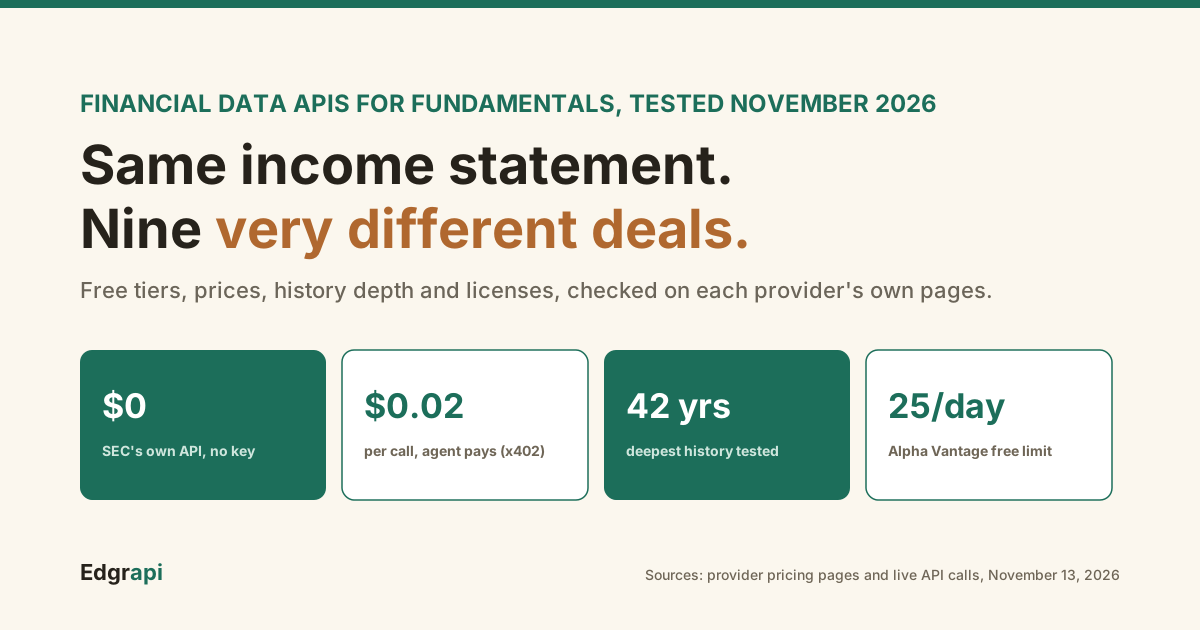
Apple's income statement costs nothing from the SEC. Financial Datasets will sell it to an AI agent for two cents a call. EODHD's free tier lets you fetch it twice a day.
Same numbers, very different deals. The best financial data API for fundamentals depends on how much history you need and what you can spend. For free and official, use the SEC's own API. For the deepest cheap history, EODHD went back to 1985 for Apple. FMP has the most generous free tier, and Edgrapi fits SEC-direct data plus AI agents. I tested all nine in November 2026.
What is the best financial data API for fundamentals?
The best financial data API for fundamentals is the one that matches your history needs and budget. On November 13, 2026, EODHD returned 42 years of Apple statements on its $59.99 Fundamentals plan, FMP gave 250 free calls a day, and the SEC's own API stayed free with no key. Alpha Vantage's free tier allows only 25 requests a day. No single API wins every column.
Here's my short list, by job:
- Free and official: the SEC's EDGAR APIs
- Deepest history for the money: EODHD
- Best free tier to build on: Financial Modeling Prep
- Fundamentals plus stock prices: Massive (formerly Polygon) or Alpha Vantage
- SEC data plus government data, built for AI agents: Edgrapi (I run it)
- Pay per call from an agent wallet: Financial Datasets
I'm biased toward the last two of those, so I tested everything the same way and I'll show you the numbers.
One thing to know before you shop. "Financial data API" covers two different products: market data (prices, quotes, ticks) and fundamentals (income statements, balance sheets, cash flows). This guide is about fundamentals.
How do the top financial data APIs compare on price and history?
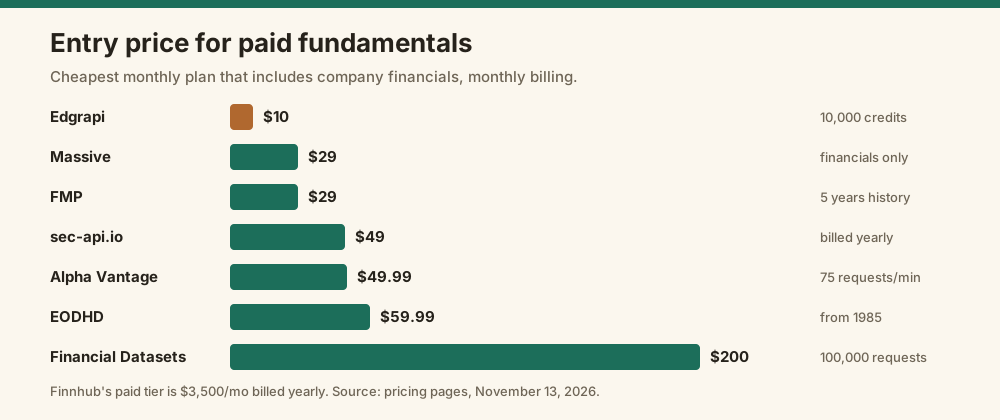
The top financial data APIs range from free to $3,500 a month. Entry paid plans cluster between $10 and $60 a month: Edgrapi at $10, Massive's financials at $29, FMP at $29, Alpha Vantage at $49.99 and EODHD at $59.99. History is the bigger difference. FMP's free and Starter plans cap at 5 years, while EODHD returned Apple statements back to 1985.
I pulled every price below from each provider's pricing page on November 13, 2026, at monthly billing.
| API | Free tier | Entry paid plan | Fundamentals history |
|---|---|---|---|
| SEC EDGAR APIs | Free, 10 requests/sec | Free | Apple from fiscal 2009 |
| Edgrapi | 50 credits, one-time | $10/mo, 10,000 credits | Apple from 2007, 20 years per call |
| Financial Modeling Prep | 250 calls/day | $29/mo | 5 years on free and Starter, 30+ on Premium ($69) |
| Alpha Vantage | 25 requests/day | $49.99/mo | IBM from 2006 (20 years) |
| EODHD | 20 calls/day | $59.99/mo | Apple from 1985 (42 years) |
| Massive | Not listed for financials | $29/mo financials only | Not tested |
| Finnhub | 60 calls/min, as-reported only | $3,500/mo, billed yearly | 30+ years on paid |
| Financial Datasets | $20 for 1,000 requests | $200/mo | 30+ years |
| sec-api.io | 100 calls, lifetime | $49/mo, billed yearly | Filings from 1993 |
Two prices need a footnote. FMP drops to $19 a month billed yearly, and EODHD to $49.99.
And Massive's $29 plan covers financials and ratios only. Add its stock prices and you're at $199.
The history column is where I'd spend your attention. Five years sounds like plenty until you try to compare a company across a recession.
I wrote up FMP's plan-by-plan limits in my FMP API pricing breakdown if you want the details.
Which financial data API has the best free tier?
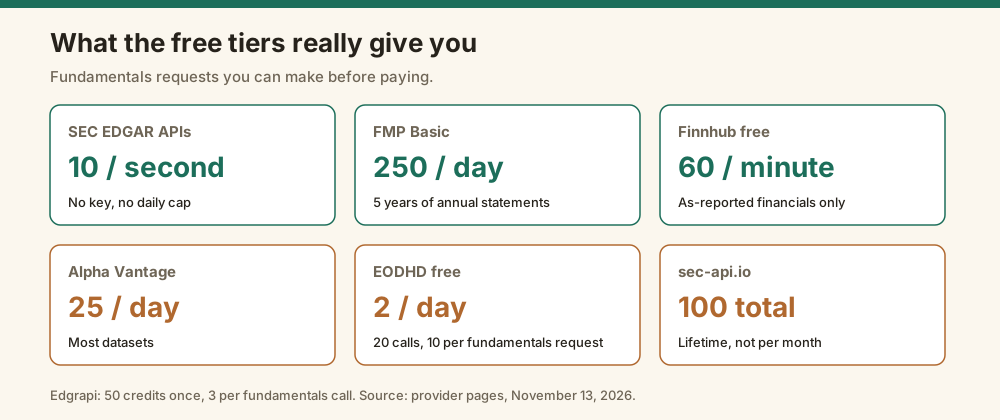
Financial Modeling Prep has the most usable free tier for fundamentals: 250 calls a day with 5 years of annual statements for US companies. Finnhub's free plan allows 60 calls a minute but only covers as-reported financials. Alpha Vantage gives 25 requests a day, and EODHD gives 20 API calls a day, where one fundamentals request costs 10. The SEC's own API is free without limits beyond 10 requests a second, per the SEC's fair access rules.
The EODHD math surprised me. Its pricing page says each fundamentals request "spends" 10 API calls. With 20 free calls a day, that's two fundamentals requests.
Alpha Vantage is generous in other ways. Its support page offers unlimited requests for verified open-source or educational projects. For everyone else, 25 a day runs out after one small watchlist.
Finnhub splits its data in two. Its docs tag the standardized "Financials" endpoint as Premium, while "Financials As Reported" carries no Premium tag. As-reported means raw line items, named however each company named them.
sec-api.io gives 100 calls total, for life, per its pricing page. Treat it as a test drive.
Edgrapi gives 50 credits once, and a fundamentals call costs 3. So that's 16 statement pulls, enough to test, not enough to run a product.
Here's what I'd do. Prototype on FMP's free key or the SEC API, then pay once you know which fields you actually need.
Where does fundamentals data come from?
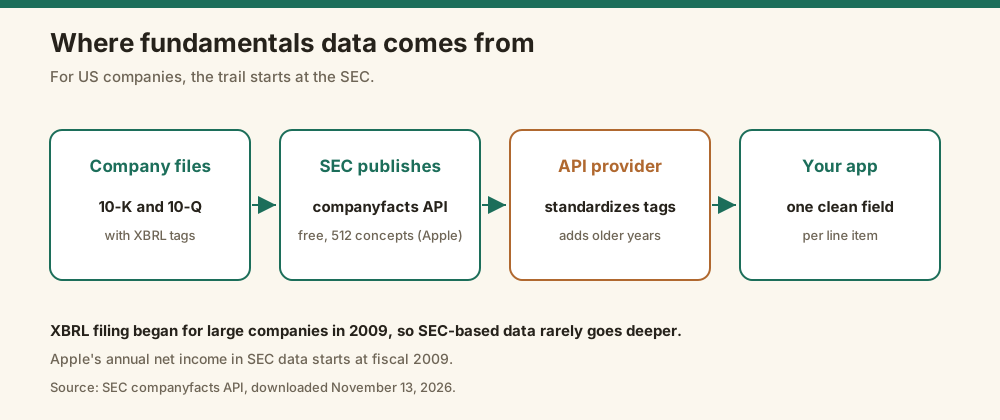
For US-listed companies, most fundamentals data starts in the same place: the XBRL financial data companies file with the SEC in their 10-Ks and 10-Qs. The SEC republishes it free through its EDGAR APIs. Apple's companyfacts file was 3.9 MB with 512 US GAAP concepts when I downloaded it. Paid APIs clean, standardize and extend that data, or license it from vendors.
Some providers say so plainly. Financial Datasets describes its income statements as "standardized from SEC filings" in its own API metadata.
The raw SEC data is free, but it's messy. Companies choose their own XBRL tags, so "revenue" can live under several different names depending on the year and the filer.
Apple's annual net income in the SEC data starts at fiscal 2009, when large companies began filing XBRL. That's why SEC-based APIs rarely go deeper than the late 2000s.
The APIs with 30 to 40 years of history get the older years from somewhere else, such as vendors who keyed in the pre-XBRL filings. That's a real advantage if you're backtesting.
If you want to parse the SEC data yourself, read why XBRL parsing is harder than it looks first. My XBRL to JSON guide covers the mechanics.
How much detail do financial data APIs return?
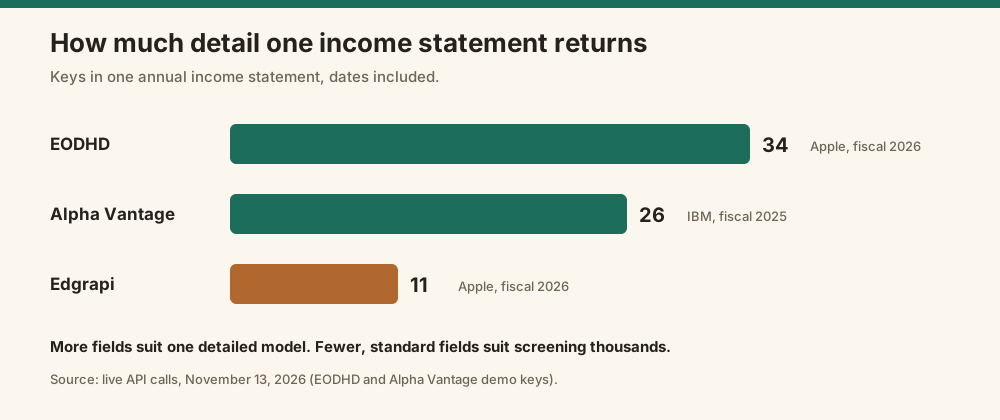
Financial data APIs differ a lot in how many line items they return per statement. In my tests, EODHD returned 34 income statement fields for Apple, Alpha Vantage returned 26 for IBM, and Edgrapi returned 11, a condensed statement. More fields help with detailed models. Fewer, standardized fields are easier to compare across companies. Check field depth before you commit.
Here's what came back for one annual income statement, counting every key in the response, dates included:
| API | Income statement fields | Test company |
|---|---|---|
| EODHD | 34 | Apple, fiscal 2026 |
| Alpha Vantage | 26 | IBM, fiscal 2025 |
| Edgrapi | 11 | Apple, fiscal 2026 |
Alpha Vantage's balance sheet had 38 fields. Edgrapi's income statement sticks to the core lines: revenue, cost of revenue, gross profit, R&D, operating income, pretax income, tax, net income and EPS.
It's a tradeoff. A screener comparing 3,000 companies wants the same 11 fields everywhere. An analyst modeling one company wants all 34.
Quarters matter too. Alpha Vantage returned 81 quarters for IBM and EODHD returned 165 for Apple. Edgrapi caps a call at 20 quarters, so a longer quarterly history takes several calls.
curl -H "X-API-Key: edgr_your_key" "https://api.edgrapi.com/v1/fundamentals/AAPL?limit=20"Do you need separate APIs for stock prices and fundamentals?
You often do, or you pay more for a bundle. Massive sells financials and ratios alone for $29 a month, but its plan with real-time stock data and financials costs $199. SEC-based APIs, including Edgrapi and sec-api.io, carry no stock prices at all. Alpha Vantage, FMP, EODHD and Finnhub sell both.
Price data is licensed by the exchanges, which is why it costs more. Alpha Vantage's support page says its real-time and 15-minute delayed US data is premium-only because it's regulated by the exchanges, FINRA and the SEC.
That affects how you compute valuation ratios. P/E needs a price, and SEC filings don't contain one.
So if your app needs P/E or market cap, plan for two sources: fundamentals from one API, prices from another. Or pay for a provider that sells both.
Edgrapi returns earnings per share and shares outstanding. You'd divide your own price by that EPS to get P/E.
Which financial data API can you use commercially?
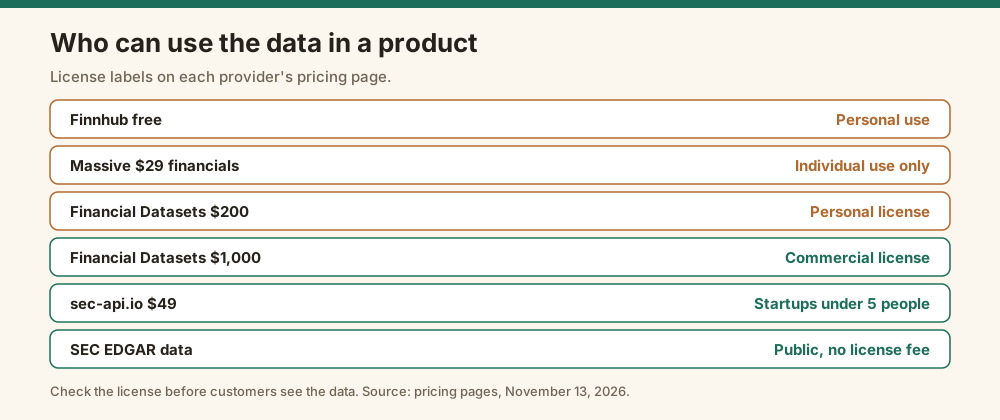
Most free and entry financial data plans are for personal use only. Finnhub's free plan, Massive's $29 financials plan and Financial Datasets' $200 Personal plan are all labeled personal or individual use. Financial Datasets' commercial license starts at $1,000 a month. SEC data is public, and sec-api.io's $49 plan covers startups under five people. Read the license before you build a product.
This catches a lot of founders. You build on a $29 plan, launch, and then learn your plan didn't allow showing the data to customers.
The license labels I found, each on the provider's pricing page:
- Finnhub free: "Personal Use. Terms apply"
- Massive Financials & Ratios: "Individual use only"
- Financial Datasets: Personal license on $20 credits and $200 Personal, commercial license at $1,000 Professional
- sec-api.io: $49 plan for startups under 5 people and individuals, $199 for business internal use, custom pricing to redistribute
- EODHD: separate pricing tabs for personal and commercial use
SEC data itself is public. If you show raw SEC numbers in your product, you don't owe the SEC a license fee.
Edgrapi's terms bar reselling raw access. If you plan to resell any API's data as-is, ask the provider first.
Which financial data APIs work with AI agents?
Several financial data APIs now ship tools for AI agents. Alpha Vantage, sec-api.io, EODHD and Edgrapi offer MCP servers, which let Claude, Cursor or another agent call them as tools. Financial Datasets takes a different route: an agent can pay $0.02 per call in USDC through the x402 protocol, with no account, for non-professional use. Check which tools your agent framework supports.
The x402 option is new, so I checked it myself. A keyless request to Financial Datasets returned HTTP 402 with payment terms: 20,000 units of USDC on the Base network, which is two cents.
That's interesting for agents that run unattended. No signup, no monthly plan, just pay per answer.
MCP is the more common route. You add the server once, and the agent discovers the tools and calls them as needed.
Edgrapi's MCP server exposes 22 tools, covering SEC fundamentals, filings, insider trades and 13F holdings plus contracts, grants, congressional trades and lobbying records. I keep a longer list of options in my roundup of MCP servers for financial data.
How should you choose a financial data API?
Choose a financial data API in three steps. First, decide how many years of history you need, because that rules out most free plans. Second, check the license if users will see the data. Third, test field depth on two or three real companies. Most teams can start free on FMP or the SEC API and switch once they know their needs.
My picks by situation:
- Hobby project or learning: SEC EDGAR APIs or FMP's free key
- Backtesting over decades: EODHD, for its 1985 history
- App needing prices and fundamentals: FMP, Alpha Vantage or Massive
- SEC-direct numbers plus government data: Edgrapi
- Agent paying per call: Financial Datasets over x402
- Full filings and exhibits: sec-api.io
If you're comparing SEC-focused options specifically, my sec-api.io alternatives and Edgrapi vs Financial Datasets posts go deeper.
One honest note on Edgrapi. It's SEC-direct, so you get the numbers as filed, ticker resolution and a free tier. You don't get stock prices, or history from before the XBRL era (2007 for Apple).
Test three companies before you pay for any API
Pick three companies you know well, one large, one small, one that restated or changed its fiscal year, and pull their statements from your top two APIs on the free tiers. Compare revenue and net income against the 10-K. Whichever API matches the filing and covers the years you need is your answer.
Frequently asked questions
What is the best API for financial data?
The best API for financial data depends on what you need. For company fundamentals, EODHD offered the deepest history in my November 2026 tests, back to 1985 for Apple, at $59.99 a month. FMP has the best free tier at 250 calls a day. The SEC's own EDGAR API is free and official. For stock prices plus fundamentals, Alpha Vantage, FMP and Massive sell both.
What is the best free API for financial statements?
The SEC's EDGAR APIs are the best free source for US company financial statements: no key, no daily cap, and 10 requests a second. The data comes as raw XBRL, so you'll need to map tags. For cleaned statements, FMP's free Basic plan gives 250 calls a day with 5 years of annual statements, and Finnhub's free plan includes as-reported financials.
Is Alpha Vantage free?
Alpha Vantage has a free API key with 25 requests a day, covering most of its datasets. Real-time and 15-minute delayed US stock data are premium-only. Paid plans start at $49.99 a month for 75 requests a minute with no daily limit. Verified open-source and educational projects can get unlimited free requests, per Alpha Vantage's support page.
How far back does fundamental data go?
It depends on the API. SEC XBRL data for large US companies starts around 2009, when XBRL filing began, so SEC-based APIs usually go back to the late 2000s. Apple's statements on Edgrapi start in 2007. EODHD returned Apple data back to 1985, and FMP's Premium plan advertises 30+ years. FMP's free and Starter plans cap at 5 years.
Can I use a free financial data API for a commercial app?
Usually not without checking the license. Finnhub's free plan is personal use, Massive's $29 financials plan is individual use only, and Financial Datasets requires its $1,000 Professional plan for commercial use. SEC data is public, so raw SEC numbers carry no license fee. Read each provider's terms before customers see the data.
Where do financial data APIs get fundamentals data?
For US companies, most fundamentals data starts in SEC filings, specifically the XBRL data in 10-Ks and 10-Qs. The SEC publishes it free through its EDGAR APIs. Providers then standardize tags, fill gaps and add older pre-XBRL years from other sources. Financial Datasets, for example, describes its income statements as standardized from SEC filings.
Related guides: Financial data APIs compared
- Alpha Vantage API: Pricing, Free Limits and MCP Server (2026)
- Yahoo Finance MCP Server: Setup, Limits and Alternatives (2026)
- SEC API Key: Do You Need One to Use EDGAR's API?
- Quiver Quantitative API: Pricing, Limits and Alternatives (2026)
- Financial Modeling Prep API Pricing (2026): Every Plan and Limit