Finnhub API: Pricing, Free Limits and Alternatives (2026)
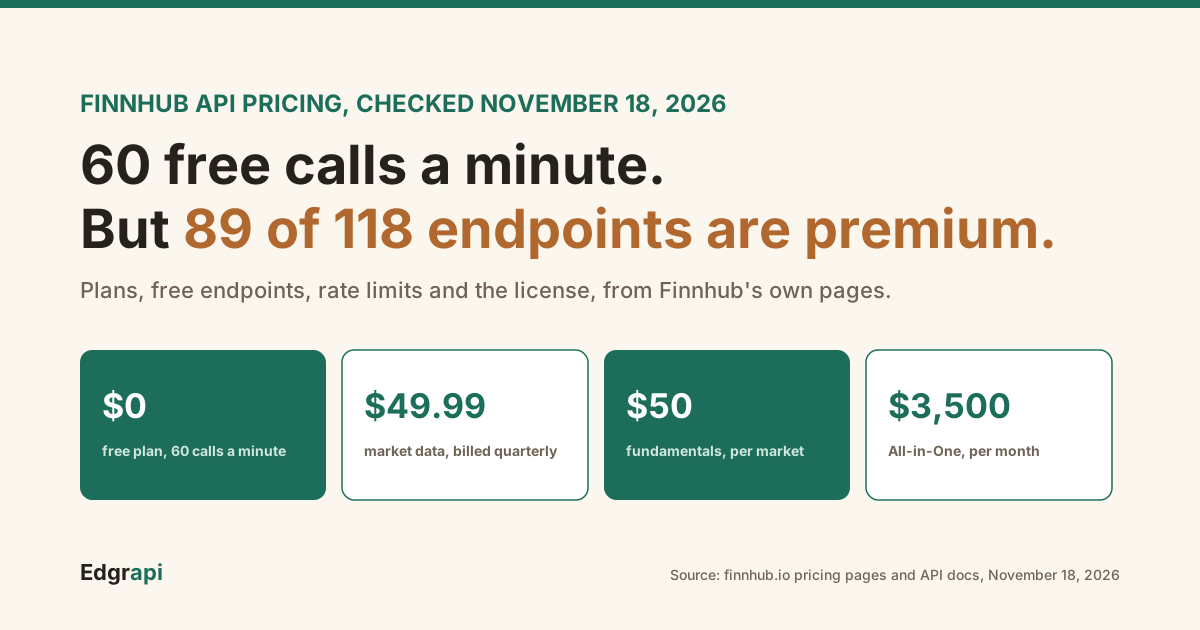
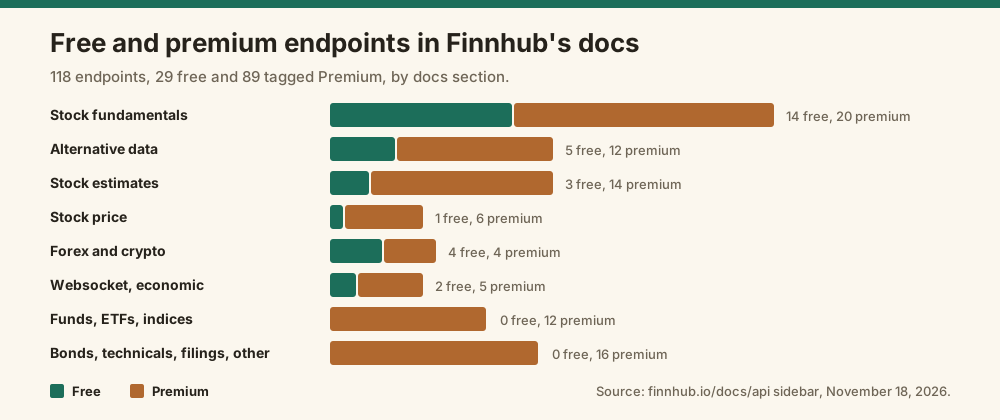
Finnhub's documentation lists 118 endpoints. On November 18, 2026, 89 of them carried a Premium tag.
The Finnhub API is a stock and company data API with a free plan of 60 calls a minute and paid plans from $49.99 a month. The free tier covers real-time quotes, basic financials, insider transactions and SEC filings, but historical price candles and standardized financial statements are premium. Every plan except Enterprise is licensed for personal use only.
What is the Finnhub API?
The Finnhub API is a REST and websocket API for market data, company fundamentals, estimates, alternative data and economic data. You authenticate with a token, either as a URL parameter or an X-Finnhub-Token header, and get JSON back. Its documentation listed 118 endpoints on November 18, 2026, covering US and global stocks, forex, crypto, bonds, ETFs and mutual funds.
The breadth is the pitch. One key reaches quotes, earnings calendars, insider trades, patents and even Senate lobbying data.
Finnhub also publishes official libraries for Python, Go, JavaScript, Ruby, Kotlin and PHP, listed in its API documentation.
Without a key, every endpoint refuses you. My keyless request to the quote endpoint returned HTTP 401 with the message "Please use an API key."
How much does the Finnhub API cost?
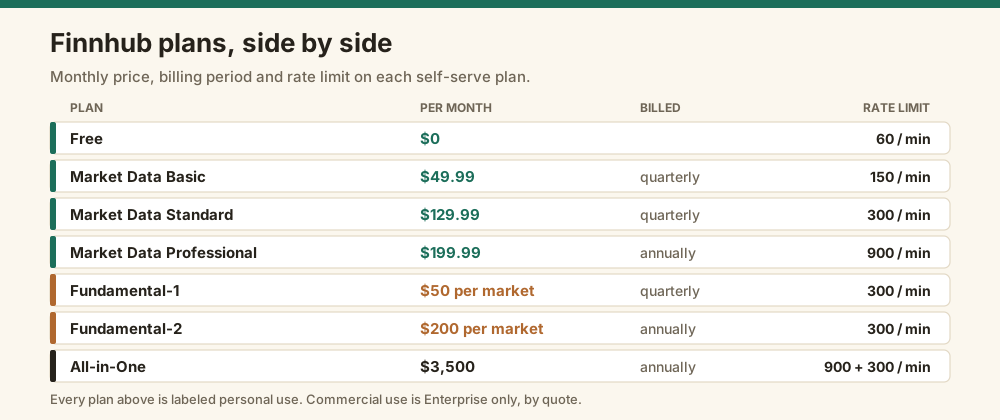
Finnhub's paid plans start at $49.99 a month for US market data and $50 a month per market for fundamentals, per its pricing pages on November 18, 2026. Fundamentals reach $200 a month per market, market data $199.99, and the All-in-One plan costs $3,500 a month billed annually. Commercial use needs an Enterprise plan with custom pricing.
Finnhub sells data in separate products, which is why its pricing looks confusing at first. The main pricing page shows only Free and All-in-One.
The cheaper plans sit on their own pages:
| Plan | Price | Billed | Rate limit |
|---|---|---|---|
| Free | $0 | 60 calls a minute | |
| Market Data Basic | $49.99/mo | Quarterly | 150 a minute |
| Market Data Standard | $129.99/mo | Quarterly | 300 a minute |
| Market Data Professional | $199.99/mo | Annually | 900 a minute |
| Fundamental-1 | $50/mo per market | Quarterly | 300 a minute |
| Fundamental-2 | $200/mo per market | Annually | 300 a minute |
| All-in-One | $3,500/mo | Annually | 900 market, 300 fundamental |
| Enterprise | Contact sales | Unlimited |
Watch the billing column. A $50 Fundamental-1 plan is charged quarterly, so the first bill is $150.
And "per market" means each exchange is a separate subscription. US fundamentals and UK fundamentals would be two plans.
What does the Finnhub free tier include?
Finnhub's free tier includes 60 API calls a minute and 29 of its 118 documented endpoints: real-time quotes, a websocket stream for 50 symbols, a basic company profile, one year of company news, basic financials, insider transactions, as-reported financials, SEC filings, recommendation trends and earnings calendars. It also includes Senate lobbying, USA Spending, patent and visa data.
The free endpoints, from the docs, grouped:
- Prices: quote, websocket trades for 50 symbols, market status and holidays
- Company data: company profile 2, peers, company news (1 year), basic financials
- Filings and insiders: insider transactions, insider sentiment, financials as reported, SEC filings
- Events: IPO calendar, earnings calendar, EPS surprises for 4 quarters, recommendation trends
- Alternative data: USPTO patents, visa applications, Senate lobbying, USA Spending, FDA calendar
That's a useful free tier for a dashboard or a learning project. Real-time quotes alone make it a favorite in tutorials.
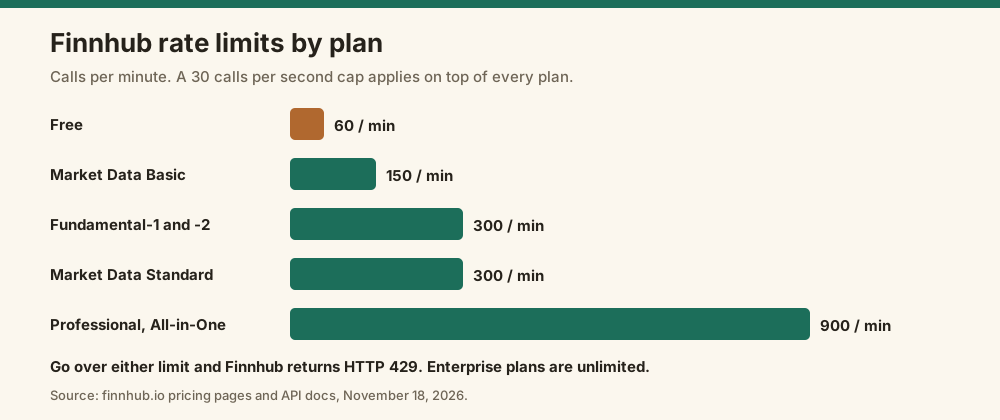
There's also a hard cap on top of every plan: 30 API calls per second, per the docs' limits section. Go over either limit and you get HTTP 429.
Which Finnhub endpoints are premium?
On November 18, 2026, Finnhub's docs tagged 89 of 118 endpoints Premium. They include historical price candles (OHLCV), standardized financial statements, dividends, company ownership and 13F data, all estimates and price targets, earnings call transcripts, ETFs and mutual funds, congressional trading, technical indicators and global filings search. The full company profile is premium too.
The candles are the one that surprises people. The free tier has the latest quote, but not the price history you'd chart.
That limit isn't new. In a 2020 GitHub notice, Finnhub told users the free plan would be limited to 1 year of intraday price data and that the company profile endpoint was moving to premium.
Today's pricing table shows no historical OHLC on the free plan at all. If you're building a backtest, budget for a paid plan from the start.
Standardized statements follow the same pattern. Free users get financials "as reported," with line items named however each company named them. Comparing companies needs the standardized version, which starts at Fundamental-1.
How do you handle Finnhub API errors in Python?
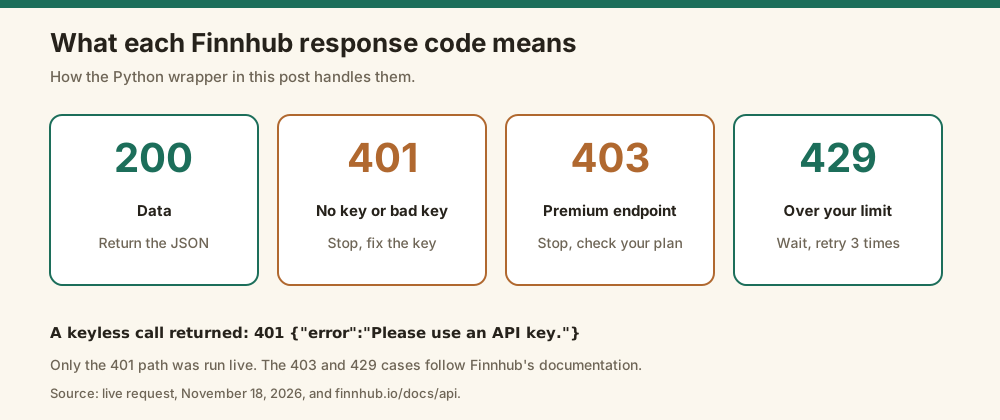
Handle three cases: HTTP 401 or 403 means a missing key, a bad key, or a premium endpoint your plan doesn't cover, so stop and report it. HTTP 429 means you went over your per-minute or 30-per-second limit, so wait and retry. Anything else, raise. A short wrapper around requests covers all three.
Here's the wrapper I use. It sends the key in the X-Finnhub-Token header, so the key stays out of URLs and server logs:
import time, requests

API_KEY = ""   # your free key from the Finnhub dashboard

def finnhub(path, **params):
    for attempt in range(3):
        r = requests.get("https://finnhub.io/api/v1/" + path, params=params,
                         headers={"X-Finnhub-Token": API_KEY}, timeout=30)
        if r.status_code == 429:          # over your plan limit or 30/sec: wait and retry
            time.sleep(2 ** attempt)
            continue
        if r.status_code in (401, 403):   # no key, bad key, or a premium endpoint
            raise RuntimeError(f"Finnhub {r.status_code}: {r.text[:120]}")
        r.raise_for_status()
        return r.json()
    raise RuntimeError("Finnhub: still rate limited after 3 tries")

print(finnhub("quote", symbol="AAPL"))
I ran it with the key left empty, since I didn't open a Finnhub account for this post. It printed Finnhub 401: {"error":"Please use an API key."}, which is the path you'll hit on day one if an environment variable didn't load. I haven't tested the 403 or 429 branches against a live key, so treat those as based on Finnhub's documentation, not my own runs.
Two habits help on the free tier. Cache anything that doesn't change often, like company profiles and basic financials, so you aren't spending your 60 calls a minute on repeats. And if you poll quotes for many symbols, use the websocket instead; it streams trades for up to 50 symbols without counting each update as a call.
curl -H "X-API-Key: edgr_your_key" "https://api.edgrapi.com/v1/fundamentals/AAPL?limit=20"How deep is Finnhub's fundamental data?
Finnhub's standardized financial statements cover 10 years and 40 quarters on the $50-a-month Fundamental-1 plan, and 30+ years annually and quarterly on the $200 Fundamental-2 plan, per its fundamentals pricing page. Free users get financials as reported from SEC filings instead. Dividends follow the same split: 10 years on Fundamental-1, 30 years on Fundamental-2.
Ten years is enough for most screens and valuation models. Thirty years matters for backtests across several market cycles.
The free as-reported data is still worth knowing about. It's built from the same SEC filings, and Finnhub even publishes an SEC financials-as-reported dataset on Kaggle for bulk download.
If you mainly need US fundamentals from SEC filings, compare that against what the SEC gives away. My best financial data APIs post tests history depth across nine providers.
Can you use Finnhub commercially?
Only on an Enterprise plan. Every Finnhub plan on its pricing pages, from Free through All-in-One at $3,500 a month, is labeled "Personal Use. Terms apply." Its Startups and Enterprise page is the one that offers commercial use with redistribution rights and unlimited API calls, at custom pricing through its sales team.
That's the biggest thing to check before you build. A $129.99 market data plan powering a public app would be outside its license.
Finnhub isn't unusual here. Alpha Vantage, Massive and Financial Datasets also label their cheaper plans personal or individual use.
What is unusual is how high the jump is. There's no published commercial plan between $0 and a sales call.
Does Finnhub have an MCP server?
Yes. Finnhub's documentation says its MCP server is available within ChatGPT, Claude and Gemini Enterprise, so AI assistants in those products can call Finnhub data as tools. The setup instructions are linked from its docs. Plan on each tool call being an API call against your plan, and on premium endpoints still needing a premium plan.
That last point matters for agents. An agent asked for a stock's price history will call the candles endpoint, which is premium.
So test your agent's common questions against the free tier before assuming it works. My roundup of MCP servers for financial data compares the options.
How does Finnhub compare to Alpha Vantage and FMP?
Finnhub has the most generous free rate limit of the three, at 60 calls a minute against Alpha Vantage's 25 requests a day and FMP's 250 calls a day. FMP has the cheapest paid entry at $29 a month and includes 5 years of statements free. Alpha Vantage's free key returns the latest 100 days of daily prices, while its full 25+ year history needs a premium key.
Here are the four providers side by side, from each one's pricing page in November 2026:
| Finnhub | Alpha Vantage | FMP | Edgrapi | |
|---|---|---|---|---|
| Free limit | 60 calls/min | 25 requests/day | 250 calls/day | 50 credits, once |
| Cheapest paid plan | $49.99/mo, billed quarterly | $49.99/mo | $29/mo | $10/mo |
| Free price history | No | Latest 100 days | Not checked | No prices |
| Free fundamentals | As reported | Yes | 5 years | SEC filings data |
| Commercial use | Enterprise, by quote | Written agreement | Separate commercial plans | Public SEC and federal data |
The rate limit column hides a real difference. Sixty calls a minute adds up to far more than 250 calls a day if your app runs all day. But a limit is only useful if the endpoints you need are free, and on Finnhub most aren't.
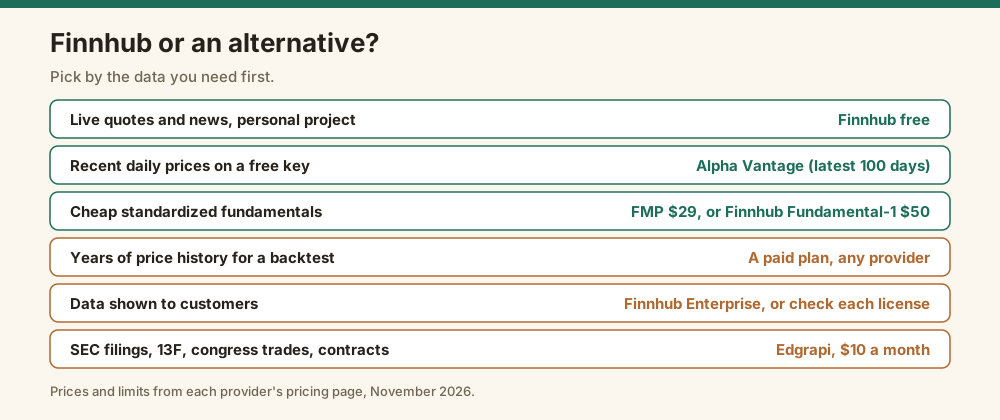
So the choice usually comes down to which data you need first.
Live quotes and news on a hobby dashboard point to Finnhub. Price history for a backtest points to a paid plan somewhere, since none of these free tiers gives you years of candles. Comparable fundamentals for a screener point to FMP.
When should you use a Finnhub alternative?
Use a Finnhub alternative when you need a commercial license without a sales call, some free price history, or SEC-sourced data with deeper free access. Financial Modeling Prep's free plan allows 250 calls a day with 5 years of statements. Alpha Vantage gives 25 free requests a day, with the latest 100 days of daily prices. For SEC filings, congress trades and federal data on one key, Edgrapi fits.
My picks by gap:
- Recent free price history: Alpha Vantage's free key returns the latest 100 daily prices
- Cheap standardized fundamentals: FMP from $29 a month, or Finnhub's own $50 Fundamental-1
- Congressional trades without a premium plan: Alpha Vantage's free tier or Edgrapi, since Finnhub's congressional trading endpoint is premium
- SEC filings, 13D stakes, Form D and contracts: Edgrapi or sec-api.io
To be fair to Finnhub, its free tier includes Senate lobbying and USA Spending data. Those overlap with what I sell, and on Finnhub they cost nothing.
Where Edgrapi differs is depth on the SEC and government side: 13F holdings, filings text, Form 144 and Form D, plus SAM.gov contract data, as REST and 23 MCP tools. It has no stock prices.
I've written up Alpha Vantage's pricing and FMP's pricing the same way.
Start on the free tier, then check the license
Get a free Finnhub key, list the five endpoints your project actually calls, and check each one against the Premium tags in the docs before you write code. If any are premium, price the smallest plan that covers them, remembering quarterly billing and per-market fees. If anyone besides you will see the data, ask Finnhub about Enterprise first.
Frequently asked questions
Is the Finnhub API free?
Partly. Finnhub's free plan allows 60 API calls a minute and covers 29 of its 118 documented endpoints, including real-time quotes, basic financials, insider transactions, SEC filings and company news for one year. Historical price candles, standardized financial statements, estimates and ownership data need a paid plan. The free plan is for personal use only.
How much does Finnhub cost?
Finnhub's paid plans start at $49.99 a month for US market data, billed quarterly, and $50 a month per market for fundamentals, also billed quarterly. Market data tops out at $199.99 and fundamentals at $200 per market. The All-in-One plan costs $3,500 a month billed annually, and commercial Enterprise plans are priced by quote.
What are Finnhub's API limits?
Finnhub's free plan allows 60 API calls a minute. Paid plans raise that to 150 to 900 calls a minute depending on the plan, and Enterprise is unlimited. On top of every plan there's a cap of 30 calls per second. Exceeding a limit returns HTTP 429, per Finnhub's documentation.
How do I get a Finnhub API key?
Register for a free account on finnhub.io, and your API key appears in your dashboard. Send it with each request as the token URL parameter or in an X-Finnhub-Token header. A request without a key returns HTTP 401 with the message "Please use an API key," which I confirmed in November 2026.
Can I use Finnhub for commercial use?
Only on Finnhub's Enterprise plan. Every self-serve plan, from Free to the $3,500 All-in-One, is labeled personal use on its pricing pages. Finnhub's Startups and Enterprise page offers commercial use and redistribution rights with unlimited API calls, at custom pricing through its sales team.
What is the best alternative to Finnhub?
It depends on the gap. For a bigger free tier, Financial Modeling Prep allows 250 calls a day. For recent daily prices on a free key, Alpha Vantage. For SEC filings, 13F holdings, congressional trades and federal contracts on one key, Edgrapi. Check each provider's license if your product will show data to other people.