Lobbying Disclosure Database: How to Search Federal Lobbying Records (2026)
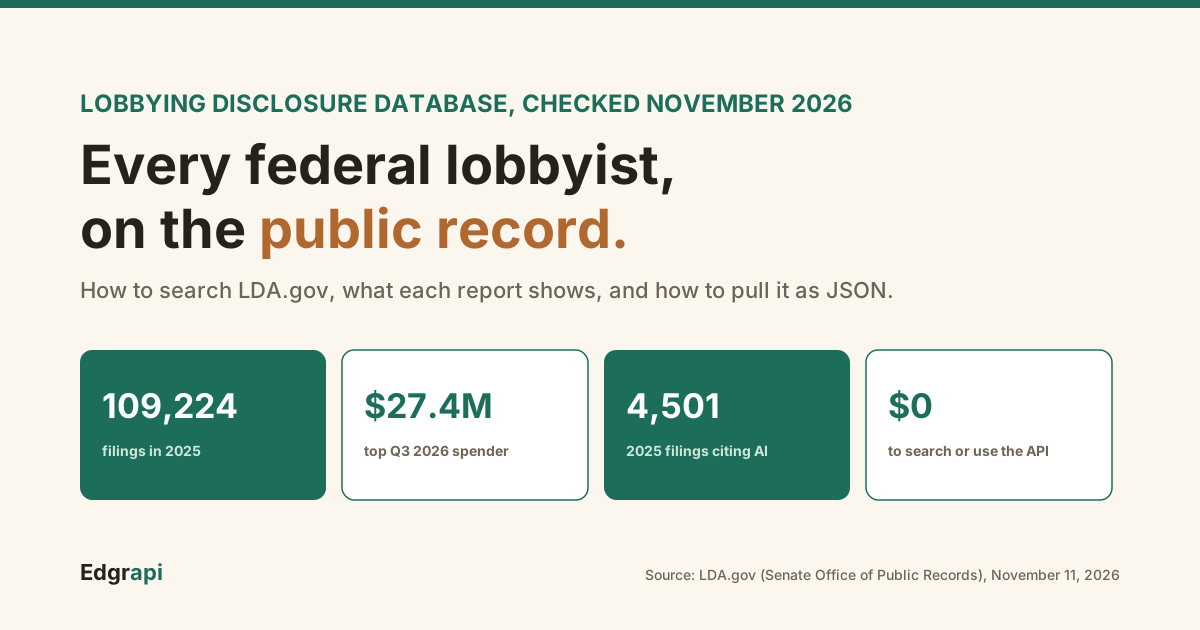
In the third quarter of 2026, the National Association of Realtors reported $27.4 million in lobbying expenses. That number is public, free, and sitting in a federal database most people never search.
The lobbying disclosure database is LDA.gov, run by the U.S. Senate Office of Public Records. It holds every registration and quarterly report filed under the Lobbying Disclosure Act: 109,224 filings in 2025 alone. You can search it free by client, lobbying firm, lobbyist or issue, and pull it as JSON through a free API. Here's how, tested in November 2026.
What is the lobbying disclosure database?
The lobbying disclosure database is the public record of federal lobbying in the United States, published at LDA.gov by the Senate Office of Public Records. It holds every lobbying registration (LD-1), quarterly activity report (LD-2) and political contribution report (LD-203) filed under the Lobbying Disclosure Act. Searching it is free and needs no account. In 2025 it took in 109,224 filings, and 83,076 more by November 11, 2026.
The law requires both the House Clerk and the Secretary of the Senate to make the filings public, and LDA.gov is where they land.
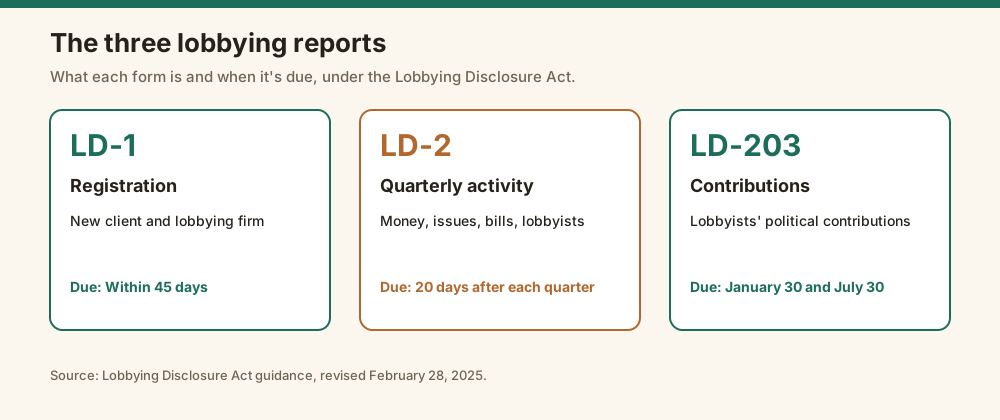
Three report types matter:
| Form | What it is | When it's filed |
|---|---|---|
| LD-1 | Registration: a new client and lobbying firm | Within 45 days of the trigger |
| LD-2 | Quarterly activity: money, issues, lobbyists | 20 days after each quarter |
| LD-203 | Lobbyists' political contributions | January 30 and July 30 |
The LD-2 is the one you'll use most. It says who paid, how much, and what they lobbied on.
How do you search lobbying records?
To search lobbying records, open LDA.gov's filing search and enter a client name, lobbying firm, lobbyist or issue keyword, then narrow by year and quarter. Each result links to the full filing as it was submitted. The search is free and needs no account. The same filters work in LDA.gov's free API, which is the faster route if you want more than a few filings at once.
The steps:
- Go to LDA.gov and open the filings search
- Type the client's name, such as "Meta Platforms"
- Filter by filing year and quarter
- Open a filing to see the issues, amounts and lobbyists
Search by client, not by company ticker. A company can show up under several names. Lockheed Martin, for example, files under both "Lockheed Martin Corporation" and "Lockheed Martin Aeronautic Sector."
A client search also returns every outside firm working for that client. In 2026 so far, a search for Meta Platforms returned 70 filings.
Only 3 were Meta's own in-house reports. The other 67 came from outside lobbying firms, each filing for itself.
What's in a lobbying disclosure report?
A quarterly lobbying report (LD-2) shows the client, the lobbying firm, the money, the issues and the people. It lists the income a firm earned from the client, or the expenses an in-house team spent, plus general issue codes like DEF for defense, the specific bills lobbied, the government bodies contacted and every individual lobbyist. Amounts are rounded to the nearest $10,000, according to the official guidance.
That rounding rule is the first thing to know before you analyze the money.
The LDA guidance, last revised February 28, 2025, says a firm with income of $5,000 or more reports "a good faith estimate of the actual dollar amount rounded to the nearest $10,000." Below $5,000, it only checks a box.
So a blank amount isn't zero. When I pulled Meta's 2026 filings, one firm, Hollier & Associates, showed no amount at all, which is most likely a "less than $5,000" report.
The other split that confuses people:
- Income: what an outside lobbying firm was paid by a client
- Expenses: what an organization spent on its own in-house lobbying
Add income and expenses together for one client and you'll double count. A company's in-house expenses can already include what it paid outside firms.
Who has to file a lobbying report, and when?
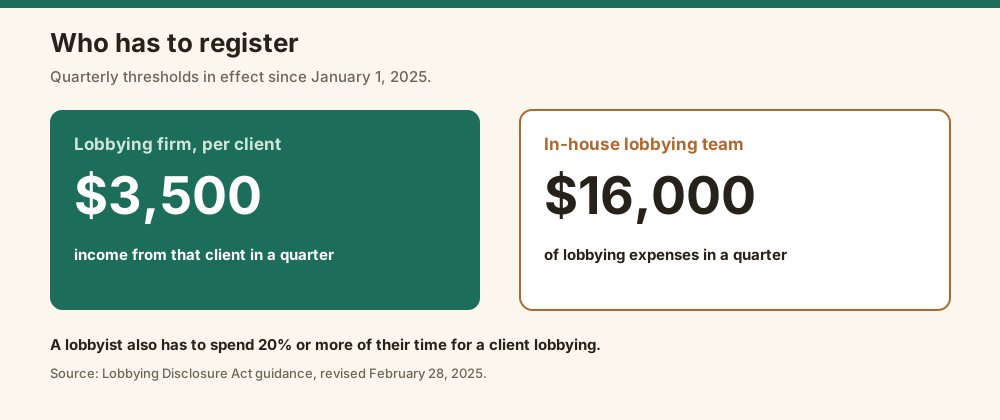
A lobbying firm must register for a client once it expects more than $3,500 in lobbying income from that client in a quarter, and an organization with in-house lobbyists must register once its lobbying expenses exceed $16,000 a quarter. Those thresholds took effect January 1, 2025. Registration (LD-1) is due within 45 days, and quarterly reports (LD-2) are due 20 days after each quarter ends.
The guidance spells out the trigger: registration is "required within 45 days" of the date a lobbyist is retained to make more than one contact, or makes a second contact.
The deadlines for quarterly reports fall on or just after:
- April 20 for January to March
- July 20 for April to June
- October 20 for July to September
- January 20 for October to December
Filers cluster near the deadline. Of the 26,583 third-quarter 2026 filings, about 10,100 were posted on October 20 or 21.
A person counts as a lobbyist only if lobbying takes up 20% or more of their time for a client over three months, per the same guidance. Plenty of people who talk to Congress never show up.
Who spent the most on lobbying in Q3 2026?
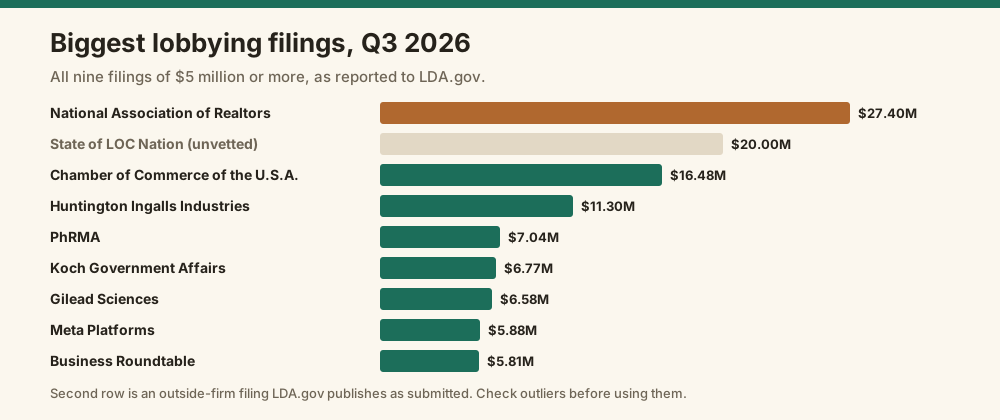
In the third quarter of 2026, the National Association of Realtors reported the most, $27.4 million in lobbying expenses, followed by the U.S. Chamber of Commerce at $16.48 million and Huntington Ingalls Industries at $11.3 million, according to LDA.gov. Only nine filings that quarter reported $5 million or more. Of the companies on that list, Meta Platforms reported $5.88 million.
The nine filings of $5 million or more, as reported:
| Client | Q3 2026 amount | Type |
|---|---|---|
| National Association of Realtors | $27.40 million | Expenses (in-house) |
| State of LOC Nation Global Public Benefit Corp. | $20.00 million | Income (outside firm) |
| Chamber of Commerce of the U.S.A. | $16.48 million | Expenses (in-house) |
| Huntington Ingalls Industries | $11.30 million | Expenses (in-house) |
| Pharmaceutical Research and Manufacturers of America | $7.04 million | Expenses (in-house) |
| Koch Government Affairs | $6.77 million | Expenses (in-house) |
| Gilead Sciences | $6.58 million | Expenses (in-house) |
| Meta Platforms | $5.88 million | Expenses (in-house) |
| Business Roundtable | $5.81 million | Expenses (in-house) |
Look twice at the second row. LDA.gov publishes filings as submitted, and that one reports $20 million in income from a client most people have never heard of. The database doesn't vet it, so check outliers against the filing document before you use them.
That's a good rule for any lobbying ranking, including this one.
curl -H "X-API-Key: edgr_your_key" "https://api.edgrapi.com/v1/awards?recipient=lockheed"What are companies lobbying about in 2026?
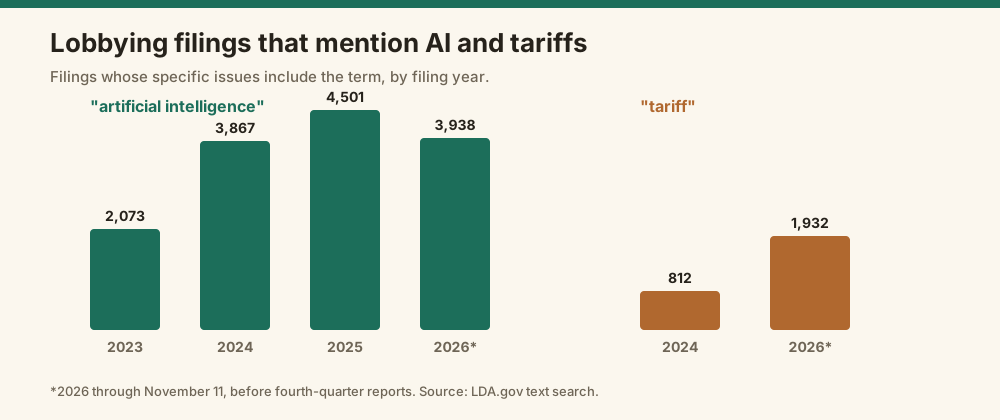
Two issues stand out in 2026: artificial intelligence and tariffs. Lobbying filings that mention artificial intelligence went from 2,073 in 2023 to 3,867 in 2024 and 4,501 in 2025, according to my searches of LDA.gov. Filings mentioning tariffs more than doubled, from 812 in 2024 to 1,932 in 2026 so far, with the fourth quarter still to come.
I counted these with LDA.gov's text search on the specific issues each filing lists:
| Search term | 2023 | 2024 | 2025 | 2026 so far |
|---|---|---|---|---|
| "artificial intelligence" | 2,073 | 3,867 | 4,501 | 3,938 |
| "tariff" | Not checked | 812 | Not checked | 1,932 |
The 2026 numbers stop at November 11, 2026, before any fourth-quarter reports are due, so the year isn't finished.
A filing counts once however many times it mentions the term. So this measures how many reports touch the issue, not how much money went to it.
What doesn't lobbying data tell you?
Federal lobbying data doesn't tell you how much was spent on any single bill, what was said in a meeting, or which lawmaker was contacted by name. Reports list issues and bills, the chambers and agencies contacted, and one rounded total per client per quarter. They also cover only federal lobbying. State lobbying is filed with each state, under different rules.
So a report can show a firm lobbied on the defense bill and an AI bill for $60,000. It can't show how that $60,000 split between them.
"Government entities" are usually broad, like "Senate" or "House of Representatives." Some name agencies too. Lockheed Martin's 2026 filings list the House and Senate most often, with a few naming the Department of Defense or the Office of Management and Budget.
Small players also drop out. A firm under the $3,500-a-quarter threshold for a client doesn't have to register at all.
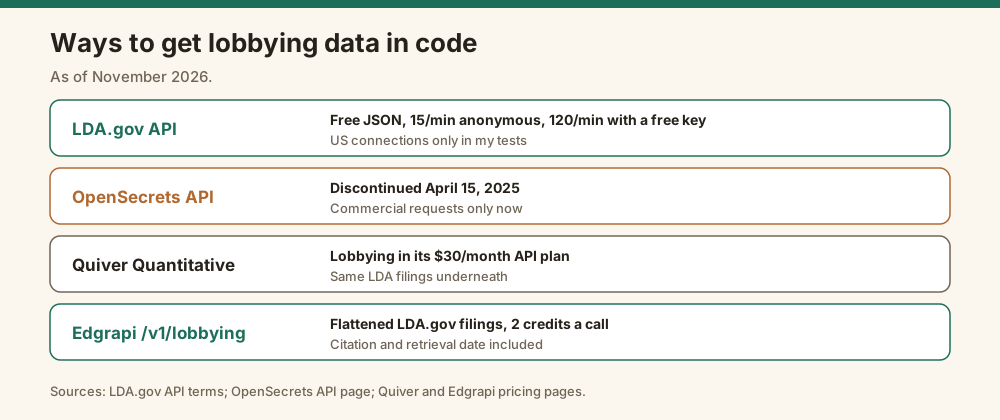
Paid trackers repackage the same filings. Quiver Quantitative, for example, includes lobbying data in its $30-a-month API plan, but the source underneath is these same LDA reports.
Is there an API for lobbying data?
Yes. LDA.gov has a free REST API that returns lobbying filings as JSON, with the same filters as the website. It allows 15 requests a minute without a key and 120 a minute with a free registered key, according to its terms. OpenSecrets, the best-known lobbying data source, discontinued its own API on April 15, 2025, so LDA.gov is now the main free option.
OpenSecrets' API page says it plainly: "As of April 15, 2025, our API offerings have been discontinued." It now points developers to a commercial contact.
LDA.gov's API terms come with two duties. You must cite the date you retrieved the data, and state that the "Senate Office of Public Records cannot vouch for the data or analyses derived from these data after the data have been retrieved from LDA.gov."
One practical catch I hit: from an internet connection in India, LDA.gov answered "Access Denied." From a US connection, the same request returned JSON. If your server runs outside the US, test that first.
Pages hold 25 filings each, whatever page size you ask for. At 15 requests a minute, that's 375 filings a minute without a key.
How do you pull lobbying data in Python?
To pull lobbying data in Python, send a GET request to LDA.gov's filings endpoint with a client name and year, then read the JSON results. No key is needed for light use. The script below pulled Meta Platforms' 2026 lobbying filings when I ran it on November 11, 2026, from a US connection. It returned 70 filings, newest first.
import requests

r = requests.get("https://lda.gov/api/v1/filings/", timeout=60, params={
    "client_name": "Meta Platforms", "filing_year": 2026, "ordering": "-dt_posted"})
data = r.json()
print(data["count"], "filings")
for f in data["results"][:4]:
    amount = f["expenses"] or f["income"]
    issues = [a["general_issue_code"] for a in f["lobbying_activities"]]
    print(f["dt_posted"][:10], f["filing_type"], f["registrant"]["name"], amount, issues[:5])
It printed four third-quarter reports filed October 20 and 21, including Sternhell Group at $60,000 on computer industry issues and 535 Group at $30,000.
The raw response nests issues, government bodies and lobbyists several levels deep. Edgrapi's /v1/lobbying endpoint, which I built on the same LDA.gov data, flattens each filing into one record, 2 credits a call:
import requests

r = requests.get("https://api.edgrapi.com/v1/lobbying", headers={"X-API-Key": "YOUR_KEY"},
                 params={"client": "Meta Platforms", "year": 2026}, timeout=60).json()
print(r["total"], "filings")
for f in r["filings"][:4]:
    print(f["posted"], f["registrant"]["name"], f["income"] or f["expenses"],
          [i["code"] for i in f["issues"]], len(f["lobbyists"]), "lobbyists")
It returned the same 70 filings, with issue codes and lobbyist counts already pulled out, plus the retrieval date and LDA.gov citation on every response.
If you also want to see which of those clients win federal contracts, the same key returns awards. I ranked the largest government contractors that way.
Search the client name, then check the outliers
Start on LDA.gov with a client name and year, and read one full quarterly report before you trust any totals. Remember that amounts are rounded to $10,000, blanks mean under $5,000, and outliers aren't vetted. When you need more than a few filings, use LDA.gov's free API from a US server, or get a free Edgrapi key and pull flat JSON from /v1/lobbying.
Frequently asked questions
How do I find lobbying records?
Search LDA.gov, the federal lobbying disclosure database run by the Senate Office of Public Records. Enter a client name, lobbying firm, lobbyist or issue, then filter by year and quarter. Each result links to the full filing. It's free with no account. For bulk access, LDA.gov's free API returns the same filings as JSON.
Is lobbying data public?
Yes. Federal lobbying data is public under the Lobbying Disclosure Act. Every registration (LD-1), quarterly activity report (LD-2) and contribution report (LD-203) is published on LDA.gov for free. Reports show the client, the lobbying firm, the amount paid or spent, the issues lobbied, the government bodies contacted and the individual lobbyists.
Is there an API for lobbying data?
Yes. LDA.gov offers a free REST API that returns lobbying filings as JSON, with filters for client, firm, lobbyist, issue, year and quarter. It allows 15 requests a minute without a key and 120 a minute with a free registered key. Its terms require you to cite the retrieval date and a Senate data disclaimer.
What happened to the OpenSecrets API?
OpenSecrets discontinued its public APIs on April 15, 2025, according to its API page, after offering them since 2007. It now directs developers to its commercial team for custom data. For federal lobbying filings, LDA.gov's free official API is the main alternative, and it serves the same underlying disclosure reports.
How much does a company spend on lobbying?
Check the company's quarterly LD-2 reports on LDA.gov. An in-house team reports its total lobbying expenses, and each outside firm reports the income it received from that client. Amounts are rounded to the nearest $10,000. Don't add a company's in-house expenses to its outside firms' income, since the expenses can already include those payments.
When are lobbying reports due?
Quarterly lobbying reports (LD-2) are due 20 days after each quarter ends: around April 20, July 20, October 20 and January 20. A new registration (LD-1) is due within 45 days of the trigger. Contribution reports (LD-203) are due July 30 and January 30, according to the Lobbying Disclosure Act guidance.