Polygon.io API (Now Massive): Pricing, Free Tier and Alternatives (2026)
If you're looking for the Polygon.io API, it's still there under a new name. On October 30, 2025, Polygon.io became Massive.
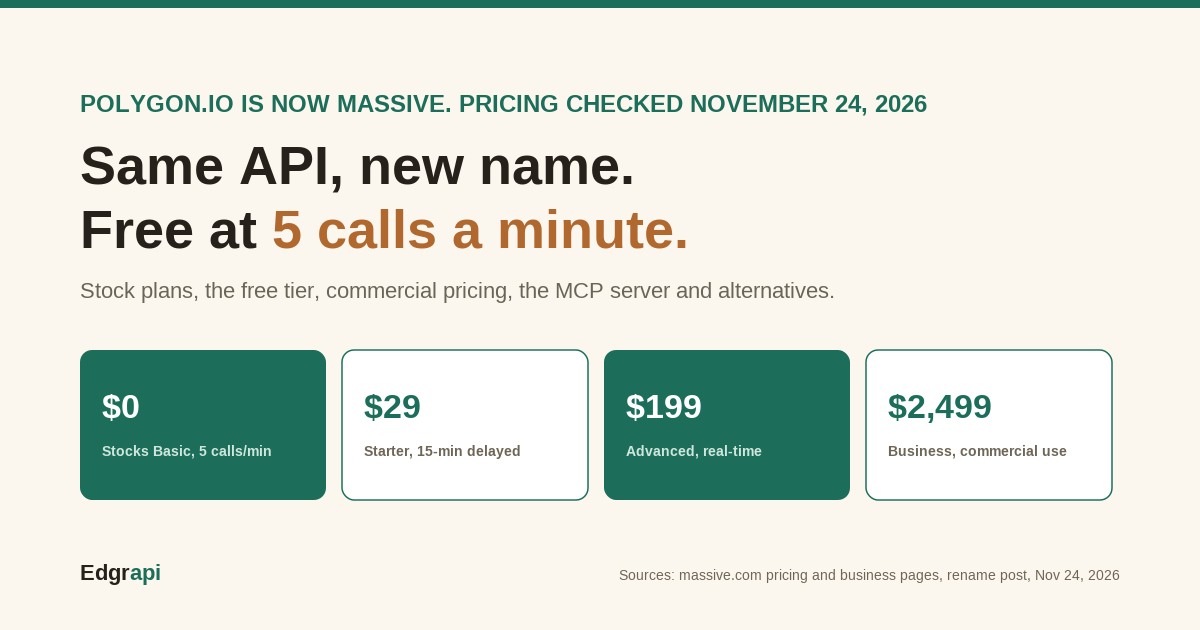
The Polygon.io API, now called Massive, is a market data API for US stocks, options, indices, currencies and futures. Its free Stocks Basic plan allows 5 API calls a minute with end-of-day data and 2 years of history. Paid stock plans cost $29, $79 and $199 a month for individuals, and business plans start at $2,499 a month.
Does Polygon.io still exist?
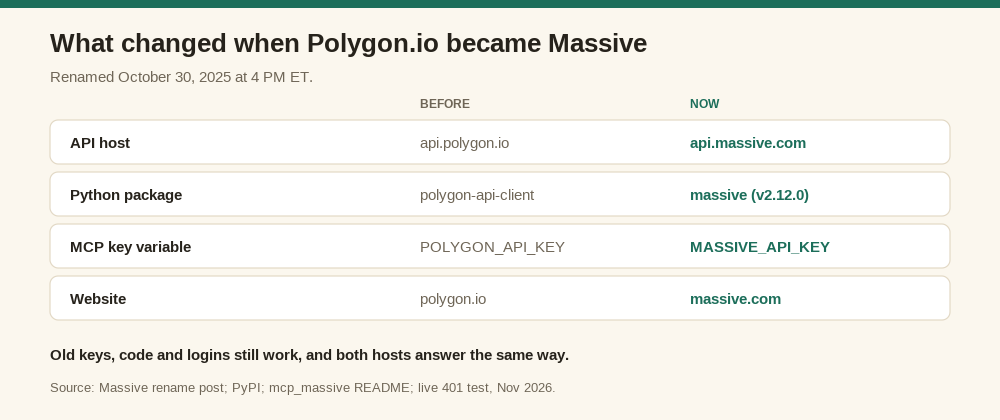
Yes, under the name Massive. Polygon.io renamed itself Massive.com on October 30, 2025, at 4 PM Eastern, per its own announcement. Existing code, API keys and logins kept working with no changes required, and both domains run in parallel. When I called api.polygon.io and api.massive.com without a key in November 2026, both returned the same 401 error.
The rename announcement says the company wanted a name reflecting "scale, reliability, and continued innovation."
For developers the practical change is the base URL. New code should use api.massive.com, and the official Python package is now massive, version 2.12.0 on PyPI when I checked.
The old polygon-api-client package is still on PyPI, at version 1.16.3. Existing projects using it keep working, but new examples in Massive's docs use the new name.
So if a tutorial shows api.polygon.io, it's not broken. It's just from before the rename.
How do you move code from Polygon.io to Massive?
Change the base URL from api.polygon.io to api.massive.com, keep your existing API key, and swap the polygon-api-client package for the massive package if you use the official Python client. Massive says existing keys and code keep working with no changes required, so there's no deadline forcing the move, but new code should use the new names.
The steps, in order:
- Replace the host in your HTTP calls. Paths like /v2/aggs/ticker/AAPL/prev stay the same.
- Keep your key. The rename announcement says existing keys remain valid.
- If you use Python, install
massiveand update imports when you're ready. The old package still installs. - If you run Massive's MCP server, set MASSIVE_API_KEY. POLYGON_API_KEY still works but is marked deprecated.
Run your test suite against the new host before switching production. When I called the same path on both hosts, the error responses matched exactly.
How much does the Polygon.io API cost?
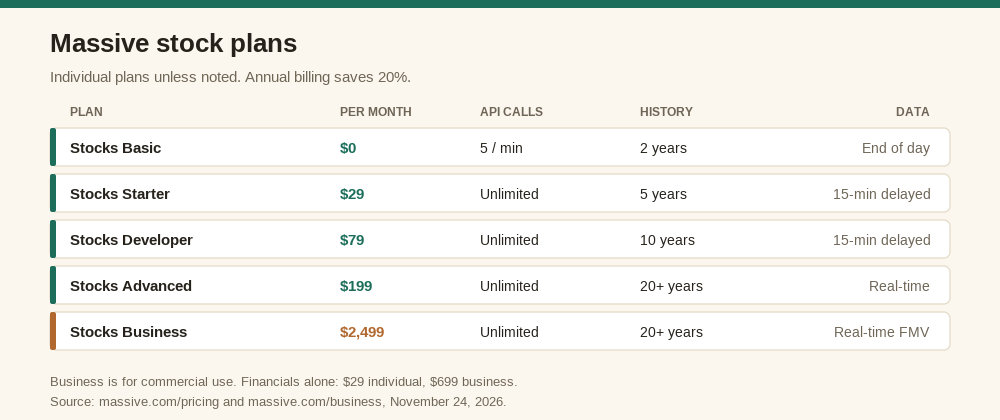
Massive's individual stock plans cost $0 for Stocks Basic, $29 a month for Starter, $79 for Developer and $199 for Advanced, per its pricing page on November 24, 2026. Annual billing saves 20%. Company financials alone cost $29 a month, and the Stocks Business plan for commercial use costs $2,499 a month. Options, indices, currencies and futures are priced separately.
Here's the stock lineup:
| Plan | Price | API calls | History | Data timing |
|---|---|---|---|---|
| Stocks Basic | $0 | 5 a minute | 2 years | End of day |
| Stocks Starter | $29/mo | Unlimited | 5 years | 15-minute delayed |
| Stocks Developer | $79/mo | Unlimited | 10 years | 15-minute delayed |
| Stocks Advanced | $199/mo | Unlimited | 20+ years | Real-time |
| Stocks Business | $2,499/mo | Unlimited | 20+ years | Real-time fair market value |
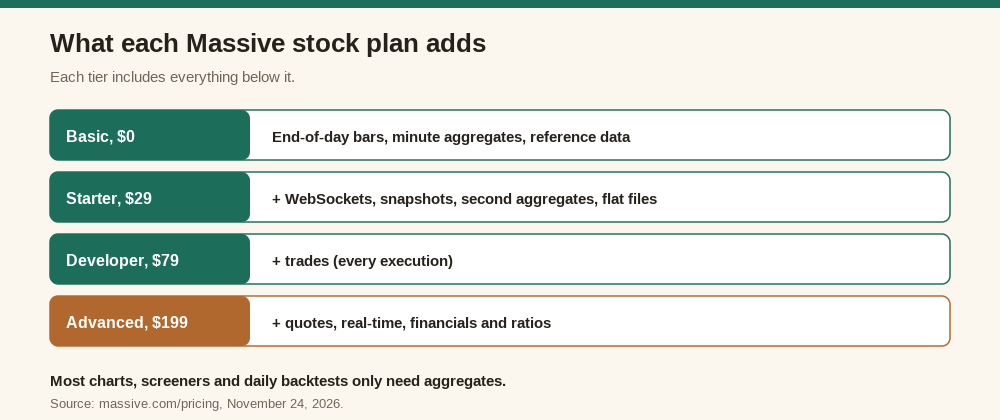
Each step up adds data types. Starter adds WebSockets, snapshots, second aggregates and flat files. Developer adds trades, and Advanced adds quotes and the financials and ratios endpoints.
If you only need company statements, the standalone Financials & Ratios plan is $29 a month. Advanced at $199 bundles it with real-time prices.
The pricing page also lists add-ons like NYSE order imbalances at $49 a month and partner datasets from Benzinga, TMX and ETF Global at $99 a month each.
What's the difference between aggregates, trades and quotes?
Aggregates are price bars, open, high, low, close and volume per minute or day, and every Massive stock plan includes minute aggregates. Trades are each individual execution, starting on the $79 Developer plan. Quotes are the bid and ask over time, and they start on the $199 Advanced plan. Pick the cheapest level of detail your project needs.
Most projects only need aggregates. A chart, a screener or a backtest on daily bars all run on them.
Trades matter for volume-weighted prices, block-trade detection or anything that cares about the exact order of executions.
Quotes matter for spread analysis and execution research. They're also by far the largest data, which is part of why they sit on the top plan.
Two more terms show up on the pricing page. Snapshots give the current state of many tickers in one call, starting on Starter. Flat files are bulk daily downloads instead of API calls, also from Starter up.
Options data follows the same ladder. Massive's options plans cost $0, $29, $79 and $199 a month, mirroring the stock tiers, and indices, currencies and futures each have their own plans on the same pricing page.
What does the free Polygon.io plan include?
The free Stocks Basic plan includes 5 API calls a minute, all US stock tickers, end-of-day data, 2 years of history, reference data, corporate actions, technical indicators and minute aggregates. It doesn't include WebSockets, snapshots, trades, quotes or real-time prices. Massive labels it "Individual use" and calls it great for trying the APIs.
Five calls a minute is the real constraint. A watchlist of 30 tickers takes six minutes to refresh one call each.
That's fine for a nightly job that pulls yesterday's closes. It isn't enough for a live dashboard.
If you go over the limit you get HTTP 429. The Python example below waits and retries when that happens.
The 2-year history limit matters for backtests. Five years needs Starter, and 20-plus needs Advanced.
curl -H "X-API-Key: edgr_your_key" "https://api.edgrapi.com/v1/fundamentals/AAPL?limit=20"Which Polygon.io plan do you need?
Pick by data timing and history. Stocks Starter at $29 a month is enough for delayed prices and 5 years of history, Developer at $79 adds tick-level trades and 10 years, and Advanced at $199 is the first plan with real-time data, quotes and company financials. Free works for end-of-day data within 2 years at 5 calls a minute.
My rough guide, by job:
- End-of-day screens or a learning project: Stocks Basic, free
- Backtests on daily or minute bars: Starter for 5 years, Developer for 10
- Trade-level research: Developer, the first plan with trades
- Live trading signals: Advanced, the first real-time plan
- Statements and ratios only: the $29 Financials & Ratios plan
Watch the "Non-pros only" note on Advanced. It's on Massive's pricing page, and it means the real-time plan is for non-professional users.
Professional status usually depends on exchange rules for market data, such as whether you're a registered investment professional. If that might be you, ask Massive before subscribing.
Can you use Polygon.io data commercially?
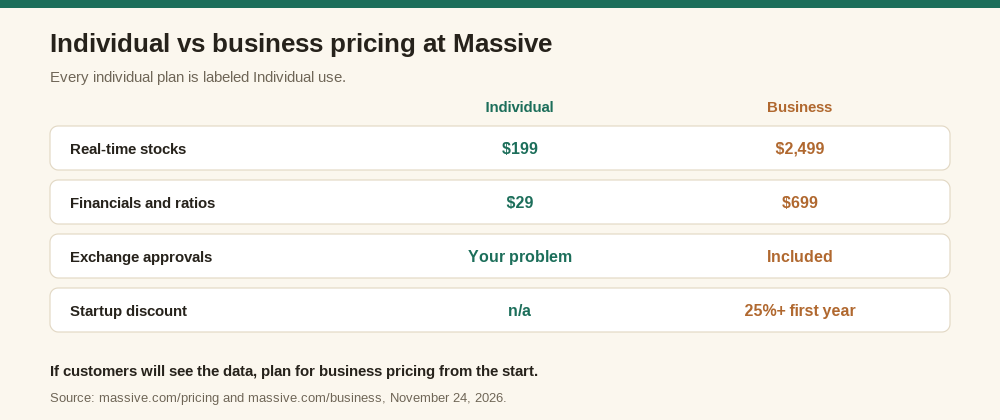
Not on the individual plans. Every individual stock plan on Massive's pricing page, from the free plan to Advanced, is labeled "Individual use." Commercial use starts with the Stocks Business plan at $2,499 a month or a custom Enterprise deal. Financials for business use cost $699 a month, and qualifying startups can get 25% or more off the first year.
The startup discount is worth knowing about. Massive's business pricing page says pre-launch companies get the largest reductions, and asks startups to email its sales team.
The gap between $199 and $2,499 is steep. If your product will show prices to customers, budget for the business tier from the start rather than finding out after launch.
Business plans also skip exchange approvals and fees, per the business pricing page, which is part of what the price covers.
How do you call the Massive API in Python?
Send your key either as an Authorization: Bearer header or an apiKey query parameter to https://api.massive.com. Both worked in my test. Handle HTTP 429 by waiting, especially on the free plan's 5 calls a minute, and treat 401 or 403 as a key or plan problem. Massive's official client is the massive package on PyPI.
Here's a small wrapper with that handling:
import os, time, requests

API_KEY = os.environ.get("MASSIVE_API_KEY", "")   # from your Massive dashboard

def massive(path, **params):
    for attempt in range(4):
        r = requests.get("https://api.massive.com" + path, params=params,
                         headers={"Authorization": "Bearer " + API_KEY}, timeout=30)
        if r.status_code == 429:                  # free plan: 5 calls a minute
            time.sleep(15 * (attempt + 1))
            continue
        if r.status_code in (401, 403):           # missing key, bad key, or not in your plan
            raise RuntimeError("Massive %d: %s" % (r.status_code, r.json().get("error")))
        r.raise_for_status()
        return r.json()
    raise RuntimeError("Still rate limited after 4 tries")

print(massive("/v2/aggs/ticker/AAPL/prev"))       # Apple's previous-day bar
I don't have a Massive subscription, so I ran this with no key. It printed Massive 401: authorization header was malformed, which is what you'd see if your environment variable didn't load.
With a made-up key, both auth styles returned "Unknown API Key." The 429 branch follows the free plan's stated limit, not my own runs.
Prefer the header. A key in a URL ends up in logs and browser history.
Does Massive have an MCP server?
Yes. Massive publishes an official MCP server on GitHub, massive-com/mcp_massive, so AI assistants like Claude can call its market data as tools. It's MIT-licensed, had 405 stars, and was last updated on November 20, 2026, when I checked. Tool calls use your Massive API key, so your plan's limits and data access still apply.
Per its README, it runs with a MASSIVE_API_KEY environment variable, and the old POLYGON_API_KEY name still works as a deprecated alias.
The plan limits matter for agents. On the free plan, an agent that checks a few tickers can hit 5 calls a minute fast.
My roundup of MCP servers for financial data compares it with the others.
What are the best Polygon.io alternatives?
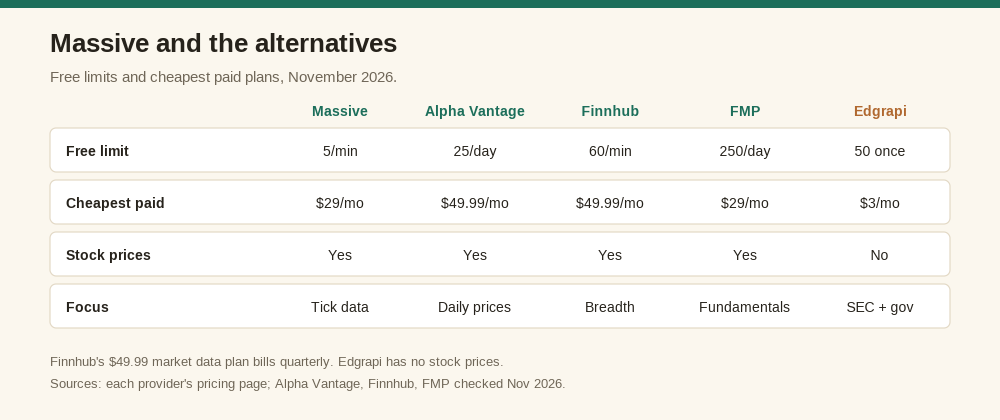
Use an alternative when you need a bigger free tier, cheap commercial rights, or SEC and government data rather than prices. Alpha Vantage's free tier allows 25 requests a day, Finnhub's allows 60 calls a minute, and Financial Modeling Prep's allows 250 calls a day. For SEC filings, insider trades, 13F holdings and federal data on one key, Edgrapi fits, with no stock prices.
Here's how they line up, from each provider's pricing page in November 2026:
| Massive | Alpha Vantage | Finnhub | FMP | Edgrapi | |
|---|---|---|---|---|---|
| Free limit | 5 calls/min | 25 requests/day | 60 calls/min | 250 calls/day | 50 credits, once |
| Cheapest paid | $29/mo | $49.99/mo | $49.99/mo, quarterly | $29/mo | $3/mo |
| Real-time prices | $199/mo | Premium only | Free quote endpoint | Not checked | No prices |
| Strength | Tick-level US market data | Recent daily prices free | Breadth of endpoints | Fundamentals | SEC and federal data, MCP |
Massive's edge is depth of market data. If you need trades, quotes or options at tick level, it's the specialist here.
The others win on other axes. I wrote up Alpha Vantage, Finnhub and FMP pricing the same way.
That's also where Edgrapi sits, and I build it, so weigh that. It has no prices at all. It covers SEC fundamentals, Form 4 insider trades, 13F holdings, House trades and federal contracts.
To be fair to Massive, its blog announced insider holdings and insider activity endpoints from Forms 3, 4 and 5 on November 13, 2026, so the overlap on insider data is growing.
Start on the free plan, then size by timing and history
Get a free Massive key, call the exact endpoints your project needs, and note which ones return a plan error. Then pick the cheapest plan that covers your data timing (delayed or real-time) and history depth. If anyone besides you will see the data, price the $2,499 business tier or a startup discount before you build.
Frequently asked questions
Is the Polygon.io API free?
Partly. Polygon.io, now Massive, has a free Stocks Basic plan with 5 API calls a minute, end-of-day data and 2 years of history for all US stocks. Real-time data, trades, quotes, WebSockets and longer history need a paid plan. The free plan is for individual use only, so it can't power a commercial product.
How much does Polygon.io cost?
Massive's individual stock plans cost $29 a month for Starter, $79 for Developer and $199 for Advanced, with 20% off on annual billing. Company financials alone cost $29 a month. Commercial use starts with Stocks Business at $2,499 a month, and options, indices, currencies and futures are priced separately.
Did Polygon.io change its name?
Yes. Polygon.io renamed itself Massive.com on October 30, 2025. Existing API keys, code and logins kept working, and the old api.polygon.io domain still answers alongside api.massive.com. The official Python client is now the massive package, while the older polygon-api-client package remains on PyPI.
What is the Polygon.io API rate limit?
The free Stocks Basic plan allows 5 API calls a minute. Every paid plan, from the $29 Starter up, lists unlimited API calls on Massive's pricing page. Going over the free limit returns HTTP 429, so free-plan code should wait and retry rather than fail.
Can I use Polygon.io commercially?
Not on the individual plans, which Massive labels "Individual use." Commercial use starts with the Stocks Business plan at $2,499 a month or a custom Enterprise plan, and business-use financials cost $699 a month. Qualifying startups can get 25% or more off their first year by emailing Massive's sales team.
What is the best alternative to Polygon.io?
It depends on what you need. For a bigger free tier, Finnhub allows 60 calls a minute and FMP 250 a day. Alpha Vantage gives the latest 100 days of daily prices free, on a 25-request-a-day limit. For SEC filings, insider trades, 13F holdings and federal data rather than prices, Edgrapi starts at $3 a month.
Related guides: Financial data APIs compared
- Unusual Whales API: Pricing, Limits, MCP and Alternatives (2026)
- Finnhub API: Pricing, Free Limits and Alternatives (2026)
- Alpha Vantage API: Pricing, Free Limits and MCP Server (2026)
- Yahoo Finance MCP Server: Setup, Limits and Alternatives (2026)
- Best Financial Data APIs for Fundamentals, Tested (2026)