Unusual Whales API: Pricing, Limits, MCP and Alternatives (2026)
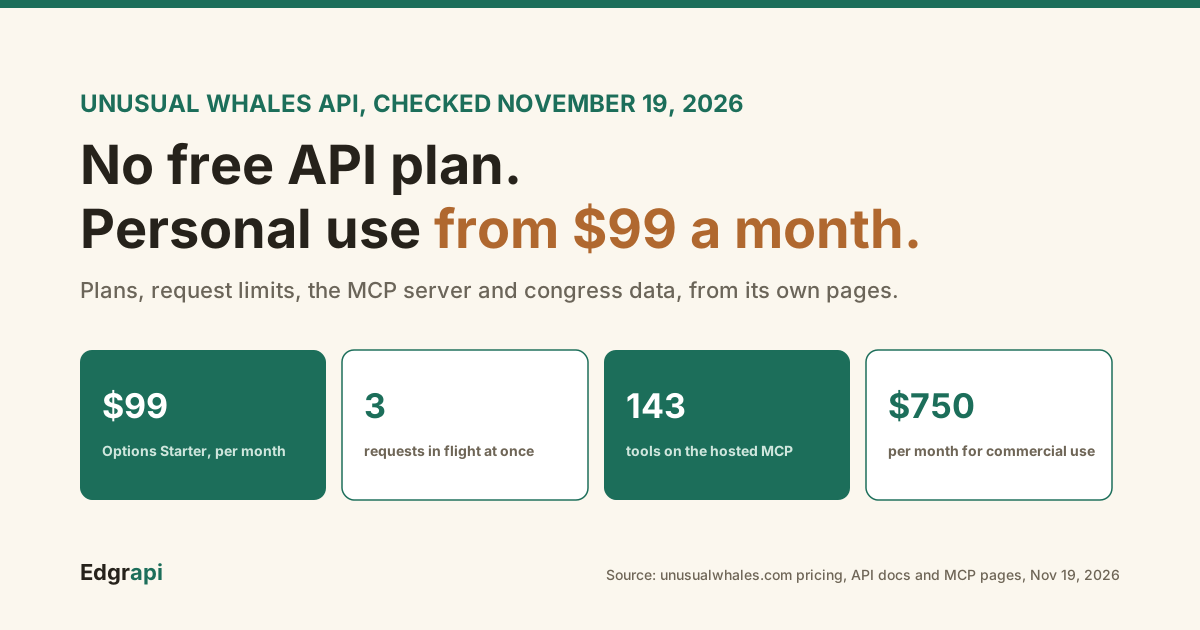
Unusual Whales has no free API plan. The cheapest one costs $99 a month and caps you at 25,000 requests.
The Unusual Whales API is a paid REST, WebSocket and MCP service for options flow, dark pool trades, Greek exposure and congressional trading. Plans cost $99, $150 and $375 a month after a 7-day free trial, or $85 to $315 a month billed annually. Every self-serve plan is personal use only; building a product on the data starts at $750 a month.
What is the Unusual Whales API?
The Unusual Whales API is the programmatic side of the Unusual Whales options-flow platform. Its public API page lists 100+ endpoints across 19 categories, including options flow, Greek exposure, dark pool, congressional trades, insider trades, institutional holdings and prediction markets. You call it at api.unusualwhales.com with a Bearer token, over REST, WebSocket, Kafka or MCP.
Most people know Unusual Whales from its options-flow dashboard and its posts about politicians' trades. The API sells the same data raw.
Options are the heart of it. There are 20+ options-flow endpoints, 8+ for Greek exposure and 21+ for technical indicators.
Congressional trading gets 10+ endpoints of its own. I'll come back to those, because that's where it overlaps with what I build.
Tokens are UUIDs. When I sent a request with an empty token, the API answered HTTP 401 with "Unusual Whales API tokens are UUIDs."
How much does the Unusual Whales API cost?
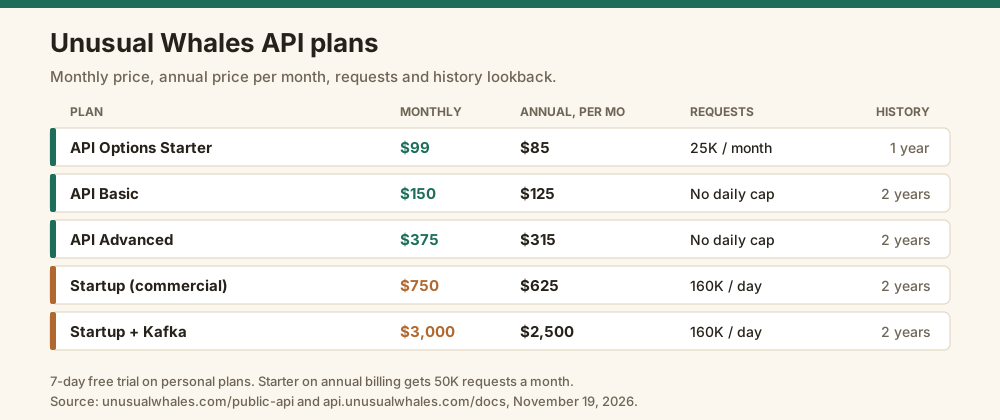
The Unusual Whales API costs $99 a month for API Options Starter, $150 for API Basic and $375 for API Advanced, each after a 7-day free trial. Annual billing drops them to $85, $125 and $315 a month. A commercial Startup tier costs $750 a month, and full-market historical option trades are a separate $250 a month, per its pricing and docs pages on November 19, 2026.
Here are the plans side by side:
| Plan | Monthly | Annual (per month) | Requests | History |
|---|---|---|---|---|
| API Options Starter | $99 | $85 | 25,000 a month (50,000 on annual) | 1 year |
| API Basic | $150 | $125 | No daily cap | 2 years |
| API Advanced | $375 | $315 | No daily cap | 2 years |
| Startup (commercial) | $750 | $625 ($7,500 a year) | 160,000 a day | 2 years |
| Startup + Kafka | $3,000 | $2,500 ($30,000 a year) | 160,000 a day | 2 years |
All three personal plans include congressional and insider trades, dark pool data and MCP support. The differences sit at the top.
Starter has no GEX (gamma exposure) data. Basic adds GEX and doubles the lookback to 2 years.
Older data than your plan's lookback is sold separately as one-time downloads in its Data Shop.
Advanced is the only personal plan with WebSocket streaming, 1-minute SPX market maker exposure, CME futures and the premium endpoints for forex, commodities and economic indicators.
Is there a free Unusual Whales API?
No. Unusual Whales has no free API plan, only a 7-day free trial on the paid API plans, per its pricing page on November 19, 2026. The free account covers the website, not the API: options flow there runs 2 trading days late, news 15 minutes late and alerts 30 minutes late. To call the API at all, you need a paid plan or an active trial.
The trial is the way to test it. Billing starts after 7 days unless you cancel.
There's one partial exception for AI chat. Unusual Whales says you can use its data inside ChatGPT, Claude and Grok by signing in with your Unusual Whales login instead of pasting an API key.
What that sign-in includes on a free account, I couldn't confirm from its pages. Treat it as a way to try the data in chat, not as a free API.
What are the Unusual Whales API rate limits?
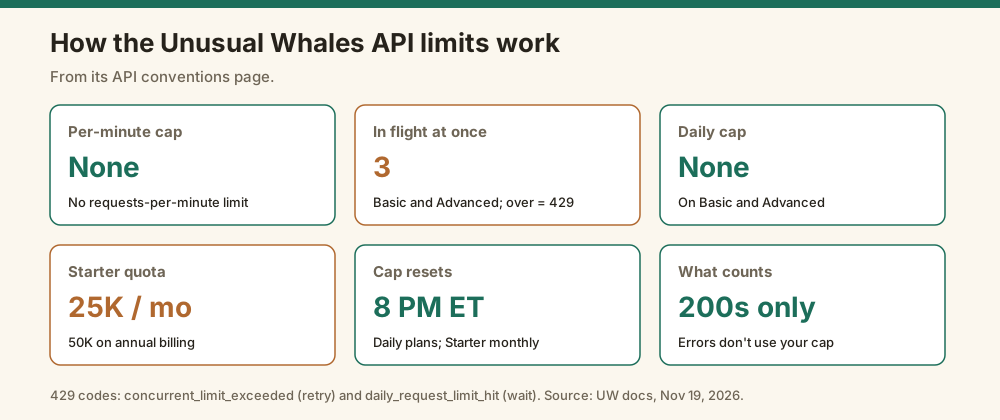
There's no per-minute cap on the Unusual Whales API. API Basic and API Advanced have no daily cap either, but allow only 3 requests in flight at once. API Options Starter gets 25,000 requests per billing month, or 50,000 on annual billing. Going over returns HTTP 429, per the docs' conventions page. Only successful responses count toward a request cap.
Its conventions page spells out the two kinds of 429:
- concurrent_limit_exceeded: you had more requests running at once than your plan allows. It doesn't count against your cap, so wait briefly and retry.
- daily_request_limit_hit: you used up your cap. Retrying won't help until it resets.
Most capped plans reset daily at 8 PM Eastern. Starter resets at the start of each billing month instead.
All your tokens share one allowance, including tokens you've rotated. Two headers, x-uw-token-req-limit and x-uw-daily-req-count, show your cap and usage on plans that have one.
The 3-request limit matters more than it sounds. A script that fires 20 ticker lookups in parallel will see most of them bounce.
For data you need all day, the docs recommend one WebSocket connection over polling REST. WebSocket messages count toward neither limit, but WebSocket needs the $375 Advanced plan.
What congressional trading data does Unusual Whales have?
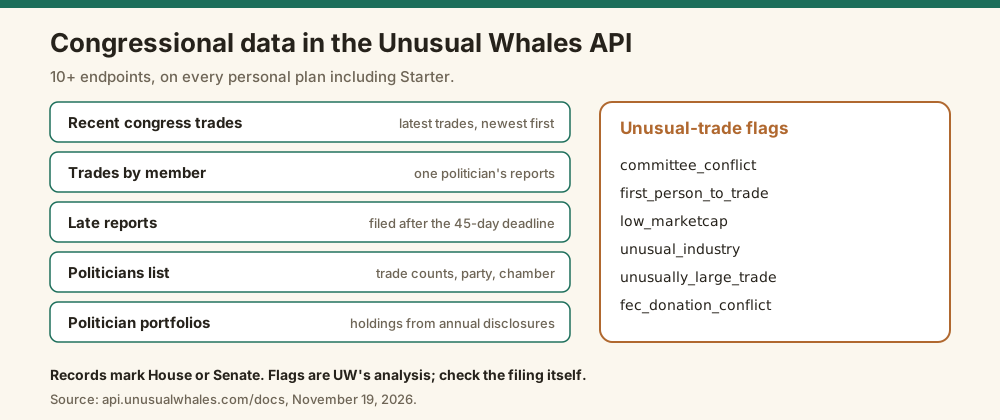
Unusual Whales has 10+ congressional endpoints: recent trades by members of Congress, trades by a named member, late reports, a list of politicians with trade data, and politician portfolios built from annual disclosures. It also flags unusual congressional trades with tags like committee_conflict, unusually_large_trade and fec_donation_conflict. Records carry a member_type field for House or Senate, per its API docs.
Congressional trades are on every personal plan, including the $99 Starter.
The late-reports endpoint is a nice touch. The STOCK Act gives members 45 days to report a trade, and that endpoint returns the reports that came in after the deadline.
The unusual-trade flags are its own analysis layered on public data. Useful as a lead, but check the underlying filing before you act on one.
Every trade starts as a public filing. House members file periodic transaction reports with the House Clerk, and senators file through the Senate's eFD system. My guide on how to track congressional stock trades walks through the raw sources.
curl -H "X-API-Key: edgr_your_key" "https://api.edgrapi.com/v1/fundamentals/AAPL?limit=20"How does the Unusual Whales MCP server work?
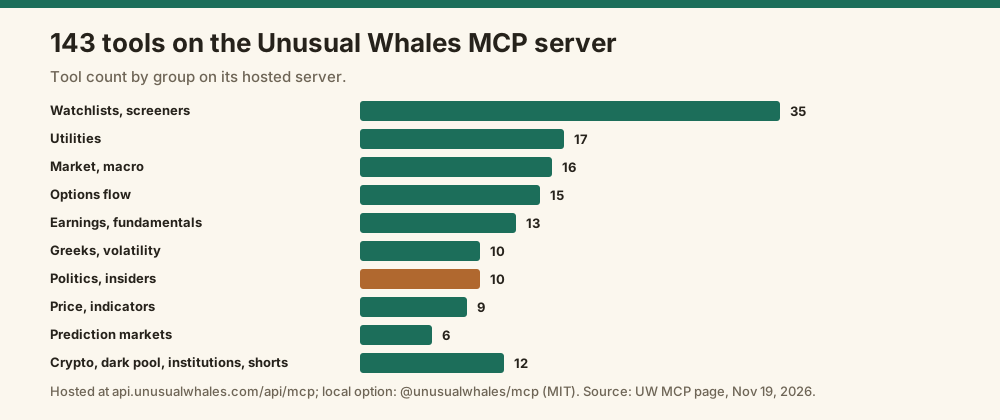
The Unusual Whales MCP server is hosted at api.unusualwhales.com/api/mcp. You connect Claude, ChatGPT, Cursor or another MCP client with your API key, and the assistant gets 143 tools, 8 prompts and 21 resources, per its MCP page on November 19, 2026. It's included on every personal API plan. There's also an open-source local version, the @unusualwhales/mcp npm package.
The hosted server is the one Unusual Whales recommends. Nothing to install, and its tools stay current.
The tools are grouped by job: 15 for options flow, 10 for Greeks and volatility, 10 for politics and insiders, 3 for dark pool, and 35 for watchlists and screeners.
One setup detail worth knowing. For Claude's custom connector, its instructions put your API key inside the connector URL as a token query parameter.
That works, but a key in a URL can end up in logs. If your client supports an Authorization header, which its own JSON config example uses, I'd pick that.
The @unusualwhales/mcp package is MIT-licensed. Its first release was March 3, 2026, and it was at version 1.2.0 when I checked.
My roundup of MCP servers for financial data compares it with the others.
Can you use the Unusual Whales API commercially?
Not on the self-serve personal plans. Unusual Whales' API page says the API "is strictly for personal use" and that redistribution isn't allowed. For a product, its docs offer a self-serve Startup tier at $750 a month with commercial use included, 160,000 requests a day and 5 concurrent requests. Redistribution licenses go through its enterprise team by email.
That terms line comes with a penalty. The same page says accounts caught redistributing are terminated with no reimbursement.
So the real decision is $150 versus $750. If anyone besides you sees the data, plan on the Startup tier from the start.
The annual Startup plan is $7,500 a year and lifts concurrency to 10 requests. With Kafka streaming added, the price is $3,000 a month or $30,000 a year.
How do you call the Unusual Whales API in Python?
Send your token in an Authorization header as Bearer YOUR_KEY to https://api.unusualwhales.com, then handle two kinds of 429. Back off and retry on concurrent_limit_exceeded, and stop on daily_request_limit_hit, because retrying won't help until your cap resets. A 401 means a missing or malformed token, and a 403 means your plan doesn't cover that endpoint.
Here's a small wrapper that does that:
import os, time, requests

API_KEY = os.environ.get("UW_API_KEY", "")   # from your Unusual Whales API dashboard

def uw(path, **params):
    for attempt in range(4):
        r = requests.get("https://api.unusualwhales.com" + path, params=params,
                         headers={"Authorization": "Bearer " + API_KEY}, timeout=30)
        if r.status_code == 429:
            code = r.json().get("code")
            if code == "concurrent_limit_exceeded":   # over 3 requests in flight
                time.sleep(1 + attempt)
                continue
            raise RuntimeError("Request cap used up: " + str(code))   # daily_request_limit_hit
        if r.status_code in (401, 403):
            raise RuntimeError("UW %d: %s" % (r.status_code, r.json().get("message")))
        r.raise_for_status()
        return r.json()
    raise RuntimeError("Still over the concurrency limit after 4 tries")

print(uw("/api/congress/recent-trades", limit=5))
I don't have an Unusual Whales subscription, so I ran this with no key. It printed UW 401: The API token provided is not in the expected format, which is the error you'd see if your environment variable didn't load. The 429 branches follow the conventions page, not my own runs.
Use exact paths from the docs. Unusual Whales warns that guessed route names return 404, and AI coding agents guess a lot.
When should you use an Unusual Whales alternative?
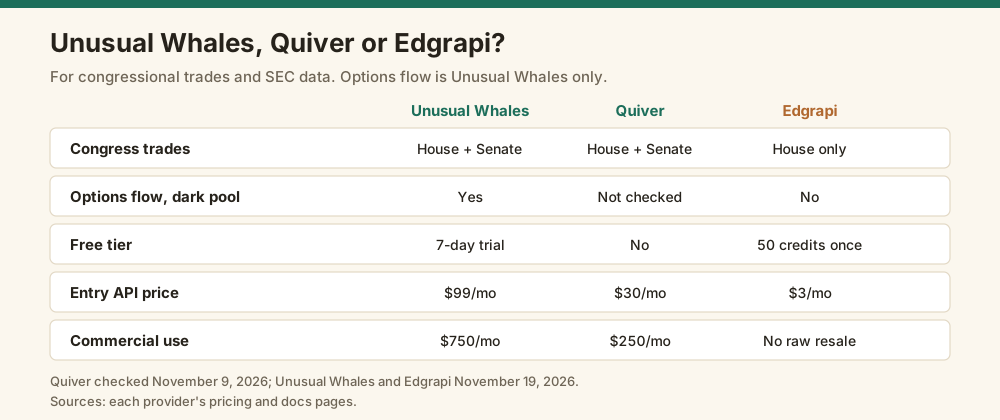
Use an Unusual Whales alternative when you only need congressional or SEC data and not options flow, when you need a commercial license under $750 a month, or when you want a free tier to start. Quiver Quantitative sells House and Senate trades from $30 a month. Edgrapi covers House trades, SEC filings and federal contracts from $3 a month, with no options data.
If options flow, GEX or dark pool is what you need, Unusual Whales is the specialist here. I don't sell any of that.
The alternatives make sense when congressional trades are the main job:
| Unusual Whales | Quiver Quantitative | Edgrapi | |
|---|---|---|---|
| Congressional trades | House and Senate | House and Senate | House only |
| SEC insider and 13F data | Yes | Trader plan, $75/mo | Yes, parsed from EDGAR |
| Free tier | No, 7-day trial | No | 50 credits, once |
| Entry API price | $99/mo | $30/mo | $3/mo |
| Commercial use | $750/mo Startup | $250/mo Startup | Raw resale barred |
The Quiver figures come from my check of its pricing pages on November 9, 2026.
I compared Quiver's plans in detail in my Quiver Quantitative API post.
For Edgrapi, the honest limits first. It covers House periodic transaction reports only, not the Senate. A congress call costs 2 credits, so the $10 plan's 10,000 credits cover 5,000 calls.
Where it fits is breadth on the government side: congress trades next to insider Form 4s, 13F holdings, lobbying records and SAM.gov contracts, on one key and 23 MCP tools. My congress trading API guide shows the calls.
Start with the trial, and test the endpoints you'll actually call
List the five Unusual Whales endpoints your project needs, start the 7-day trial on the cheapest plan that covers them, and call each one before the trial ends. Check the response fields and your request count. If anyone besides you will see the data, price the $750 Startup tier before you build, not after.
Frequently asked questions
Is the Unusual Whales API free?
No. Unusual Whales has no free API plan. Its paid API plans, from $99 a month, come with a 7-day free trial, and billing starts after the trial unless you cancel. The free Unusual Whales account covers the website only, with options flow delayed 2 trading days, news 15 minutes and alerts 30 minutes.
How much does the Unusual Whales API cost?
The Unusual Whales API costs $99 a month for Options Starter, $150 for Basic and $375 for Advanced, or $85, $125 and $315 a month billed annually. Commercial use starts with the Startup tier at $750 a month. Full-market historical option trades cost a separate $250 a month, per its docs in November 2026.
What are the Unusual Whales API limits?
There's no per-minute limit. API Basic and Advanced have no daily cap but allow 3 requests in flight at once, and going over returns HTTP 429 with the code concurrent_limit_exceeded. API Options Starter is capped at 25,000 requests per billing month, or 50,000 on annual billing. Only successful responses count toward the cap.
Does Unusual Whales have an MCP server?
Yes. Unusual Whales hosts an MCP server at api.unusualwhales.com/api/mcp with 143 tools, 8 prompts and 21 resources, covering options flow, dark pool, congressional trades, Greeks and prediction markets. It's included on every personal API plan. There's also an open-source local version, the MIT-licensed @unusualwhales/mcp npm package.
Does the Unusual Whales API include congressional trading?
Yes. Every personal plan, including the $99 Starter, includes congressional and insider trades. The API has 10+ congressional endpoints: recent trades, trades by member, late reports, politician portfolios and flagged unusual trades. Records mark whether the member is in the House or the Senate.
Can I use Unusual Whales data commercially?
Not on the personal API plans, which Unusual Whales says are strictly for personal use, with no redistribution. Commercial use starts with its self-serve Startup tier at $750 a month, which includes 160,000 requests a day. Redistribution licenses and custom deals go through its enterprise team by email.