How to Track a Competitor's Government Contract Awards (and Spot Recompetes)
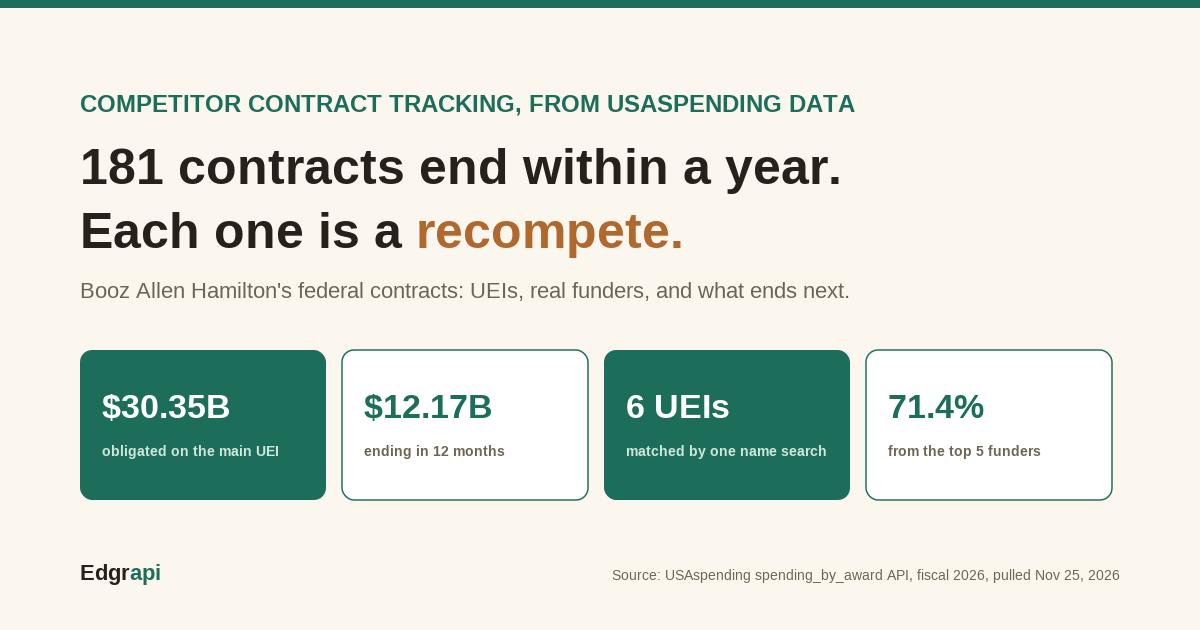
Booz Allen Hamilton has 181 federal contracts that end within the next year, worth $12.2 billion in obligations. Every one of them is a recompete some competitor is already planning for.
You can track a competitor's government contract awards for free on USAspending.gov, the federal spending database. Search the company's name, check which UEIs the results belong to, group the awards by funding agency, and sort by end date to find contracts that will be recompeted. The same search works through USAspending's free API, so you can run it every week in a short script.
How do you see a competitor's government contract awards?
Search the company's name on USAspending.gov, or call its free spending_by_award API with the name as recipient_search_text, award types A to D for contracts, and a date range. You get every contract with activity in that period, its value, the awarding and funding agencies, and its start and end dates. No account or API key is needed.
USAspending pulls contract data from FPDS, the system agencies report contract actions into, and publishes it as award summaries.
The website is fine for a quick look. The API is better for anything you'll repeat, because you can save the results and compare them week to week.
I ran this for Booz Allen Hamilton, a large consulting and technology contractor, over fiscal 2026 (October 1, 2025 to September 30, 2026). The 500 largest contracts with activity in that year came back in five API calls, because each call returns at most 100 records. Sorting by award amount first means the pages you do fetch hold the contracts that matter most.
If you need contract-level history instead of award summaries, SAM.gov has it, but its API needs a key. I covered the trade-offs in SAM.gov vs USAspending.
Why does one company show up under several UEIs?
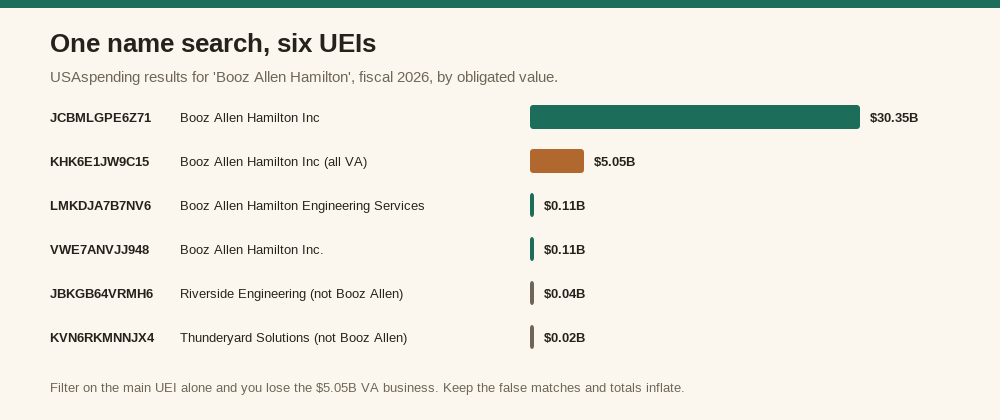
Because large contractors register separate entities in SAM.gov, each with its own Unique Entity ID. A name search also catches unrelated companies whose names or parent records match. In my Booz Allen search, six UEIs came back. Four belonged to Booz Allen entities and two belonged to other companies, so you have to review the UEIs before trusting any totals.
Here's what the name search returned:
| UEI | Recipient name | Contracts | Obligated value |
|---|---|---|---|
| JCBMLGPE6Z71 | Booz Allen Hamilton Inc | 480 | $30.35B |
| KHK6E1JW9C15 | Booz Allen Hamilton Inc | 10 | $5.05B |
| LMKDJA7B7NV6 | Booz Allen Hamilton Engineering Services, LLC | 5 | $0.11B |
| VWE7ANVJJ948 | Booz Allen Hamilton Inc. | 2 | $0.11B |
| JBKGB64VRMH6 | Riverside Engineering LLC | 2 | $0.04B |
| KVN6RKMNNJX4 | Thunderyard Solutions LLC | 1 | $0.02B |
The second UEI is the trap. All 10 of its contracts are with Veterans Affairs, worth $5.05 billion.
If you'd filtered on the main UEI alone, you'd have missed Booz Allen's whole VA business.
The last two rows go the other way. They aren't Booz Allen at all, so leaving them in would inflate the totals.
My UEI lookup guide shows how to check who a UEI belongs to.
Who is actually paying for a competitor's contracts?
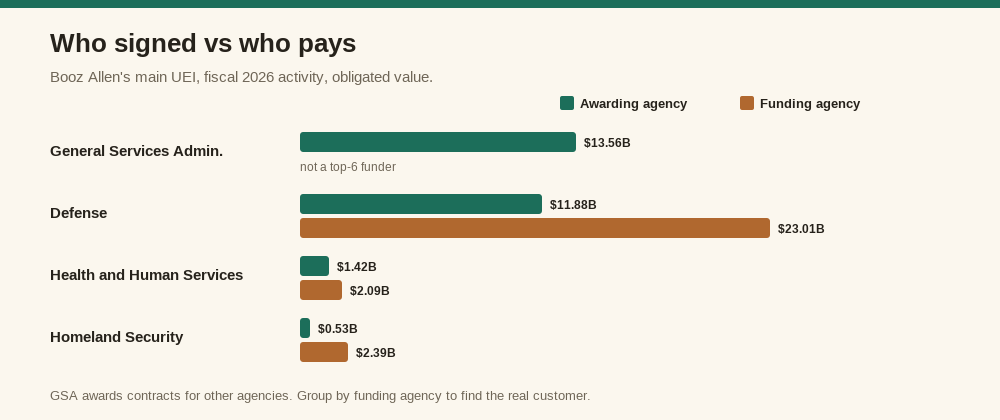
The funding agency, which is often not the agency that signed the contract. GSA's Federal Acquisition Service awards many contracts on behalf of other agencies. On Booz Allen's main UEI, GSA awarded $13.56 billion and Defense $11.88 billion, but Defense funded $23.01 billion. Group by funding agency to see who the real customer is.
Here's the same set of contracts, counted two ways:
| Agency | As awarding agency | As funding agency |
|---|---|---|
| General Services Administration | $13.56B | Not in the top 6 |
| Department of Defense | $11.88B | $23.01B |
| Department of Homeland Security | $0.53B | $2.39B |
| Department of Health and Human Services | $1.42B | $2.09B |
Booz Allen's largest contract ending soon shows why. Task order 47QFCA22F0047 was awarded by GSA's Federal Acquisition Service for $1.3 billion, but the Air Force funds it.
That matters for business development. You'd chase the next round with the Air Force program office, not with GSA.
USAspending returns both fields on every award: Awarding Agency and Funding Agency, with sub-agencies for each. You can see both on the award page for 47QFCA22F0047.
Which customers does a competitor depend on most?
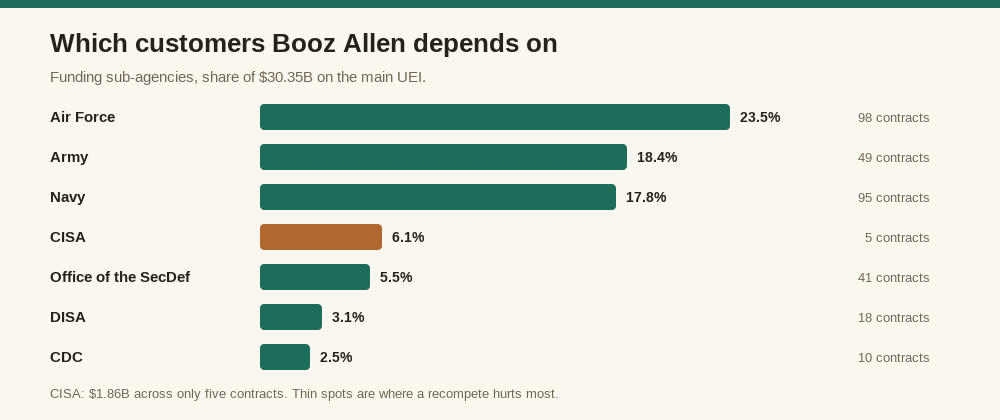
Group the competitor's contracts by funding sub-agency and rank them by value. On Booz Allen's main UEI, the Air Force funds $7.14 billion, or 23.5% of the $30.35 billion total, the Army 18.4% and the Navy 17.8%. The top five funders cover 71.4%. That concentration tells you which program offices matter most to the competitor.
Here's the top of that list:
| Funding sub-agency | Contracts | Obligated value | Share |
|---|---|---|---|
| Department of the Air Force | 98 | $7.14B | 23.5% |
| Department of the Army | 49 | $5.59B | 18.4% |
| Department of the Navy | 95 | $5.41B | 17.8% |
| Cybersecurity and Infrastructure Security Agency | 5 | $1.86B | 6.1% |
| Immediate Office of the Secretary of Defense | 41 | $1.67B | 5.5% |
Two readings come out of a table like this. The first is where the competitor is strong. Three military departments fund almost 60% of this business, so that's where they have relationships and past performance.
The second is where they're thin. CISA funds $1.86 billion through only five contracts, so each of those is a big bet, and losing one at recompete would hurt.
If you're a smaller firm, the thin spots are usually the better place to compete than the strongholds.
What is a recompete?
A recompete is when an agency competes a contract again because the current one is ending. The incumbent, the company holding the contract now, has to win it back against competitors. For anyone tracking a rival, a recompete is the opening: a known amount of work, with a known end date, that a new company could win.
Recompetes are predictable because the end date is public. USAspending lists each contract's current end date, so you can see the pipeline months ahead.
Agencies usually signal a recompete on SAM.gov before the contract ends, with sources-sought notices, draft requests for proposal, or presolicitations.
Booz Allen's list has a clear example: a CDM Defend bridge task order funded by CISA, worth $713 million and ending April 30, 2027. A bridge exists because a follow-on competition is coming.
Not every ending contract gets recompeted. Some are extended, folded into a bigger vehicle, or ended for good. Treat the end date as the start of your research, not a guarantee.
curl -H "X-API-Key: edgr_your_key" "https://api.edgrapi.com/v1/awards?recipient=lockheed"How do you find a competitor's contracts that are ending soon?
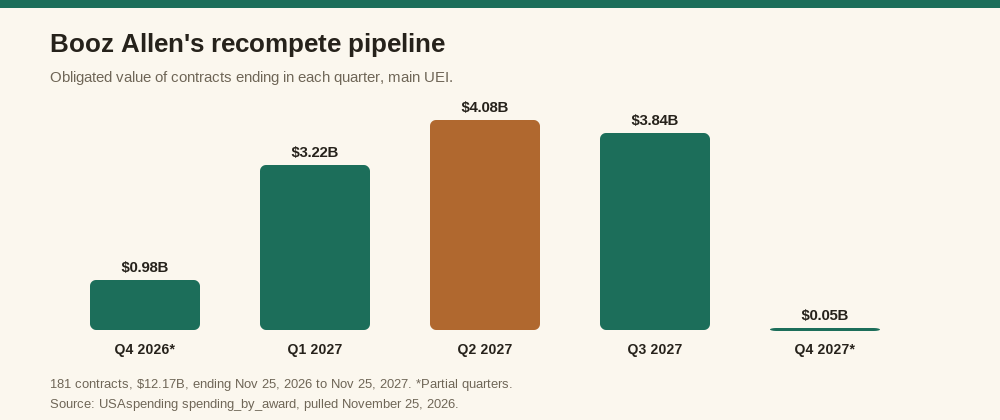
Take the competitor's contracts and keep those whose end date falls in the next 12 months. On Booz Allen's main UEI, 181 contracts worth $12.17 billion in obligations end between November 2026 and November 2027. Then group them by quarter and by funding agency to see when, and where, the recompete work will come up.
Here's when Booz Allen's ending contracts land, by obligated value:
| Quarter | Ending value |
|---|---|
| Q4 2026 (from November 25) | $0.98B |
| Q1 2027 | $3.22B |
| Q2 2027 | $4.08B |
| Q3 2027 | $3.84B |
| Q4 2027 (to November 25) | $0.05B |
The biggest five, all awarded through GSA:
- 47QFCA22F0047: $1.30B, funded by the Air Force, ends September 5, 2027
- 47QFCA24F0037: $898M, funded by the Army, ends September 9, 2027
- 47QFRA24F0006: $713M, funded by CISA, ends April 30, 2027
- 47QFCA23F0058: $561M, funded by the CDC, ends April 22, 2027
- 47QFCA23F0014: $560M, funded by the Army, ends February 23, 2027
The third one is a "bridge" task order, per its description. Bridges extend work while an agency prepares a new competition, which makes them strong recompete signals.
How do you track a competitor's contracts in Python?
Call USAspending's spending_by_award endpoint with the competitor's name, contract award types A to D and your date range, then page through the results. Print the UEIs so you can drop false matches, total the funding agencies, and filter end dates to the next 12 months. It runs in seconds and needs no key.
The endpoint and its filters are in the USAspending API docs. Here's the script I used:
import datetime, collections, requests

URL = "https://api.usaspending.gov/api/v2/search/spending_by_award/"

def competitor_contracts(name, fy_start="2025-10-01", fy_end="2026-09-30", pages=5):
    body = {"filters": {"recipient_search_text": [name], "award_type_codes": ["A", "B", "C", "D"],
                        "time_period": [{"start_date": fy_start, "end_date": fy_end}]},
            "fields": ["Award ID", "Recipient Name", "Recipient UEI", "Award Amount",
                       "Awarding Agency", "Funding Agency", "End Date", "Description"],
            "sort": "Award Amount", "order": "desc", "limit": 100}
    rows = []
    for page in range(1, pages + 1):
        body["page"] = page
        data = requests.post(URL, json=body, timeout=60).json()
        rows += data["results"]
        if not data["page_metadata"]["hasNext"]:
            break
    return rows

rows = competitor_contracts("Booz Allen Hamilton")

# 1) Check which companies the name search actually matched, by UEI
for (uei, who), n in collections.Counter((r["Recipient UEI"], r["Recipient Name"]) for r in rows).most_common():
    print(uei, who, n)

# 2) Who pays for the work (the funding agency), beside who signed it
funders = collections.Counter()
for r in rows:
    funders[r["Funding Agency"]] += r["Award Amount"] or 0
print(funders.most_common(3))

# 3) The recompete pipeline: contracts ending in the next 12 months
today = datetime.date.today()
soon = [r for r in rows if r["End Date"] and
        today <= datetime.date.fromisoformat(r["End Date"]) <= today + datetime.timedelta(days=365)]
print(len(soon), "contracts end within a year")
When I ran it on November 25, 2026, it printed the six UEIs above, then Defense, Veterans Affairs and Homeland Security as the top funders, and 187 contracts ending within a year.
That 187 includes the false matches and the other Booz Allen UEIs. In a real report, keep only the UEIs you've confirmed, which gave the 181 above for the main one.
The script pulls the 500 largest contracts. Raise pages for a full list, and mind USAspending's 10,000-record limit on deep paging, which I covered in the USAspending pagination guide.
What can't USAspending tell you about a competitor?
USAspending shows prime contracts as award summaries, about two days behind FPDS. It holds back recent Defense awards for 90 days, it doesn't show subcontracts in the same search, and its obligated value isn't the contract ceiling. A contract with activity in your date range can also be an old award with a small recent adjustment, so always filter on end date.
That last point caught me. Sorting the year's results by end date put contracts that ended in 2007 first, because they had small paperwork adjustments within the year.
The Defense delay matters most for defense competitors. A big Army award signed last month won't show up yet. I explained the 90-day rule in my FPDS replacement guide.
Obligated value is what's been committed so far. A five-year contract can have a much larger ceiling that only gets obligated year by year.
And subcontracts are reported separately as subawards. A competitor working as a sub on someone else's prime won't show in this search at all.
How do you turn this into a weekly competitor report?
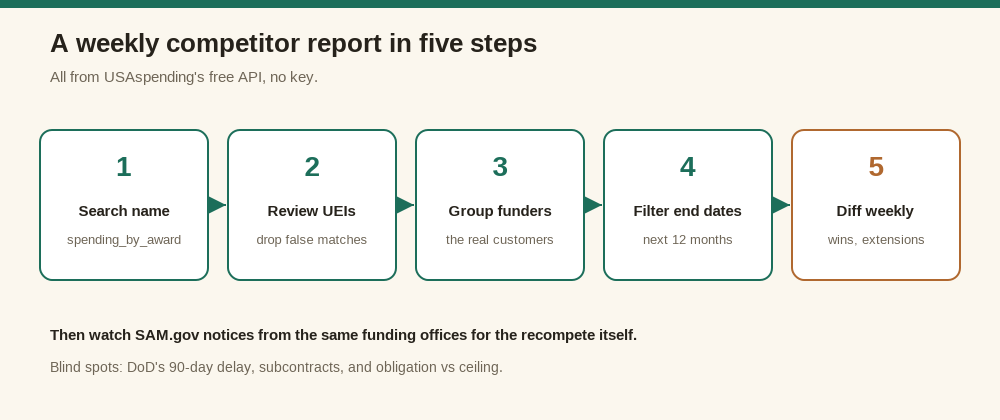
Run the script on a schedule, save each week's results, and compare them to the last run. New award IDs are wins, changed end dates are extensions, and contracts that move inside 12 months join the recompete list. Pair that with SAM.gov opportunity searches for the same funding offices and NAICS codes, so you see the recompete solicitation when it posts.
The comparison is the useful part. A list of 480 contracts is a spreadsheet, but "three new Army task orders this week" is a briefing.
On SAM.gov, sources-sought and presolicitation notices are the early signals. My guide to monitoring SAM.gov contract opportunities shows how to watch for them.
If you'd rather get flat JSON, Edgrapi's /v1/awards wraps the same USAspending data in a simple GET with a recipient filter, and /v1/opportunities serves SAM.gov notices. That's what I build, so weigh that, but both also work as MCP tools for an AI agent.
Start with one competitor and one year
Pick your closest competitor, pull one fiscal year of their contracts, and review the UEIs before you total anything. Then group by funding agency and list what ends in the next 12 months. That one report tells you who their real customers are and where the next openings will be, and it costs nothing to run again next week.
Frequently asked questions
How can I see what government contracts a company has?
Search the company's name on USAspending.gov or call its free spending_by_award API with the name as recipient_search_text and contract award types A to D. You'll get each contract's value, agencies and dates. Review the UEIs in the results, because large companies have several and name searches also catch unrelated firms.
What is a recompete in government contracting?
A recompete is when an agency competes a contract again because the current one is ending. The incumbent has to win it back against other bidders. Because USAspending publishes each contract's end date, you can see recompetes coming months ahead, though some contracts are extended or ended instead of competed.
How do I find government contracts that are expiring?
Pull a company's or agency's contracts from USAspending and keep those whose end date falls in your window, such as the next 12 months. Filter on the end date directly, because a date-range search also returns old contracts with small recent adjustments. Booz Allen's main UEI had 181 contracts ending within a year in November 2026.
Is USAspending contract data free?
Yes. USAspending.gov and its API are free and need no account or key. The data comes from FPDS and is published about two days after it's finalized. Recent Department of Defense awards are held back for 90 days, so the newest defense contracts appear late.
What's the difference between the awarding agency and the funding agency?
The awarding agency signs the contract, and the funding agency pays for the work. They often differ because GSA awards many contracts for other agencies. On Booz Allen's main UEI, GSA awarded $13.56 billion of contracts, while Defense funded $23.01 billion, so Defense is the real customer.
Can I track a competitor's subcontracts too?
Not in the same search. USAspending reports subcontracts separately as subawards, so a competitor working as a subcontractor on another company's prime contract won't appear in a prime contract search. Subaward reporting also depends on the prime contractor filing it, so coverage is less complete than for prime contracts.
Related guides: Government contracts, grants and lobbying
- Lobbying Disclosure Database: How to Search Federal Lobbying Records (2026)
- Largest Government Contractors in 2026: Who Depends Most on Federal Money
- UEI Number Lookup: Find Any Company's Unique Entity ID
- Lockheed Martin Government Contracts: Look Up Any Company
- How to Search SAM.gov Contract Opportunities in 2026